

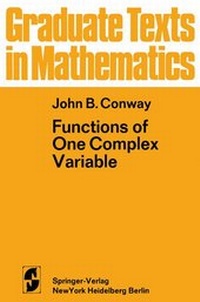
Functions of One Complex Variable
Published on 16. October 1973
Book
Paperback/Softback
XIII, 313 pages
978-0-387-90062-9 (ISBN)
Description
This book is intended as a textbook for a first course in the theory of functions of one complex variable for students who are mathematically mature enough to understand and execute E - I) arguments. The actual pre requisites for reading this book are quite minimal; not much more than a stiff course in basic calculus and a few facts about partial derivatives. The topics from advanced calculus that are used (e.g., Leibniz's rule for differ entiating under the integral sign) are proved in detail. Complex Variables is a subject which has something for all mathematicians. In addition to having applications to other parts of analysis, it can rightly claim to be an ancestor of many areas of mathematics (e.g., homotopy theory, manifolds). This view of Complex Analysis as "An Introduction to Mathe matics" has influenced the writing and selection of subject matter for this book. The other guiding principle followed is that all definitions, theorems, etc.
More details
Series
Edition
Softcover reprint of the original 1st ed. 1973
Language
English
Place of publication
NY
United States
Target group
Professional and scholarly
Research
Illustrations
biography
Dimensions
Height: 22.9 cm
Width: 15.2 cm
Weight
470 gr
ISBN-13
978-0-387-90062-9 (9780387900629)
DOI
10.1007/978-1-4615-9972-2
Schweitzer Classification
Other editions
New editions
John B. Conway
Functions of One Complex Variable I
Book
01/1994
2nd Edition
Springer
€53.45
Shipment within 5-7 days
Person
Content
I. The Complex Number System.- §1. The real numbers.- §2. The field of complex numbers.- §3. The complex plane.- §4. Polar representation and roots of complex numbers.- §5. Lines and half planes in the complex plane.- §6. The extended plane and its spherical representation.- II. Metric Spaces and the Topology of C.- §1. Definition and examples of metric spaces.- §2. Connectedness.- §3. Sequences and completeness.- §4. Compactness.- §5. Continuity.- §6. Uniform convergence.- III. Elementary Properties and Examples of Analytic Functions.- §1. Power series.- §2. Analytic functions.- §3. Analytic functions as mappings, Möbius transformations.- IV. Complex Integration.- §1. Riemann-Stieltjes integrals.- §2. Power series representation of analytic functions.- §3. Zeros of an analytic function.- §4. Cauchy's Theorem.- §5. The index of a closed curve.- §6. Cauchy's Integral Formula.- §7. Counting zeros; the Open Mapping Theorem.- §8. Goursat's Theorem.- V. Singularities.- §1. Classification of singularities.- §2. Residues.- §3. The Argument Principle.- VI. The Maximum Modules Theorem.- §1. The Maximum Principle.- §2. Schwarz's Lemma.- §3. Convex functions and Hadamard's Three Circles Theorem.- §4. Phragmen-Lindelöf Theorem.- VII. Compactness and Convergence in the Space of Analytic Functions.- §1. The space of continuous functions C(G,?).- §2. Spaces of analytic functions.- §3. Spaces of meromorphic functions.- §4. The Riemann Mapping Theorem.- §5. Weierstrass Factorization Theorem.- §6. Factorization of the sine function.- §7. The gamma function.- §8. The Riemann zeta function.- VIII. Runge's Theorem.- §1. Runge's Theorem.- §2. Another version of Cauchy's Theorem.- §3. Simple connectedness.- §4. Mittag-Leffler's Theorem.- IX. Analytic Continuation and Riemann Surfaces.- §1. Schwarz Reflection Principle.- §2. Analytic Continuation Along A Path.- §3. Mondromy Theorem.- §4. Topological Spaces and Neighborhood Systems.- §5. The Sheaf of Germs of Analytic Functions on an Open Set.- §6. Analytic Manifolds.- §7. Covering spaces.- X. Harmonic Functions.- §1. Basic Properties of harmonic functions.- §2. Harmonic functions on a disk.- §3. Subharmonic and superharmonic functions.- §4. The Dirichlet Problem.- §5. Green's Functions.- XI. Entire Functions.- §1. Jensen's Formula.- §2. The genus and order of an entire function.- §3. Hadamard Factorization Theorem.- XII. The Range of an Analytic Function.- §1. Bloch's Theorem.- §2. The Little Picard Theorem.- §3. Schottky's Theorem.- §4. The Great Picard Theorem.- Appendix: Calculus for Complex Valued Functions on an Interval.- List of Symbols.