

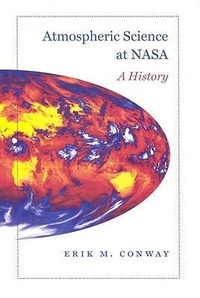
Atmospheric Science at NASA
A History
Published on 2. February 2009
Book
Hardback
416 pages
978-0-8018-8984-4 (ISBN)
Description
This book offers an informed and revealing account of NASA's involvement in the scientific understanding of the Earth's atmosphere. Since the nineteenth century, scientists have attempted to understand the complex processes of the Earth's atmosphere and the weather created within it. This effort has evolved with the development of new technologies-from the first instrument-equipped weather balloons to multibillion-dollar meteorological satellite and planetary science programs. Erik M. Conway chronicles the history of atmospheric science at NASA, tracing the story from its beginnings in 1958, the International Geophysical Year, through to the present, focusing on NASA's programs and research in meteorology, stratospheric ozone depletion, and planetary climates and global warming. But the story is not only a scientific one. NASA's researchers operated within an often politically contentious environment. Although environmental issues garnered strong public and political support in the 1970s, the following decades saw increased opposition to environmentalism as a threat to free market capitalism.
Atmospheric Science at NASA critically examines this politically controversial science, dissecting the often convoluted roles, motives, and relationships of the various institutional actors involved-among them NASA, congressional appropriation committees, government weather and climate bureaus, and the military.
Atmospheric Science at NASA critically examines this politically controversial science, dissecting the often convoluted roles, motives, and relationships of the various institutional actors involved-among them NASA, congressional appropriation committees, government weather and climate bureaus, and the military.
Reviews / Votes
Comprehensive history... recommended. Choice As one of the latest books in the New Series in NASA History, Conway's project introduces a new aspect of space science that will be of interest to scholars of this field. -- Kristine C. Harper American Historical Review Excellent. -- Roger D. Launius QuestMore details
Series
Language
English
Place of publication
Baltimore, MD
United States
Target group
Professional and scholarly
Product notice
sewn/stitched
Cloth over boards
With dust jacket
Illustrations
19 s/w Abbildungen, 3 s/w Zeichnungen, 8 farbige Abbildungen
8 Illustrations, color; 3 Line drawings, black and white; 19 Illustrations, black and white
Dimensions
Height: 236 mm
Width: 159 mm
Thickness: 35 mm
Weight
708 gr
ISBN-13
978-0-8018-8984-4 (9780801889844)
DOI
10.1353/book.3472
Copyright in bibliographic data and cover images is held by Nielsen Book Services Limited or by the publishers or by their respective licensors: all rights reserved.
Schweitzer Classification
Other editions
Additional editions
E-Book
02/2009
Johns Hopkins University Press
€45.49
Available for download
Person
Erik M. Conway is a historian at the Jet Propulsion Laboratory, California Institute of Technology in Pasadena, California, and author of High-Speed Dreams: NASA and the Technopolitics of Supersonic Transportation, 1945-1999 and Blind Landings: Low-Visibility Operations in American Aviation, 1918-1958, also published by Johns Hopkins.
Content
Acknowledgments
List of Abbreviations
Introduction
1. Establishing the Meteorology Program
2. Developing Satellite Meteorology
3. Constructing a Global Meteorology
4. Planetary Atmospheres
5. NASA Atmospheric Research in Transition
6. Atmospheric Chemistry
7. The Quest for a Climate Observing System
8. Missions to Planet Earth: Architectural Warfare
9. Atmospheric Science in the Mission to Planet Earth
Conclusion
Epilogue
Notes
Index
List of Abbreviations
Introduction
1. Establishing the Meteorology Program
2. Developing Satellite Meteorology
3. Constructing a Global Meteorology
4. Planetary Atmospheres
5. NASA Atmospheric Research in Transition
6. Atmospheric Chemistry
7. The Quest for a Climate Observing System
8. Missions to Planet Earth: Architectural Warfare
9. Atmospheric Science in the Mission to Planet Earth
Conclusion
Epilogue
Notes
Index