

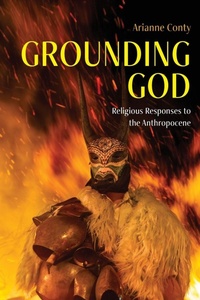
Grounding God
Religious Responses to the Anthropocene
Published on 2. June 2024
Book
Paperback/Softback
230 pages
978-1-4384-9574-3 (ISBN)
Description
Looks at how different religious traditions (Christian, Buddhist, neopagan, and animist) have attempted to resacralize the earth and provide new values that include the more-than-human world.
Now that we have entered the Anthropocene, the geological age in which humans have altered the natural world to such an extent that nature and culture can no longer be separated, the modern dichotomies of mind versus body and culture versus nature have become implausible and need to be replaced. In Grounding God, Arianne Conty argues that it is in the field of religion where we can find a new ontology better suited for the Anthropocene. Conty calls this new religious ontology the grounding of the sacred, in that it seeks to deconstruct the binaries of modernity and provide in their place a revalorization of the immanent earth and the more-than-human beings that inhabit it. Such a grounding of the sacred is a potent means to overcome the exploitation and desecration of the earth and its nonhuman beings and, to provide in its stead, an inclusive cosmopolitics that extends mind into matter and culture into nature. Tracing such a grounding in the Christian, Buddhist, neopagan, and animist traditions, Conty seeks to elaborate an interdisciplinary ecosophy, one that uses philosophy, anthropology, and religious studies to provide new values for the present age.
This book is freely available in an open access edition thanks to Knowledge Unlatched-an initiative that provides libraries and institutions with a centralized platform to support OA collections and from leading publishing houses and OA initiatives. Learn more at the Knowledge Unlatched website at https://www.knowledgeunlatched.org.
Now that we have entered the Anthropocene, the geological age in which humans have altered the natural world to such an extent that nature and culture can no longer be separated, the modern dichotomies of mind versus body and culture versus nature have become implausible and need to be replaced. In Grounding God, Arianne Conty argues that it is in the field of religion where we can find a new ontology better suited for the Anthropocene. Conty calls this new religious ontology the grounding of the sacred, in that it seeks to deconstruct the binaries of modernity and provide in their place a revalorization of the immanent earth and the more-than-human beings that inhabit it. Such a grounding of the sacred is a potent means to overcome the exploitation and desecration of the earth and its nonhuman beings and, to provide in its stead, an inclusive cosmopolitics that extends mind into matter and culture into nature. Tracing such a grounding in the Christian, Buddhist, neopagan, and animist traditions, Conty seeks to elaborate an interdisciplinary ecosophy, one that uses philosophy, anthropology, and religious studies to provide new values for the present age.
This book is freely available in an open access edition thanks to Knowledge Unlatched-an initiative that provides libraries and institutions with a centralized platform to support OA collections and from leading publishing houses and OA initiatives. Learn more at the Knowledge Unlatched website at https://www.knowledgeunlatched.org.
Reviews / Votes
"Arianne Conty's Grounding God is an ambitious work of comparative philosophy. It offers a striking synthesis of scholarship by placing several renowned anthropologists and philosophers in conversation, including Philippe Descola, Felix Guattari, Donna Haraway, Eduardo Kohn, Bruno Latour, and Eduardo Viveiros de Castro alongside many others in the broad fields of new materialism and political ecology." - H-Net Reviews (H-Environment)"This is an important and prodigiously informed contribution to our understanding of the intersections between religion and the Anthropocene (or Anthropocenes). Furthermore, it focuses on the ways in which religion both presupposes and potentiates certain kinds of ontologies that either protect nature or turn it into a cheap externality. In this sense, it is a contribution to what is called 'philosophical theology' or the 'philosophy of religion.' It has the additional virtue of being a comparative religious and philosophical text. The discussions of Fudo, neopaganism, and animism (or shamanism) are fascinating, very well informed, and most appropriate given the main thrust of the book, namely, to develop an ecosophia for the Anthropocene." - Eduardo Mendieta, Pennsylvania State University
More details
Series
Language
English
Place of publication
Albany, NY
United States
Target group
Professional and scholarly
US School Grade: College Graduate Student and over
Product notice
Paperback (trade)
Dimensions
Height: 229 mm
Width: 152 mm
Thickness: 14 mm
Weight
380 gr
ISBN-13
978-1-4384-9574-3 (9781438495743)
DOI
10.1353/book.119180
Copyright in bibliographic data and cover images is held by Nielsen Book Services Limited or by the publishers or by their respective licensors: all rights reserved.
Schweitzer Classification
Other editions
Additional editions
E-Book
12/2023
1st Edition
SUNY Press
€33.99
Available for download
Person
Arianne Conty is a philosopher living in Palermo. She works in the fields of philosophy of nature and philosophy of religion.
Content
Acknowledgments
Introduction: One Earth, Many Worlds
1. The Ends of the Anthropocene: Eschatology in Uncertain Times
Part I. Religious Responses to the Anthropocene
2. Christian Responses to the Anthropocene
3. A Buddhist Response to the Anthropocene: Fudo
4. Neopaganism and the Grounding of the Sacred
5. Animism in the Anthropocene
Part II. Philosophical Responses to the Anthropocene
6. Panpsychism: A Metaphysics for the Anthropocene Age
7. Ecosophy: New Values for the Anthropocene Age
Notes
Bibliography
Index
Introduction: One Earth, Many Worlds
1. The Ends of the Anthropocene: Eschatology in Uncertain Times
Part I. Religious Responses to the Anthropocene
2. Christian Responses to the Anthropocene
3. A Buddhist Response to the Anthropocene: Fudo
4. Neopaganism and the Grounding of the Sacred
5. Animism in the Anthropocene
Part II. Philosophical Responses to the Anthropocene
6. Panpsychism: A Metaphysics for the Anthropocene Age
7. Ecosophy: New Values for the Anthropocene Age
Notes
Bibliography
Index