

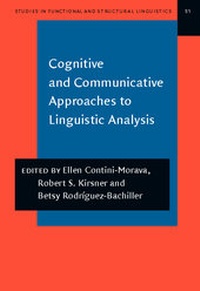
Cognitive and Communicative Approaches to Linguistic Analysis
Published on 23. December 2004
Book
Hardback
389 pages
978-90-272-1560-4 (ISBN)
Description
This volume is the product of a Columbia School Linguistics Conference held at Rutgers University in October 1999, where the plenary speaker was Ronald W. Langacker, a founder of Cognitive Linguistics. The goal of the book is to promote two kinds of dialogue. First, dialogue between Cognitive Grammar and the particular sign-based approach to language known as the Columbia School. While they share certain basic assumptions, the "maximalist" CG and the "minimalist" CS differ both theoretically and methodologically. Given that philosophers from Mill to Kuhn to Feyerabend have stressed the importance to any discipline of dialogue between opposing views, the dialogue begun here cannot fail to bear fruit. The second kind of dialogue is that among several sign-based approaches themselves and also between them and two competitors: grammaticalization theory and generic functionalism. Topics range from phonology to discourse. Analytical problems are taken from a wide range of languages including English, German, Guarani, Hebrew, Hualapai, Japanese, Korean, Macedonian, Mandarin, Polish, Russian, Serbian, Spanish, Urdu, and Yaqui.
More details
Series
Language
English
Place of publication
Amsterdam
Netherlands
Target group
Professional and scholarly
Dimensions
Height: 225 mm
Width: 154 mm
Weight
660 gr
ISBN-13
978-90-272-1560-4 (9789027215604)
Copyright in bibliographic data and cover images is held by Nielsen Book Services Limited or by the publishers or by their respective licensors: all rights reserved.
Schweitzer Classification
Other editions
Additional editions
Ellen Contini-Morava | Robert S. Kirsner | Betsy Rodríguez-Bachiller
Cognitive and Communicative Approaches to Linguistic Analysis
E-Book
12/2004
1st Edition
John Benjamins Publishing Company
€155.99
Available for download
Persons
Content
1. Introduction (by Kirsner, Robert S.); 2. I. Cognitive Grammar; 3. Form, meaning, and behavior: The Cognitive Grammar analysis of double subject constructions (by Langacker, Ronald W.); 4. Cataphoric pronouns as mental space designators: Their conceptual import and discourse function (by Smith, Michael B.); 5. II. Theoretical issues in classical sign-based linguistics; 6. Monosemy, homonymy and polysemy (by Reid, Wallis); 7. On the relationship between form and grammatical meaning in the linguistic sign (by Elson, Mark J.); 8. Revisiting the gap between meaning and message (by Davis, Joseph); 9. III. Analyses on the level of the classic linguistic sign; 10. The givenness of background: A semantic-pragmatic study of two modern German subordinating conjunctions (by Jing-Schmidt, Zhuo); 11. The relevance of relevance in linguistic analysis: Spanish subjunctive mood (by Jonge, Bob de); 12. A sign-based analysis of English pronouns in conjoined expressions (by Stern, Nancy); 13. Semantic oppositions in the Hebrew verb system (by Oron, Noah); 14. Grammaticization of 'to' and 'away': A unified account of -k and -m in Hualapai (by Ichihashi-Nakayama, Kumiko); 15. IV. Below and above the level of the sign; 16. Interaction of physiology and communication in the make-up and distribution of stops in Lucknow Urdu (by Hameed, Shabana); 17. Between phonology and lexicon: The Hebrew triconsonantal (CCC) root system revolving around /r/ (C-r-C) (by Tobin, Yishai); 18. Length of the extra-information phrase as a predictor of word order: A cross-language comparison (by Otheguy, Ricardo); 19. Word-order variation in spoken Spanish in constructions with a verb, a direct object, and an adverb: The interaction of syntactic, cognitive, pragmatic, and prosodic features (by Ocampo, Francisco); 20. Estrategias discursivas como parametros para el analisis linguistico (by Martinez, Angelita); 21. Index of Names; 22. Index of Subjects