

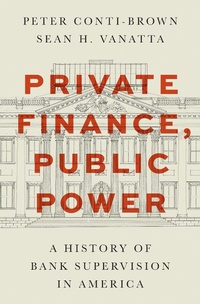
Private Finance, Public Power
A History of Bank Supervision in America
Published on 24. June 2025
Book
Hardback
424 pages
978-0-691-23282-9 (ISBN)
Description
The strange and contested evolution of the management of banking risk
Banks in America are private institutions with private shareholders, boards of directors, profit motives, customers, and competitors. And yet the public plays a key role in deciding what risks are taken as well as how, when, and to what end. Public-private negotiations over financial governance has evolved into an essential ecosystem of banking risk management. In Private Finance, Public Power, Peter Conti-Brown and Sean Vanatta offer a new history of finance and public policy in the United States by examining the idiosyncratic way the nation manages financial risk across the public-private divide. Covering two centuries, from the founding of the Republic to the early 1980s, Conti-Brown and Vanatta describe the often-contested, sometimes chaotic, engagement of bankers, politicians, bureaucrats, and others in the overlapping spaces of the public-private system of bank supervision.
Conti-Brown and Vanatta trace the different supervisory frameworks that evolved over time, from the imposition of private liability on bank shareholders to the development of the central bank to the creation of federal deposit insurance. Negotiations took place at federal and state levels, but, over time, the federal government assumed most of the responsibility for managing financial risk. Moreover, federal supervisory officials began to undertake more varied tasks, including monitoring racial discrimination and managing financial concentration. Conti-Brown and Vanatta introduce a diverse cast of characters-bankers, politicians, bureaucrats, and others-and show how they navigated two hundred years of financial panics, scandals, and crises to build the system that structures modern America's banking system.
Banks in America are private institutions with private shareholders, boards of directors, profit motives, customers, and competitors. And yet the public plays a key role in deciding what risks are taken as well as how, when, and to what end. Public-private negotiations over financial governance has evolved into an essential ecosystem of banking risk management. In Private Finance, Public Power, Peter Conti-Brown and Sean Vanatta offer a new history of finance and public policy in the United States by examining the idiosyncratic way the nation manages financial risk across the public-private divide. Covering two centuries, from the founding of the Republic to the early 1980s, Conti-Brown and Vanatta describe the often-contested, sometimes chaotic, engagement of bankers, politicians, bureaucrats, and others in the overlapping spaces of the public-private system of bank supervision.
Conti-Brown and Vanatta trace the different supervisory frameworks that evolved over time, from the imposition of private liability on bank shareholders to the development of the central bank to the creation of federal deposit insurance. Negotiations took place at federal and state levels, but, over time, the federal government assumed most of the responsibility for managing financial risk. Moreover, federal supervisory officials began to undertake more varied tasks, including monitoring racial discrimination and managing financial concentration. Conti-Brown and Vanatta introduce a diverse cast of characters-bankers, politicians, bureaucrats, and others-and show how they navigated two hundred years of financial panics, scandals, and crises to build the system that structures modern America's banking system.
Reviews / Votes
"Conti-Brown and Vanatta, through deep historical research and tales of key individuals, chart the U.S.'s bank supervisory pendulum from the Constitution through the 1970s. It's a story of competing theories of capitalism, banking and risk management that is essential reading for the modern moment. As a wave of new bank regulators descends on Washington less than two years after three historic bank failures, bank supervision is at a pivotal moment. "Private Finance, Public Power" holds countless insights for bank supervision stakeholders to at least only make new mistakes."---Steven Kelly, American BankerMore details
Language
English
Place of publication
New Jersey
United States
Target group
College/higher education
Professional and scholarly
Product notice
Trade binding
Illustrations
3 b/w illus.
Dimensions
Height: 240 mm
Width: 165 mm
Thickness: 44 mm
Weight
782 gr
ISBN-13
978-0-691-23282-9 (9780691232829)
Copyright in bibliographic data and cover images is held by Nielsen Book Services Limited or by the publishers or by their respective licensors: all rights reserved.
Schweitzer Classification
Other editions
Additional editions
Peter Conti-Brown | Sean H. Vanatta
Private Finance, Public Power
A History of Bank Supervision in America
E-Book
06/2025
1st Edition
Princeton University Press
€38.99
Available for download
Persons
Peter Conti-Brown is the Class of 1965 Associate Professor of Financial Regulation at The Wharton School of the University of Pennsylvania and a nonresident fellow in economic studies at the Brookings Institution. He is the author of The Power and Independence of the Federal Reserve and the coauthor of The Law of Financial Institutions. Sean H. Vanatta is senior lecturer in financial history and policy at the University of Glasgow and nonresident fellow at the Julis-Rabinowitz Center for Public Policy and Finance at Princeton University. He is the author of Plastic Capitalism: Banks, Credit Cards, and the End of Financial Control.