

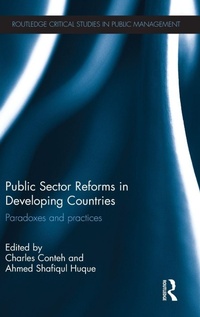
Public Sector Reforms in Developing Countries
Paradoxes and Practices
1st Edition
Published on 4. April 2014
Book
Hardback
220 pages
978-0-415-85856-4 (ISBN)
Description
The underpinning assumption of public management in the developing world as a process of planned change is increasingly being recognized as unrealistic. In reality, the practice of development management is characterized by processes of mutual adjustment among individuals, agencies, and interest groups that can constrain behaviour, as well as provide incentives for collaborative action. Paradoxes inevitably emerge in policy network practice and design.
The ability to manage government departments and operations has become less important than the ability to navigate the complex world of interconnected policy implementation processes. Public sector reform policies and programmes, as a consequence, are a study in the complexities of the institutional and environmental context in which these reforms are pursued. Building on theory and practice, this book argues that advancing the theoretical frontlines of development management research and practice can benefit from developing models based on innovation, collaboration and governance.
The themes addressed in Public Sector Reforms in Developing Countries will enable public managers in developing countries cope in uncertain and turbulent environments as they seek optimal fits between their institutional goals and environmental contingencies.
The ability to manage government departments and operations has become less important than the ability to navigate the complex world of interconnected policy implementation processes. Public sector reform policies and programmes, as a consequence, are a study in the complexities of the institutional and environmental context in which these reforms are pursued. Building on theory and practice, this book argues that advancing the theoretical frontlines of development management research and practice can benefit from developing models based on innovation, collaboration and governance.
The themes addressed in Public Sector Reforms in Developing Countries will enable public managers in developing countries cope in uncertain and turbulent environments as they seek optimal fits between their institutional goals and environmental contingencies.
Reviews / Votes
Public Sector Reforms in Developing Countries moves the study of contemporary reform out of the Western democracies to consider the impact of various ideas about management on public administration in other parts of the world. This is an extremely useful and informative collection of papers that should be read by scholars in administration and those in development.B. Guy Peters, Professor, University of Pittsburgh, USA
More details
Series
Language
English
Place of publication
London
United Kingdom
Publishing group
Taylor & Francis Ltd
Target group
College/higher education
Professional and scholarly
Academic and Postgraduate
Illustrations
9 s/w Zeichnungen, 9 s/w Abbildungen, 9 s/w Tabellen
9 Tables, black and white; 9 Line drawings, black and white; 9 Illustrations, black and white
Dimensions
Height: 240 mm
Width: 161 mm
Thickness: 17 mm
Weight
499 gr
ISBN-13
978-0-415-85856-4 (9780415858564)
Copyright in bibliographic data and cover images is held by Nielsen Book Services Limited or by the publishers or by their respective licensors: all rights reserved.
Schweitzer Classification
Other editions
Additional editions
Charles Conteh | Ahmed Shafiqul Huque
Public Sector Reforms in Developing Countries
Paradoxes and Practices
Book
10/2024
1st Edition
Routledge
€69.51
Shipment within 10-20 days
Charles Conteh | Ahmed Shafiqul Huque
Public Sector Reforms in Developing Countries
Paradoxes and Practices
E-Book
04/2014
Routledge
€55.49
Available for download
Charles Conteh | Ahmed Shafiqul Huque
Public Sector Reforms in Developing Countries
Paradoxes and Practices
E-Book
04/2014
Routledge
€55.49
Available for download
Persons
Charles Conteh is Associate Professor in the Department of Political Science, Brock University, Canada
Ahmed Shafiqul Huque is Professor of Political Science at McMaster University, Canada
Ahmed Shafiqul Huque is Professor of Political Science at McMaster University, Canada
Content
Introduction Part I: Conceptual Overview 2. Public Management Reform in Developing Countries: Contradictions and the Inclusive State 2. An Appraisal of the New Public Governance as a "Paradigm" of Public Sector Reform in Africa Part II: Case Studies on Participation 3. Institutional Reforms in Irrigation Sector of Punjab of Pakistan: Moving towards Participatory Irrigation Management 4. Partnerships between Governments and Nongovernmental Organizations In Brazil: Progress and Setbacks Part III: Case Studies on Decentralization 5. Paradoxes of Decentralisation Reform at the Periphery: Evidence of Decentralised Drugs Policy in Thailand 6. The Political Context of Decentralization: Reflections on South Asia 7. Decentralization in Turkey (2002-2010): Achievements and Shortcomings Part IV: Public Sector Reform: Prospects and Challenges 8. The Elusive Goal of 'Perfect Administration': An Analysis of Public Sector Reform in Jamaica 9. The Internationalization of Public Performance Management and Budgeting: Limitations in the Gulf States 10. Where Private Sector Solutions are not Enough: The Case for a Developmental Public Sector in Africa Conclusion