

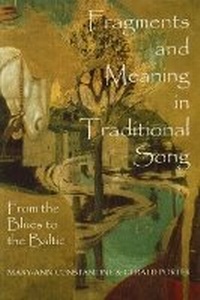
Fragments and Meaning in Traditional Song
From the Blues to the Baltic
Published on 7. August 2003
Book
Hardback
278 pages
978-0-19-726288-7 (ISBN)
Description
This book takes a radical approach to the study of traditional songs. Folk song scholarship was originally obsessed with notions of completeness and narrative coherence; even now long narratives hold a privileged place in most folk song canons. Yet field notebooks and recordings (and, increasingly, publications) overwhelmingly suggest that apparently 'broken' and drastically shortened versions are not perceived as incomplete by those who sing them. Dealing with a wide range of traditions and languages, this study turns the focus on these 'dog-ends' of oral tradition, and looks closely at how very short texts convey meaning in performance by working the audience's knowledge of a highly allusive idiom. What emerges is the tenacity of meaning in the connotative and metaphorical language of traditional song, and the extraordinary adaptability of songs in different cultural contexts. Such pieces have a strong metonymic force: they should not be seen as residual 'last leaves' of a once-complete tradition, but as dynamic elements in the process of oral transmission.
Not all song fragments remain in their natural environment, and this book also explores relocations and dislocations as songs are adapted to new contexts: a ballad of love and death is used to count pins in lace-making, song-snippets trail subversive meanings in the novels of Charles Dickens.
Because they are variable and elusive to dating, songs have had little attention from the literary establishment: the authors show both how certain critical approaches can be fruitfully applied to song texts, and how concepts from studies in oral traditions prefigure aspects of contemporary critical theory. Like the songs themselves, this book crosses and recrosses the perceived divide between the literary and the oral. Coverage includes English, Welsh, Breton, American, and Finnish songs.
Not all song fragments remain in their natural environment, and this book also explores relocations and dislocations as songs are adapted to new contexts: a ballad of love and death is used to count pins in lace-making, song-snippets trail subversive meanings in the novels of Charles Dickens.
Because they are variable and elusive to dating, songs have had little attention from the literary establishment: the authors show both how certain critical approaches can be fruitfully applied to song texts, and how concepts from studies in oral traditions prefigure aspects of contemporary critical theory. Like the songs themselves, this book crosses and recrosses the perceived divide between the literary and the oral. Coverage includes English, Welsh, Breton, American, and Finnish songs.
Reviews / Votes
It is a tribute to the authors' vision and tenacity...that Fragments and Meaning has come to fruition as a source of insight and information, an inspiration to scholars seeking to understand better the meaning of song. * Thomas A. McKean Journal of American Folklore 120 (2007) d *More details
Series
Language
English
Place of publication
Oxford
United Kingdom
Target group
Professional and scholarly
Dimensions
Height: 243 mm
Width: 164 mm
Thickness: 19 mm
Weight
590 gr
ISBN-13
978-0-19-726288-7 (9780197262887)
Copyright in bibliographic data and cover images is held by Nielsen Book Services Limited or by the publishers or by their respective licensors: all rights reserved.
Schweitzer Classification