

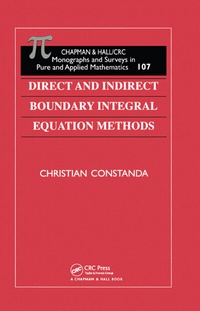
Direct and Indirect Boundary Integral Equation Methods
1st Edition
Published on 28. September 1999
Book
Hardback
216 pages
978-0-8493-0639-6 (ISBN)
Description
The computational power currently available means that practitioners can find extremely accurate approximations to the solutions of more and more sophisticated mathematical models-providing they know the right analytical techniques. In relatively simple terms, this book describes a class of techniques that fulfill this need by providing closed-form solutions to many boundary value problems that arise in science and engineering.
Boundary integral equation methods (BIEM's) have certain advantages over other procedures for solving such problems: BIEM's are powerful, applicable to a wide variety of situations, elegant, and ideal for numerical treatment. Certain fundamental constructs in BIEM's are also essential ingredients in boundary element methods, often used by scientists and engineers.
However, BIEM's are also sometimes more difficult to use in plane cases than in their three-dimensional counterparts. Consequently, the full, detailed BIEM treatment of two-dimensional problems has been largely neglected in the literature-even when it is more than marginally different from that applied to the corresponding three-dimensional versions.
This volume discusses three typical cases where such differences are clear: the Laplace equation (one unknown function), plane strain (two unknown functions), and the bending of plates with transverse shear deformation (three unknown functions). The author considers each of these with Dirichlet, Neumann, and Robin boundary conditions. He subjects each to a thorough investigation-with respect to the existence and uniqueness of regular solutions-through several BIEM's. He proposes suitable generalizations of the concept of logarithmic capacity for plane strain and bending of plates, then uses these to identify contours where non-uniqueness may occur. In the final section, the author compares and contrasts the various solution representations, links them by means of boundary operators, and evaluates them for their suitability for numeric computation.
Boundary integral equation methods (BIEM's) have certain advantages over other procedures for solving such problems: BIEM's are powerful, applicable to a wide variety of situations, elegant, and ideal for numerical treatment. Certain fundamental constructs in BIEM's are also essential ingredients in boundary element methods, often used by scientists and engineers.
However, BIEM's are also sometimes more difficult to use in plane cases than in their three-dimensional counterparts. Consequently, the full, detailed BIEM treatment of two-dimensional problems has been largely neglected in the literature-even when it is more than marginally different from that applied to the corresponding three-dimensional versions.
This volume discusses three typical cases where such differences are clear: the Laplace equation (one unknown function), plane strain (two unknown functions), and the bending of plates with transverse shear deformation (three unknown functions). The author considers each of these with Dirichlet, Neumann, and Robin boundary conditions. He subjects each to a thorough investigation-with respect to the existence and uniqueness of regular solutions-through several BIEM's. He proposes suitable generalizations of the concept of logarithmic capacity for plane strain and bending of plates, then uses these to identify contours where non-uniqueness may occur. In the final section, the author compares and contrasts the various solution representations, links them by means of boundary operators, and evaluates them for their suitability for numeric computation.
Reviews / Votes
"The text is written clearly and the proofs are given in detail."M. Aron, Proceedings of the Edinburgh Mathematical Society, Vol. 44, 445-448, 2001
"...the book offers a comprehensive treatment of the subject matter and constitutes a very useful source of information for mathematicians and other scientists interested in boundary integral equation methods.
M. Aron, Proceedings of the Edinburgh Mathematical Society, Vol. 44, 445-448, 2001
More details
Series
Language
English
Place of publication
Oxford
United Kingdom
Publishing group
Taylor & Francis Ltd
Target group
Professional and scholarly
Professional
Dimensions
Height: 234 mm
Width: 156 mm
Weight
480 gr
ISBN-13
978-0-8493-0639-6 (9780849306396)
Copyright in bibliographic data and cover images is held by Nielsen Book Services Limited or by the publishers or by their respective licensors: all rights reserved.
Schweitzer Classification
Other editions
Additional editions
Christian Constanda
Direct and Indirect Boundary Integral Equation Methods
E-Book
01/2020
1st Edition
Chapman & Hall/CRC
€73.99
Available for download
Person
Content
Introduction. The Laplace Equation. Plane Strain. Bending of Elastic Plates. Which Method?
NTI/Sales Copy
NTI/Sales Copy