

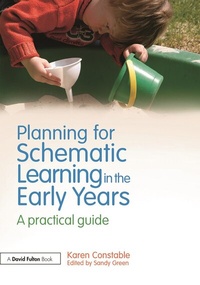
Planning for Schematic Learning in the Early Years
A practical guide
Published on 24. May 2013
Book
Paperback/Softback
140 pages
978-0-415-69712-5 (ISBN)
Description
What are schemas and why should you know about them? How can schemas be identified in young children? What does schematic learning look like and how does it meet the needs of individual children?
All children are different, they look different, sound different, behave in different ways and crucially they learn differently. It is a constant challenge in Early Years settings and Reception classes to provide opportunities that are relevant and valuable for all the children. Being able to recognise and identify schemas in young children enables practitioners to plan a play-based curriculum that allows for individualised learning based around each child's interests that will support the next steps of their development.
Drawing on current research, the book clearly explains what schemas are and how they can be identified in children. Looking at how settings can plan to incorporate schemas into their schemes and topics and providing real life examples of schematic learning in practice, features include:
Examples of schemas alongside descriptions of common behaviour patterns
A chapter on using schemas to support children with additional needs
Photocopiable key checklists to help identify different schemas
Guidance on developing schemas to support children in their next steps
Advice on using schemas to aid the transition to Key Stage 1
Including case studies and photographs to illustrate practice, this highly practical book aims to inspire practitioners, teachers and students to be creative in the way they work with children and ensure the best for those in their care.
All children are different, they look different, sound different, behave in different ways and crucially they learn differently. It is a constant challenge in Early Years settings and Reception classes to provide opportunities that are relevant and valuable for all the children. Being able to recognise and identify schemas in young children enables practitioners to plan a play-based curriculum that allows for individualised learning based around each child's interests that will support the next steps of their development.
Drawing on current research, the book clearly explains what schemas are and how they can be identified in children. Looking at how settings can plan to incorporate schemas into their schemes and topics and providing real life examples of schematic learning in practice, features include:
Examples of schemas alongside descriptions of common behaviour patterns
A chapter on using schemas to support children with additional needs
Photocopiable key checklists to help identify different schemas
Guidance on developing schemas to support children in their next steps
Advice on using schemas to aid the transition to Key Stage 1
Including case studies and photographs to illustrate practice, this highly practical book aims to inspire practitioners, teachers and students to be creative in the way they work with children and ensure the best for those in their care.
More details
Language
English
Place of publication
London
United Kingdom
Publishing group
Taylor & Francis Ltd
Target group
Professional and scholarly
College/higher education
Professional, Professional Practice & Development, and Undergraduate
Illustrations
32 s/w Abbildungen, 32 s/w Photographien bzw. Rasterbilder, 24 s/w Tabellen
24 Tables, black and white; 32 Halftones, black and white; 32 Illustrations, black and white
Dimensions
Height: 246 mm
Width: 174 mm
Weight
317 gr
ISBN-13
978-0-415-69712-5 (9780415697125)
Copyright in bibliographic data and cover images is held by Nielsen Book Services Limited or by the publishers or by their respective licensors: all rights reserved.
Schweitzer Classification
Other editions
Additional editions
E-Book
05/2013
1st Edition
Routledge
€41.99
Available for download
E-Book
05/2013
1st Edition
Routledge
€41.99
Available for download
Book
05/2013
Routledge
€215.41
Shipment within 15-20 days
Persons
Karen Constable is an experienced early years teacher, working for almost 20 years in nursery and school settings. Specialising in how children learn and using the outdoor environment, Karen has worked across schools in Somerset supporting teachers and students to improve children's learning. She is currently a reception class teacher and early years leader, working with children ranging from two to five years at Mark First School, UK.?
Sandy Green worked within the early years sector for over 35 years, initially as a nursery nurse in both education and social services settings and later as a lecturer in further education. She is now an educational consultant and has written extensively on early years education.
Sandy Green worked within the early years sector for over 35 years, initially as a nursery nurse in both education and social services settings and later as a lecturer in further education. She is now an educational consultant and has written extensively on early years education.
Content
1. Children Learning through Play 2. Identifying Schematic Learning in Young Children 3. Children with Special Educational Needs and Schematic Learning 4. Case studies: Hudson The Connector, Ellie The Transporter, Jenson and the Trajectory Schema, Madison The Enveloper 5. Creating an Appropriate Curriculum 6. Rockets and Aliens 7. The Outdoor Classroom, All About Me, Towns and Cities, Transition 7. Conclusion