

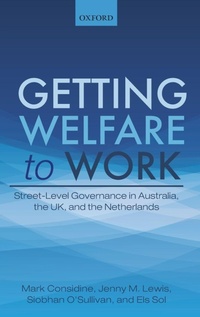
Getting Welfare to Work
Street-Level Governance in Australia, the UK, and the Netherlands
Published on 24. September 2015
Book
Hardback
216 pages
978-0-19-874370-5 (ISBN)
Description
Getting Welfare to Work traces the radical reform of the Australian, UK, and Dutch public employment services systems. Starting with major changes from 1998, this book examines how each national system has moved from traditional public services towards more privately provided and market-based methods.
Each of these three countries developed innovative forms of contracting-out and complex incentive regimes to motivate welfare clients and to control the agencies charged with helping them. The Australian system pioneered the use of large, national contracts for services to all unemployed jobseekers. By the end of our study period this system was entirely outsourced to private agencies. Meanwhile the UK elected a form of contestability under Blair and Cameron, culminating in a new public-private financing model known as the 'Work Programme'. The Dutch had evolved their far more complex system from a traditional public service approach to one using a variety of specific contracts for private agencies. These innovations have changed welfare delivery and created both opportunities and new constraints for policy makers.
Getting Welfare to Work tells the story of these bold policy reforms from the perspective of street-level bureaucrats. Interviews and surveys in each country over a fifteen year period are used to critically appraise this central pillar of the welfare state. The original data analysed in Getting Welfare to Work provides a unique comparative perspective on three intriguing systems. It points to new ways of thinking about modes of governance, system design, regulation of public services, and so-called activation of welfare clients. It also sheds light on the predicament of third sector organisations that contract to governments through competitive tenders with precise performance monitoring, raising questions of 'mission drift'.
Each of these three countries developed innovative forms of contracting-out and complex incentive regimes to motivate welfare clients and to control the agencies charged with helping them. The Australian system pioneered the use of large, national contracts for services to all unemployed jobseekers. By the end of our study period this system was entirely outsourced to private agencies. Meanwhile the UK elected a form of contestability under Blair and Cameron, culminating in a new public-private financing model known as the 'Work Programme'. The Dutch had evolved their far more complex system from a traditional public service approach to one using a variety of specific contracts for private agencies. These innovations have changed welfare delivery and created both opportunities and new constraints for policy makers.
Getting Welfare to Work tells the story of these bold policy reforms from the perspective of street-level bureaucrats. Interviews and surveys in each country over a fifteen year period are used to critically appraise this central pillar of the welfare state. The original data analysed in Getting Welfare to Work provides a unique comparative perspective on three intriguing systems. It points to new ways of thinking about modes of governance, system design, regulation of public services, and so-called activation of welfare clients. It also sheds light on the predicament of third sector organisations that contract to governments through competitive tenders with precise performance monitoring, raising questions of 'mission drift'.
More details
Other editions
Additional editions
Mark Considine | Jenny M. Lewis | Siobhan O'Sullivan
Getting Welfare to Work
Street-Level Governance in Australia, the UK, and the Netherlands
E-Book
09/2015
1st Edition
OUP eBook
€63.49
Available for download
Persons
Mark Considine is Professor of Political Science and Dean of Arts at the University of Melbourne. He specialises in public policy and administration, including the study of the use of new forms of governance in the delivery of social programs.
Jenny M. Lewis is Professor of Public Policy in the School of Social and Political Sciences at the University of Melbourne, and an Australian Research Council Future Fellow for 2013-16. Jenny is a public policy expert, with particular interests in governance, street-level bureaucracy, policy influence, and the policy process. She has published widely in journals and is the author of five books, and has been awarded American, European, and Australian prizes for her research.
Siobhan O'Sullivan was a Research Fellow in the School of Social and Political Sciences, at the University of Melbourne from 2008 until 2014. Her work is focused on the welfare state, with a particular emphasis on welfare-to-work. In 2015 she relocated to the University of New South Wales (UNSW) where she teaches Social Policy. Siobhan also maintains an on going interest in animal welfare and environmental policy.
Els Sol is a Sociologist and Geographer and she works as an Associate Professor at the AIAS/Hugo Sinzheimer Institute, University of Amsterdam. Els is program leader of a major university research program entailing ten research projects on welfare to work, masterclasses, and conferences (www.rvo.nl). She also coordinates the Flexwork Research Centre, an academic database with research reports on non-standard employment (www.flexworkresearch.org). Her research focuses on the field of (theory and international comparisons of) labour market and social security policies, re-employment services, policy evaluation, social policies and social protection schemes.
Jenny M. Lewis is Professor of Public Policy in the School of Social and Political Sciences at the University of Melbourne, and an Australian Research Council Future Fellow for 2013-16. Jenny is a public policy expert, with particular interests in governance, street-level bureaucracy, policy influence, and the policy process. She has published widely in journals and is the author of five books, and has been awarded American, European, and Australian prizes for her research.
Siobhan O'Sullivan was a Research Fellow in the School of Social and Political Sciences, at the University of Melbourne from 2008 until 2014. Her work is focused on the welfare state, with a particular emphasis on welfare-to-work. In 2015 she relocated to the University of New South Wales (UNSW) where she teaches Social Policy. Siobhan also maintains an on going interest in animal welfare and environmental policy.
Els Sol is a Sociologist and Geographer and she works as an Associate Professor at the AIAS/Hugo Sinzheimer Institute, University of Amsterdam. Els is program leader of a major university research program entailing ten research projects on welfare to work, masterclasses, and conferences (www.rvo.nl). She also coordinates the Flexwork Research Centre, an academic database with research reports on non-standard employment (www.flexworkresearch.org). Her research focuses on the field of (theory and international comparisons of) labour market and social security policies, re-employment services, policy evaluation, social policies and social protection schemes.
Author
Professor of Political Science and Dean of ArtsProfessor of Political Science and Dean of Arts, University of Melbourne
Professor of Public Policy and ARC Future FellowProfessor of Public Policy and ARC Future Fellow, University of Melbourne
LecturerLecturer, University of New South Wales
Associate ProfessorAssociate Professor, University of Amsterdam
Content
1. Reforming Welfare Systems ; 2. Australia's Competitive Contract Model ; 3. Driving Change at the Australian Frontline ; 4. The United Kingdom's Dual System ; 5. When Less is More - Transforming the UK Frontline ; 6. The Netherlands' Hybrid Market ; 7. Activation and the Dutch Frontline ; 8. Governance Modes ; 9. Networking Types ; 10. Welfare Markets and the Politics of Activation