

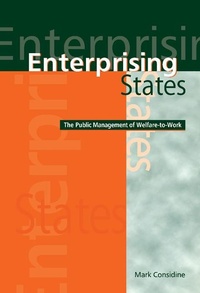
Enterprising States
The Public Management of Welfare-to-Work
Published on 2. May 2001
Book
Hardback
232 pages
978-0-521-80598-8 (ISBN)
Description
This book, first published in 2001, explores two shifts in the paradigms of governance in Western bureaucracies. They are the widespread use of privatisation, private firms and market methods to run core public services, and the conscious attempt to transform the role of citizenship from ideals of entitlement and security to notions of mutual obligation, selectivity and risk. Considine examines the most important service of the modern welfare state - unemployment assistance - to explain and theorise the nature of these radical changes. He undertakes research in the United Kingdom, the Netherlands, Australia and New Zealand, four countries which have been among the boldest reformers within the OECD, yet each adopting different models. Each case is a break from the standards of responsible democracy and legal-rational bureaucracy, with at least one government opting for a commercial paradigm based on targets and economic incentives and another opting for a model based on network governance, co-production and trust.
Reviews / Votes
"American scholars and practitioners will find a wealth of useful, often unsettling, insights in this well-conceived comparative study." Social Service ReviewMore details
Language
English
Place of publication
Cambridge
United Kingdom
Target group
Professional and scholarly
Illustrations
20 Tables, unspecified
Dimensions
Height: 235 mm
Width: 157 mm
Thickness: 17 mm
Weight
493 gr
ISBN-13
978-0-521-80598-8 (9780521805988)
Copyright in bibliographic data and cover images is held by Nielsen Book Services Limited or by the publishers or by their respective licensors: all rights reserved.
Schweitzer Classification
Other editions
Additional editions
Book
05/2001
Cambridge University Press
€43.90
Shipment within 15-20 days
Person
Mark Considine is Redmond Barry Distinguished Professor of Political Science in the School of Social and Political Studies, University of Melbourne.
Content
1. Enterprising the state; 2. Governance in fours; 3. The United Kingdom: managing by numbers; 4. New Zealand: two steps forward; 5. The Netherlands: the part-time miracle; 6. Australia: governance by competition; 7. Taking the measure of the 'new governance'; 8. Conclusion: de-coupling, contracting and self-enterprise.