

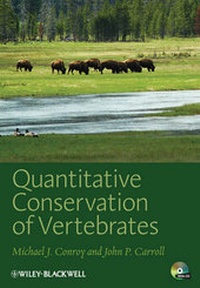
Quantitative Conservation of Vertebrates
Published on 16. January 2009
Book
Paperback/Softback
352 pages
978-1-4051-8228-7 (ISBN)
Description
This book provides a hands-on introduction to the construction and application of models to studies of vertebrate distribution, abundance, and habitat. The book is aimed at field biologists, conservation planners, and advanced undergraduate and postgraduate students who are involved with planning and analyzing conservation studies, and applying the results to conservation decisions. The book also acts as a bridge to more advanced and mathematically challenging coverage in the wider literature.
Part I provides a basic background in population and community modeling. It introduces statistical models, and familiarizes the reader with important concepts in the design of monitoring and research programs. These programs provide the essential data that guide conservation decision making. Part II covers the principal methods used to estimate abundance, occupancy, demographic parameters, and community parameters, including occupancy sampling, sample counts, distance sampling, and capture-mark-recapture (for both closed and open populations). Emphasis is placed on practical aspects of designing and implementing field studies, and the proper analysis of data. Part III introduces structured decision making and adaptive management, in which predictive models are used to inform conservation decision makers on appropriate decisions in the face of uncertainty--with the goal of reducing uncertainty through monitoring and research. A detailed case study is used to illustrate each of these themes.
Numerous worked examples and accompanying electronic material (on a website and accompanying CD) provide the details of model construction and application, and data analysis.
Reviews / Votes
"Overall, this would be a plausible book for an upper-division course in which students would learn, rather painlessly, the necessary combination of observation and mathematics necessary to make important conservation decisions." (CHOICE, December 2009)More details
Other editions
Additional editions
Michael J. Conroy | John P. Carroll
Quantitative Conservation of Vertebrates
E-Book
09/2011
Wiley-Blackwell
€63.99
Available for download
Michael J. Conroy | John P. Carroll
Quantitative Conservation of Vertebrates
E-Book
01/2009
Wiley-Blackwell
€63.99
Available for download
Michael J. Conroy | John P. Carroll
Quantitative Conservation of Vertebrates
Book
01/2009
Wiley
€163.41
Article exhausted; check different version
Persons
Dr Michael J. Conroy has nearly 30 years of experience in developing sampling approaches, statistical estimation methods, and modeling for a wide variety of natural resource management problems. He is the author of numerous publications in applied quantitative approaches, and is coauthor on the widely acclaimed volume by Williams et al. (2002). He is currently Adjunct Professor of Wildlife Ecology and Management at the University of Georgia, and Assistant Unit Leader of the Georgia Cooperative Fish and Wildlife Research Unit. He is literate in Spanish and has taught short courses on quantitative methods in the US, Spain, India, Ecuador, Costa Rica, and Argentina.
Dr John P. Carroll has been researching conservation issues relative to the Galliformes for more than 20 years. He is Chair of the World Pheasant Association/BirdLife/IUCN Species Survival Commission Partridge, Quail, and Francolin Specialist Group. He is author of numerous publications on the biology and conservation of Galliformes and the effects of agricultural practices on wildlife. He is currently Professor of Wildlife Ecology and Management in the Warnell School of Forestry and Natural Resources at the University of Georgia. He has taught short courses on field research methods and techniques in Malaysia, Nepal, and India.
Content
Preface.
Acknowledgments.
Companion website and CD-ROM.
1. Introduction: The role of science in conservation.
Part 1. Basic concepts in scientific investigations for conservation.
2. Using models in conservation biology.
3. Models of population dynamics.
4. Applying population models to conservation.
5. Basics of study design and analysis.
Part 2. Conservation studies and monitoring programs.
6. General principles of estimation.
7. Occupancy (presence-absence) analysis.
8. Sample counts for abundance estimation.
9. Distance sampling for estimating density and abundance.
10. Capture-mark-recapture studies for estimating abundance and density.
11. Estimation of survival from radiotelemetry, nesting success studies, and age distributions.
12. Mark-recapture for estimating survival, recruitment, abundance, and movement rates.
13. Analysis of habitat.
14. Estimation of species richness and other community parameters.
Part 3. Integrating modeling and monitoring for conservation.
15. Elements of conservation decision making.
16. Accounting for uncertainty in conservation decisions.
17. Learning and adaptive management.
18. Case study: decision modeling and adaptive management for declining grassland birds in the southeastern USA.
19. Summary and recommendations.
Literature cited.
Glossary.
Appendix A. Statistical and modeling programs available on the worldwide web.
Appendix B. Other internet resources.
Appendix C. Modeling and statistical notation.
Appendix D. Key to abundance and parameter estimation.
Index