

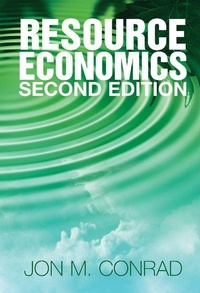
Resource Economics
2nd Edition
Published on 14. June 2010
Book
Hardback
300 pages
978-0-521-87495-3 (ISBN)
Description
Resource Economics is a text for students with a background in calculus and intermediate microeconomics and a familiarity with the spreadsheet software Excel. The book covers basic concepts (Chapter 1), shows how to set up spreadsheets to solve simple dynamic allocation problems (Chapter 2), and presents economic models for fisheries, forestry, nonrenewable resources, and stock pollutants (Chapters 3-6). Chapter 7 examines the maximin utility criterion when the utility of a generation depends on consumption of a manufactured good, harvest from a renewable resource, and extraction from a nonrenewable resource. Within the text, numerical examples are posed and solved using Excel's Solver. Exercises are included at the end of each chapter. These problems help make concepts operational, develop economic intuition, and serve as a bridge to the study of real-world problems in resource management.
Reviews / Votes
'Jon Conrad's second edition of Resource Economics is an articulate, well-organized presentation of key applications of intertemporal economics to problems of natural resources. More than a routine update of the first edition, it admirably balances theoretical rigor and clarity in the presentation of models, with the kinds of institutional discussions that motivate students to think about research questions.' Robert T. Deacon, University of California, Santa Barbara 'This book builds on the already-excellent first edition, with its unique focus on computational solution of dynamic optimization problems, by providing a richer and more detailed discussion of theoretical models of renewable, nonrenewable, and environmental resource management along with very helpful discussion of the intuition behind the models, and applications to resource problems.' Anthony Fisher, University of California, Berkeley 'Jon Conrad's Resource Economics is a unique and indeed indispensable learning resource. It teaches students to work with sophisticated mathematical models using a hands-on, intuitive approach based on the standard spreadsheet tools that are now pervasive in quantitative analysis. Conrad's book sets a standard to which other textbook authors should aspire.' Richard Howarth, Dartmouth University 'Jon Conrad's second edition of Resource Economics is an elegant mathematical treatment of the many complex management issues confronting natural resource managers. The book presents dynamic modeling and optimization in a practical context. The use of Excel throughout the book gives it a concreteness that is lost in purely theoretical texts. It is an ideal advanced text covering the economics of fisheries, forestry, nonrenewable resources, and stock pollutants.' Robert Mendelsohn, Yale University 'Resource Economics is an excellent choice for advanced undergraduates and master's students. The book's use of Excel's solver gives students an intuitive grasp of dynamic optimization without relying on advanced mathematics. Students analyze fisheries, forests, and fossil fuels as they learn spreadsheet programming skills that are valuable in other economics, business, and management courses.' Martin Smith, Duke University 'I wish there had been a textbook such as Jon Conrad's Resource Economics available when I was a young student beginning to learn about natural resource and environmental economics. This is a rigorous but highly accessible mathematical introduction to the field that brings home to the reader the fundamental common threads, as well as the differentiating factors, among nonrenewable, renewable, and environmental resource problems.' Robert N. Stavins, Harvard UniversityMore details
Edition
2nd Revised edition
Language
English
Place of publication
Cambridge
United Kingdom
Target group
College/higher education
Edition type
Revised edition
Illustrations
Worked examples or Exercises; 49 Tables, unspecified; 1 Maps; 1 Halftones, unspecified; 30 Line drawings, unspecified
Dimensions
Height: 235 mm
Width: 157 mm
Thickness: 22 mm
Weight
640 gr
ISBN-13
978-0-521-87495-3 (9780521874953)
Copyright in bibliographic data and cover images is held by Nielsen Book Services Limited or by the publishers or by their respective licensors: all rights reserved.
Schweitzer Classification
Other editions
Additional editions

Jon M. Conrad
Resource Economics
Online / Databases
12/2014
2nd Edition
Cambridge University Press
€2,643.50
Access within 15-20 days
Jon M. Conrad
Resource Economics
E-Book
11/2010
2nd Edition
Cambridge University Press
€36.99
Available for download
Jon M. Conrad
Resource Economics
E-Book
06/2010
1st Edition
Cambridge University Press
€31.99
Available for download
Previous edition
Jon M. Conrad
Resource Economics
Book
10/1999
Cambridge University Press
€77.99
Article exhausted; check for reprint
Person
Jon M. Conrad is Professor of Resource Economics in the Department of Applied Economics and Management at Cornell University. He taught at the University of Massachusetts, Amherst, from 1973 to 1977, joining the Cornell faculty in 1978. His research interests focus on the use of dynamic optimization techniques to manage natural resources and environmental quality. He has published articles in the Journal of Political Economy, the Quarterly Journal of Economics, the American Journal of Agricultural Economics, the Canadian Journal of Economics, Land Economics, Marine Resource Economics, Biomathematics, Ecological Economics, Natural Resource Modeling and the Journal of Environmental Economics and Management, where he served as an associate editor. He is coauthor, with Colin Clark, of the text Natural Resource Economics: Notes and Problems (Cambridge University Press, 1987) and past President of the Resource Modeling Association. Cambridge University Press published the first edition of Resource Economics in 1999.
Content
1. Basic concepts; 2. Solving numerical allocation problems using Excel's Solver; 3. The economics of fisheries; 4. The economics of forestry; 5. The economics of nonrenewable resources; 6. Stock pollutants; 7. Maximin utility with renewable and nonrenewable resources.