

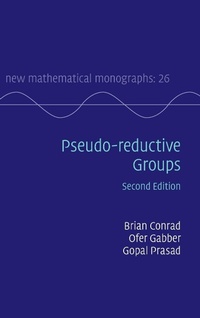
Pseudo-reductive Groups
2nd Edition
Published on 4. June 2015
Book
Hardback
690 pages
978-1-107-08723-1 (ISBN)
Description
Pseudo-reductive groups arise naturally in the study of general smooth linear algebraic groups over non-perfect fields and have many important applications. This monograph provides a comprehensive treatment of the theory of pseudo-reductive groups and gives their classification in a usable form. In this second edition there is new material on relative root systems and Tits systems for general smooth affine groups, including the extension to quasi-reductive groups of famous simplicity results of Tits in the semisimple case. Chapter 9 has been completely rewritten to describe and classify pseudo-split absolutely pseudo-simple groups with a non-reduced root system over arbitrary fields of characteristic 2 via the useful new notion of 'minimal type' for pseudo-reductive groups. Researchers and graduate students working in related areas, such as algebraic geometry, algebraic group theory, or number theory will value this book, as it develops tools likely to be used in tackling other problems.
Reviews / Votes
Review of previous edition: 'This book is an impressive piece of work; many hard technical difficulties are overcome in order to provide the general structure of pseudo-reductive groups and to elucidate their classification by means of reasonable data. In view of the importance of this class of algebraic groups ... and of the impact of a better understanding of them on the general theory of linear algebraic groups, this book can be considered a fundamental reference in the area.' Mathematical Reviews Review of previous edition: 'Researchers and graduate students working in related areas, such as algebraic geometry, algebraic group theory, or number theory will appreciate this book and find many deep ideas, results and technical tools that may be used in other branches of mathematics.' Zentralblatt MATH '[This book] is devoted to the elucidation of the structure and classification of pseudo-reductive groups over imperfect fields, completing the program initiated by J. Tits, A. Borel and T. Springer in the last three decades of the last century ... [it] is a remarkable achievement and the definitive reference for pseudo-reductive groups. It certainly belongs in the library of anyone interested in algebraic groups and their arithmetic and geometry.' Felipe Zaldivar, MAA Reviews (maa.org/press/maa-reviews)More details
Series
Edition
2nd Revised edition
Language
English
Place of publication
Cambridge
United Kingdom
Target group
Professional and scholarly
Edition type
Revised edition
Illustrations
Worked examples or Exercises
Dimensions
Height: 235 mm
Width: 157 mm
Thickness: 45 mm
Weight
1254 gr
ISBN-13
978-1-107-08723-1 (9781107087231)
Copyright in bibliographic data and cover images is held by Nielsen Book Services Limited or by the publishers or by their respective licensors: all rights reserved.
Schweitzer Classification
Other editions
Additional editions
Brian Conrad
Pseudo-reductive Groups
E-Book
06/2015
Cambridge University Press
€96.49
Available for download
Brian Conrad | Ofer Gabber | Gopal Prasad
Pseudo-reductive Groups
E-Book
04/2015
2nd Edition
Cambridge University Press
€115.99
Available for download
Previous edition
Brian Conrad | Ofer Gabber | Gopal Prasad
Pseudo-reductive Groups
Book
07/2010
Cambridge University Press
€99.03
Article exhausted; check for reprint
Persons
Brian Conrad is a Professor in the Department of Mathematics at Stanford University. Ofer Gabber is a Directeur de Recherches CNRS at the Institut des Hautes Etudes Scientifiques (IHES). Gopal Prasad is Raoul Bott Professor of Mathematics at the University of Michigan.
Content
Preface to the second edition; Introduction; Terminology, conventions, and notation; Part I. Constructions, Examples, and Structure Theory: 1. Overview of pseudo-reductivity; 2. Root groups and root systems; 3. Basic structure theory; Part II. Standard Presentations and Their Applications: 4. Variation of (G', k'/k, T', C); 5. Ubiquity of the standard construction; 6. Classification results; Part III. General Classification and Applications: 7. The exotic constructions; 8. Preparations for classification in characteristics 2 and 3; 9. Absolutely pseudo-simple groups in characteristic 2; 10. General case; 11. Applications; Part IV. Appendices: A. Background in linear algebraic groups; B. Tits' work on unipotent groups in nonzero characteristic; C. Rational conjugacy in connected groups; References; Index.