

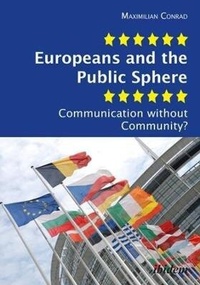
Europeans and the Public Sphere - Communication Without Community?
Communication Without Community?
Published on 7. October 2014
Book
Paperback/Softback
326 pages
978-3-8382-0685-1 (ISBN)
Description
What kind of public sphere is possible in the European Union with its considerable diversity of national identities, languages, and media systems? Against the backdrop of debates about a fundamental European community deficit and the possibility of postnational democracy, this book explores the role of a European public sphere not only in bridging presumed gaps between citizens and their representatives in the European institutions but also in creating transnational communicative spaces that contribute to the politicization of EU politics. Drawing on Deweyan pragmatism, social constructivism, and the Habermasian notion of constitutional patriotism, this book moves beyond the conventional wisdom that a European public sphere necessitates the existence of a sense of European 'identity light'.
Arguing that a political sense of community along the lines of a European constitutional patriotism can only emerge out of the democratic process itself, Maximilian Conrad looks at the role of daily newspapers not only as framers of public debate, but also as actors with distinct normative views regarding the future of the integration process, both in terms of the nature of the EU as a polity and the nature of democratic rule in this polity. The crucial empirical question addressed in the book is: Do newspapers with a pronounced preference for more democracy beyond the nation state also play a more active role in providing forums for transnational debate?
Arguing that a political sense of community along the lines of a European constitutional patriotism can only emerge out of the democratic process itself, Maximilian Conrad looks at the role of daily newspapers not only as framers of public debate, but also as actors with distinct normative views regarding the future of the integration process, both in terms of the nature of the EU as a polity and the nature of democratic rule in this polity. The crucial empirical question addressed in the book is: Do newspapers with a pronounced preference for more democracy beyond the nation state also play a more active role in providing forums for transnational debate?
Reviews / Votes
A theoretically well-grounded and empirically rich investigation into the possibilities of a transnational public sphere and its capacities to bridge the deficits of social integration and democracy in Europe. At the same time, it provides a highly applicable analytical framework for the study of transnational communication in the media. -- Hans-Jorg Trenz, University of Copenhagen and ARENA Centre for European Studies, University of OsloMore details
Language
English
Place of publication
Stuttgart
Germany
Target group
Professional and scholarly
Product notice
Paperback (trade)
Illustrations
tab: 35, b&w; fig: 3, b&w
Dimensions
Height: 240 mm
Width: 168 mm
Thickness: 15 mm
Weight
454 gr
ISBN-13
978-3-8382-0685-1 (9783838206851)
Copyright in bibliographic data and cover images is held by Nielsen Book Services Limited or by the publishers or by their respective licensors: all rights reserved.
Schweitzer Classification
Other editions
Additional editions

E-Book
09/2014
ibidem
€25.66
Available for download
Person
Maximilian Conrad is assistant professor of European Politics at the Faculty of Political Science, University of Iceland. His main research interests lie in the fields of European integration studies and political philosophy, with numerous publications on the EU democratic deficit, the viability of a European public sphere, and the role and impact of the European Citizens' Initiative.
Content
1. Democracy: The Unfinished Project of European Integration 2. Communicative Spaces between Communication and Community 3. Communication vs. Community: An Ontological Critique-and Beyond 4. Connecting the Dots: Daily Newspapers and Transnational Debate 5. Intergovernmental, Supranational or Postnational? Daily Newspapers' Views on European Integration and EU Democracy 6. The Finality Debate 7. Constitutional Ratification Crisis 8. The Relaunch of the Constitutional Process 9. Communication and Community Revisited References Appendices