

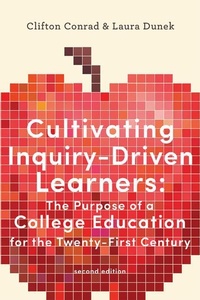
Cultivating Inquiry-Driven Learners
The Purpose of a College Education for the Twenty-First Century
2nd Edition
Will be published approx. on 29. September 2020
Book
Paperback/Softback
160 pages
978-1-4214-3848-1 (ISBN)
Description
How can colleges develop learners who pursue innovative ideas that enable them to flourish and contribute in a rapidly changing world?
Two decades into the twenty-first century, our nation's colleges and universities no longer embrace a clear and convincing definition of the purpose of a college education. Instead, most institutions have fallen prey to a default purpose in which college is essentially workforce preparation for jobs that already exist, while students are viewed as commodities instead of being educated to flourish throughout their lives. But rather than bemoan the diminishing legacy of liberal education, this new edition of Cultivating Inquiry-Driven Learners argues that the time has come to advance a pioneering purpose of college that guides the undergraduate experience from program requirements to teaching and learning.
This purpose, Clifton Conrad and Laura Dunek write, is anchored in the premise that the world in which we live is one in which change-environmental, cultural, economic, political-is a constant driving force. The authors envision a college-educated person in the twenty-first century as an "inquiry-driven learner": a person equipped with the capabilities to explore and cultivate ideas that will prepare them to successfully navigate constant change, capitalize on career opportunities, enrich their personal life, and contribute to the public good. They describe four signature capabilities that students must develop in order to innovate and adapt: core qualities of mind, critical thinking skills, expertise in divergent modes of inquiry, and the capacity to express and communicate ideas.
Guided by this trailblazing vision, Conrad and Dunek have thoroughly revised every chapter of the book to reflect current scholarship and emerging trends. In an expanded conclusion, they provide a cornucopia of ideas for replenishing undergraduate education accompanied by real-world examples of innovative programs and practices from colleges and universities across the United States. Throughout, Cultivating Inquiry-Driven Learners challenges stakeholders from across higher learning-faculty, students, staff, administrators, and policymakers-to reflect on the purpose of college, embrace innovation, and ensure that students are educated to thrive in and contribute to our constantly changing world.
Two decades into the twenty-first century, our nation's colleges and universities no longer embrace a clear and convincing definition of the purpose of a college education. Instead, most institutions have fallen prey to a default purpose in which college is essentially workforce preparation for jobs that already exist, while students are viewed as commodities instead of being educated to flourish throughout their lives. But rather than bemoan the diminishing legacy of liberal education, this new edition of Cultivating Inquiry-Driven Learners argues that the time has come to advance a pioneering purpose of college that guides the undergraduate experience from program requirements to teaching and learning.
This purpose, Clifton Conrad and Laura Dunek write, is anchored in the premise that the world in which we live is one in which change-environmental, cultural, economic, political-is a constant driving force. The authors envision a college-educated person in the twenty-first century as an "inquiry-driven learner": a person equipped with the capabilities to explore and cultivate ideas that will prepare them to successfully navigate constant change, capitalize on career opportunities, enrich their personal life, and contribute to the public good. They describe four signature capabilities that students must develop in order to innovate and adapt: core qualities of mind, critical thinking skills, expertise in divergent modes of inquiry, and the capacity to express and communicate ideas.
Guided by this trailblazing vision, Conrad and Dunek have thoroughly revised every chapter of the book to reflect current scholarship and emerging trends. In an expanded conclusion, they provide a cornucopia of ideas for replenishing undergraduate education accompanied by real-world examples of innovative programs and practices from colleges and universities across the United States. Throughout, Cultivating Inquiry-Driven Learners challenges stakeholders from across higher learning-faculty, students, staff, administrators, and policymakers-to reflect on the purpose of college, embrace innovation, and ensure that students are educated to thrive in and contribute to our constantly changing world.
More details
Edition
second edition
Language
English
Place of publication
Baltimore, MD
United States
Target group
College/higher education
Edition type
Revised edition
Product notice
Paperback (trade)
Illustrations
2 s/w Zeichnungen
2 Line drawings, black and white
Dimensions
Height: 221 mm
Width: 145 mm
Thickness: 13 mm
Weight
227 gr
ISBN-13
978-1-4214-3848-1 (9781421438481)
DOI
10.56021/9781421438498
Copyright in bibliographic data and cover images is held by Nielsen Book Services Limited or by the publishers or by their respective licensors: all rights reserved.
Schweitzer Classification
Other editions
Additional editions
Clifton Conrad | Laura Dunek
Cultivating Inquiry-Driven Learners
The Purpose of a College Education for the Twenty-First Century
E-Book
09/2020
2nd Edition
Johns Hopkins University Press
€20.99
Available for download
Previous edition
Clifton Conrad | Laura Dunek
Cultivating Inquiry-Driven Learners
A College Education for the Twenty-First Century
Book
08/2012
Johns Hopkins University Press
€25.38
Article exhausted; check for reprint
Persons
Clifton Conrad is the Vilas Distinguished Achievement Professor and a professor of higher education at the University of Wisconsin-Madison. He is the coauthor of Educating a Diverse Nation: Lessons from Minority-Serving Institutions and Emblems of Quality: Developing and Sustaining High-Quality Academic Programs. Laura Dunek is the special assistant for governance and strategic initiatives for the University of Wisconsin System and a lecturer in the School of Education at the University of Wisconsin-Madison.
Content
Preface
Part I. What Is the Purpose of a College Education?
Chapter 1. Contemporary Discourse on the Purpose of a College Education
Part II. Transformative Change: Higher Education in the Twenty-First Century
Chapter 2. A Rapidly Changing World Challenges Us to Rewrite Higher Education's Social Contract
Chapter 3. Heading toward Obsolescence: The Default Purpose of a College Education
Part III. Becoming an Inquiry-Driven Learner
Chapter 4. Portrait of an Inquiry-Driven Learner
Part IV. Fostering Inquiry-Driven Learners
Chapter 5. Ideas for Developing Inquiry-Driven Learners
Notes
References
Index
Part I. What Is the Purpose of a College Education?
Chapter 1. Contemporary Discourse on the Purpose of a College Education
Part II. Transformative Change: Higher Education in the Twenty-First Century
Chapter 2. A Rapidly Changing World Challenges Us to Rewrite Higher Education's Social Contract
Chapter 3. Heading toward Obsolescence: The Default Purpose of a College Education
Part III. Becoming an Inquiry-Driven Learner
Chapter 4. Portrait of an Inquiry-Driven Learner
Part IV. Fostering Inquiry-Driven Learners
Chapter 5. Ideas for Developing Inquiry-Driven Learners
Notes
References
Index