

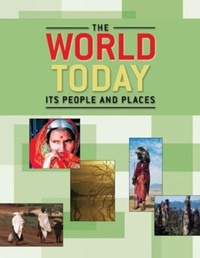
The World Today
Its People and Places
Will be published approx. on 17. August 2006
Book
Hardback
315 pages
978-1-55379-082-2 (ISBN)
Description
This exciting student textbook presents a contemporary global look at human geography. The World Today: Its People and Places connects your students to different cultures and geographical areas and helps them develop a sense of global awareness and responsible citizenship.
This engaging textbook includes unique and interesting features designed to help your students become geographically literate. Explore the world with your students using:
hundreds of illustrations and stunning photographs of people and places
detailed maps, charts, and graphs
quotations from contemporary international and Canadian public figures
hundreds of glossary terms conveniently highlighted in the text
guiding questions; concluding and summary comments
Special-interest icons that appear throughout the textbook guide your students to further learning adventures, discussion topics, media investigations, opportunities for developing social studies skills, informative Internet sites, and much more. Recommended by Manitoba Education, Citizenship and Youth as a Manitoba grade 7 social studies learning resource.
This engaging textbook includes unique and interesting features designed to help your students become geographically literate. Explore the world with your students using:
hundreds of illustrations and stunning photographs of people and places
detailed maps, charts, and graphs
quotations from contemporary international and Canadian public figures
hundreds of glossary terms conveniently highlighted in the text
guiding questions; concluding and summary comments
Special-interest icons that appear throughout the textbook guide your students to further learning adventures, discussion topics, media investigations, opportunities for developing social studies skills, informative Internet sites, and much more. Recommended by Manitoba Education, Citizenship and Youth as a Manitoba grade 7 social studies learning resource.
More details
Language
English
Place of publication
Canada
Target group
Children/juvenile
US School Grade: Second Grade, Interest Age: From 12 to 13 years
Product notice
sewn/stitched
Illustrations
Illustrations
Dimensions
Height: 279 mm
Width: 216 mm
Thickness: 23 mm
Weight
1247 gr
ISBN-13
978-1-55379-082-2 (9781553790822)
Copyright in bibliographic data and cover images is held by Nielsen Book Services Limited or by the publishers or by their respective licensors: all rights reserved.
Schweitzer Classification
Other editions
Additional editions
E-Book
09/2021
Portage & Main Press
€56.99
Available for download
Persons
William Norton, PhD, is a professor in the Department of Environment and Geography at the University of Manitoba. He previously taught at Rhodes University (Grahamstown, South Africa), State University of New York College at Buffalo (USA), Sheffield University (England), and Memorial University at Cornerbrook in Newfoundland. He has been Visiting Research Fellow at the University of Melbourne (Australia), and served as the invited Paul F. Sharpe lecturer at the Comparative Frontier Studies Conference, University of Oklahoma (Norman, USA). William's principal teaching and research interests are in Cultural and Social Geography, Historical Geography, History and Methodology of Geography, Geographic Education, and the Geography of Canada.
Michele Visser-Wikkerink has been published in the Winnipeg Free Press, The Banner, and Geez magazine. Other writings include Hunger in a World of Abundance: A Study Guide, and Refugees and Exiles: A Canadian Perspective. She is currently writing a history of the Canadian Foodgrains Bank and ghost-writing a memoir. Michele's areas of expertise include food and justice issues, social concerns, Canadian history, and freelance recipe development. She is a member of the Manitoba Writer's Guild.
Michele Visser-Wikkerink has been published in the Winnipeg Free Press, The Banner, and Geez magazine. Other writings include Hunger in a World of Abundance: A Study Guide, and Refugees and Exiles: A Canadian Perspective. She is currently writing a history of the Canadian Foodgrains Bank and ghost-writing a memoir. Michele's areas of expertise include food and justice issues, social concerns, Canadian history, and freelance recipe development. She is a member of the Manitoba Writer's Guild.
Content
ContentsIntroduction: Thinking Geographically
Section I: Describing this Planet
1 Where in the World
2 Our Physical World
3 Our Human World
Section II: Well-Being around the World
4 Quality of Life
5 Universal Human Rights
6 Democratic Values and Principles
7 Power and Wealth in Today's World
8 Working Together around the Globe
Section III: Societies and Ways of Life
9 Society and Culture
10 Adapting to the Natural Environment
11 Indigenous Peoples of the World
12 Comparing Cultural Expressions
13 Changing Peoples and Places
14 Health and Well-Being across the World
Section IV: Ecological Effects of Modern Societies
15 Peoples and Places of Europe
16 Peoples and Places of the Americas
17 Influences of the Past
18 Moving to the Cities
19 Toward a Sustainable World
20 Sharing the Planet
Conclusion: Making Sense of the World Today
Index
Credits
Section I: Describing this Planet
1 Where in the World
2 Our Physical World
3 Our Human World
Section II: Well-Being around the World
4 Quality of Life
5 Universal Human Rights
6 Democratic Values and Principles
7 Power and Wealth in Today's World
8 Working Together around the Globe
Section III: Societies and Ways of Life
9 Society and Culture
10 Adapting to the Natural Environment
11 Indigenous Peoples of the World
12 Comparing Cultural Expressions
13 Changing Peoples and Places
14 Health and Well-Being across the World
Section IV: Ecological Effects of Modern Societies
15 Peoples and Places of Europe
16 Peoples and Places of the Americas
17 Influences of the Past
18 Moving to the Cities
19 Toward a Sustainable World
20 Sharing the Planet
Conclusion: Making Sense of the World Today
Index
Credits