


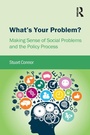
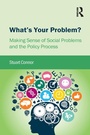
What's Your Problem?
Making Sense of Social Problems and the Policy Process
1st Edition
Published on 31. March 2025
Book
Hardback
184 pages
978-1-041-05791-8 (ISBN)
Description
This lively book provides an essential introduction to the critical analysis of social problems and the policy process. It argues that policy does not just have an impact of people's lives, but that people can and should have an impact on policy.
Rather than assuming that social policies reflect an inevitable response to pre-existing givens, the author adopts a more proactive position to show how a 'problem' is fabricated and how a particular response to a 'problem' is legitimated. He goes on to demonstrate how the struggle over the meaning and desirable response to a range of social issues continues to take place not only in Parliament, but across broadcast and print media and the numerous internet channels. The book provides students, practitioners and activists with a rationale for and means to read, write and perform policy analysis.
Drawing on the notion of policy literacy, readers will be introduced to a range of resources to enable them to further develop the ability to both read (comprehend), write (create, design, produce) and perform (influence and shape) policies. The book is illustrated throughout with examples from historical and contemporary representations of social problems and local, national and global policy making and practice. Each section will make reference to a toolkit that tutors, student and activists can access to help inform their practice.
Presented in an accessible format, the book demonstrates that making sense of social issues and the policy process, also means making sense of some of the fundamental questions, values and assumptions of how is / should society be organised and our own role in the shaping of society. In this way the book not only provides practical and critical insights into the policy process, but is also an intellectually challenging and stimulating read.
Rather than assuming that social policies reflect an inevitable response to pre-existing givens, the author adopts a more proactive position to show how a 'problem' is fabricated and how a particular response to a 'problem' is legitimated. He goes on to demonstrate how the struggle over the meaning and desirable response to a range of social issues continues to take place not only in Parliament, but across broadcast and print media and the numerous internet channels. The book provides students, practitioners and activists with a rationale for and means to read, write and perform policy analysis.
Drawing on the notion of policy literacy, readers will be introduced to a range of resources to enable them to further develop the ability to both read (comprehend), write (create, design, produce) and perform (influence and shape) policies. The book is illustrated throughout with examples from historical and contemporary representations of social problems and local, national and global policy making and practice. Each section will make reference to a toolkit that tutors, student and activists can access to help inform their practice.
Presented in an accessible format, the book demonstrates that making sense of social issues and the policy process, also means making sense of some of the fundamental questions, values and assumptions of how is / should society be organised and our own role in the shaping of society. In this way the book not only provides practical and critical insights into the policy process, but is also an intellectually challenging and stimulating read.
Reviews / Votes
Yes, law and policy as supplementary reading. I like the fact it is smalland offers a different approach to most books looking at social policy.
- Liam Foster, University of SheffieldThe book is very thought provoking and potentially helpful to Social Work Students grappling with the broad menu of social policy issues. I would recommend this as background reading. The book essentially sets out to 'demystify' social policy in a suitably robust yet engaging way that should lead readers to see the world around them in a slightly clearer manner regarding politics, policy and media/cultural/community drivers for change.
- Scott Parker, University of Northampton
More details
Language
English
Place of publication
London
United Kingdom
Publishing group
Taylor & Francis Ltd
Target group
Adult education
Undergraduate Core
Dimensions
Height: 174 mm
Width: 111 mm
Weight
220 gr
ISBN-13
978-1-041-05791-8 (9781041057918)
Copyright in bibliographic data and cover images is held by Nielsen Book Services Limited or by the publishers or by their respective licensors: all rights reserved.
Schweitzer Classification
Other editions
Additional editions
E-Book
02/2025
Routledge
€27.49
Available for download
E-Book
02/2025
Routledge
€27.49
Available for download

Book
09/2013
1st Edition
Critical Publishing Ltd
€33.20
Shipment within 3-4 weeks
Person
Stuart Connor is a lecturer in social policy at the University of Birmingham. His teaching and research interests include critical approaches to the analysis of contemporary social policy and practice. This work includes examining the role of governments, trade unions, NGOs, social movements and community practitioners in the fabrication of 'social problems' and attempts to legitimate and challenge particular policy responses.
Content
Introduction Section 1 - Reading policy Chapter 1 - Making claims and using frames Chapter 2 - Equivalence and difference Chapter 3 - Legitimate assumptions Section 2 - Writing policy Chapter 4 - The role of the analyst Chapter 5 - What do you think? Chapter 6 - Making your case Section 3 - Performaing Policy Chapter 7 - Models of the Policy Process Chapter 8 - Power and Influence Chapter 9 - Making a difference Conclusion