

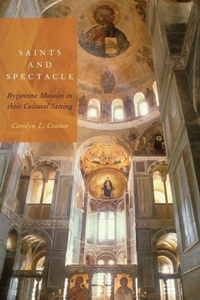
Saints and Spectacle
Byzantine Mosaics in their Cultural Setting
Published on 10. March 2016
Book
Hardback
232 pages
978-0-19-045762-4 (ISBN)
Description
Saints and Spectacle examines the origins and reception of the Middle Byzantine program of mosaic decoration. This complex and colorful system of images covers the walls and vaults of churches with figures and compositions seen against a dazzling gold ground. The surviving eleventh-century churches with their wall and vault mosaics largely intact, Hosios Loukas, Nea Moni and Daphni in Greece, pose the challenge of how, when and where this complex and
gloriously conceived system was created.
Using an interdisciplinary approach, Connor explores the urban culture and context of church-building in Constantinople, capital of the Byzantine Empire, during the century following the end of Iconoclasm, of around 843 to 950. The application of an innovative frame of reference, through ritual studies, helps recreate the likely scenario in which the medium of mosaics attained its highest potential, in the mosaiced Byzantine church. For mosaics were enlisted to convey a religious and political
message that was too nuanced to be expressed in any other way. At a time of revival of learning and the arts, and development of ceremonial practices, the Byzantine emperor and patriarch were united in creating a solution to the problem of consolidating the Greek Orthodox Byzantine Empire. It was
through promoting a vision of the unchallengeable authority residing in God and his earthly representative, the emperor. The beliefs and processional practices affirming the protective role of the saints in which the entire city participated, were critical to the reception of this vision by the populace as well as the court. Mosaics were a luxury medium that was ideally situated aesthetically to convey a message at a particularly important historical moment-a brilliant solution to a problem
that was to subtly unite an empire for centuries to come. Supported by a wealth of testimony from literary sources, Saints and Spectacle brings the Middle Byzantine church to life as the witness to a compelling and fascinating drama.
gloriously conceived system was created.
Using an interdisciplinary approach, Connor explores the urban culture and context of church-building in Constantinople, capital of the Byzantine Empire, during the century following the end of Iconoclasm, of around 843 to 950. The application of an innovative frame of reference, through ritual studies, helps recreate the likely scenario in which the medium of mosaics attained its highest potential, in the mosaiced Byzantine church. For mosaics were enlisted to convey a religious and political
message that was too nuanced to be expressed in any other way. At a time of revival of learning and the arts, and development of ceremonial practices, the Byzantine emperor and patriarch were united in creating a solution to the problem of consolidating the Greek Orthodox Byzantine Empire. It was
through promoting a vision of the unchallengeable authority residing in God and his earthly representative, the emperor. The beliefs and processional practices affirming the protective role of the saints in which the entire city participated, were critical to the reception of this vision by the populace as well as the court. Mosaics were a luxury medium that was ideally situated aesthetically to convey a message at a particularly important historical moment-a brilliant solution to a problem
that was to subtly unite an empire for centuries to come. Supported by a wealth of testimony from literary sources, Saints and Spectacle brings the Middle Byzantine church to life as the witness to a compelling and fascinating drama.
Reviews / Votes
"Carolyn Connor lays out the Constantinopolitan origins of one of the greatest achievements of Byzantine civilization, the mosaic programs of Middle Byzantine churches. Exploring the imperial, intellectual, and ritual contexts of their system, Connor provides a striking new interpretation of familiar monuments, viewing them as reflections of the ordering of medieval Byzantine society." -- Henry Maguire, Johns Hopkins University "Saints and Spectacle represents a valuable supplement to the classic postwar work on Byzantine mosaic by Otto Demus. Told with sympathy, clarity, and care, it brings these multi-media performances back to life in ways not often seen in contemporary Byzantine scholarship. Anyone interested in the moving theatre of medieval ritual and art will find this text and its fine illustrations compelling reading." -- Glenn Peers, University of Texas at AustinMore details
Other editions
Additional editions
E-Book
03/2016
1st Edition
OUP eBook
€43.49
Available for download
E-Book
02/2016
1st Edition
OUP eBook
€60.99
Available for download
Person
Carolyn Connor is Professor Emerita of Classics at the University of North Carolina, Chapel Hill. Her teaching and scholarship in Byzantine Studies integrate art and architecture, literary texts, religious beliefs, and the historical record. She is the author of four books.
Content
List of Illustrations; Abbreviations; Acknowledgments; Introduction; Chapter One Byzantine Mosaics: Appearance and Character; Chapter Two The Lost Mosaics of Constantinople and the Middle Byzantine Program of Church Decoration; Chapter Three Urban Culture of the Ninth and Tenth Centuries; Chapter Four Feasting the Saints: The Sanctoral Topography of Constantinople; Chapter Five Mosaics as a Ritual Art: Byzantine Mosaics at Work; Appendices; Bibliography; Index