

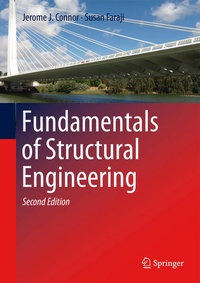
Fundamentals of Structural Engineering
2nd Edition
Published on 2. March 2016
Book
Hardback
XXVII, 1050 pages
978-3-319-24329-0 (ISBN)
Description
This updated textbook provides a balanced, seamless treatment of both classic, analytic methods and contemporary, computer-based techniques for conceptualizing and designing a structure. New to the second edition are treatments of geometrically nonlinear analysis and limit analysis based on nonlinear inelastic analysis. Illustrative examples of nonlinear behavior generated with advanced software are included.
The book fosters an intuitive understanding of structural behavior based on problem solving experience for students of civil engineering and architecture who have been exposed to the basic concepts of engineering mechanics and mechanics of materials. Distinct from other undergraduate textbooks, the authors of Fundamentals of Structural Engineering, 2/e embrace the notion that engineers reason about behavior using simple models and intuition they acquire through problem solving. The perspective adopted in this text therefore develops this type of intuition by presenting extensive, realistic problems and case studies together with computer simulation, allowing for rapid exploration of how a structure responds to changes in geometry and physical parameters. The integrated approach employed in Fundamentals of Structural Engineering, 2/e make it an ideal instructional resource for students and a comprehensive, authoritative reference for practitioners of civil and structural engineering.
The book fosters an intuitive understanding of structural behavior based on problem solving experience for students of civil engineering and architecture who have been exposed to the basic concepts of engineering mechanics and mechanics of materials. Distinct from other undergraduate textbooks, the authors of Fundamentals of Structural Engineering, 2/e embrace the notion that engineers reason about behavior using simple models and intuition they acquire through problem solving. The perspective adopted in this text therefore develops this type of intuition by presenting extensive, realistic problems and case studies together with computer simulation, allowing for rapid exploration of how a structure responds to changes in geometry and physical parameters. The integrated approach employed in Fundamentals of Structural Engineering, 2/e make it an ideal instructional resource for students and a comprehensive, authoritative reference for practitioners of civil and structural engineering.
More details
Edition
2nd ed. 2016
Language
English
Place of publication
Cham
Switzerland
Publishing group
Springer International Publishing
Target group
Upper undergraduate
Edition type
Revised edition
Illustrations
754 s/w Abbildungen, 146 farbige Abbildungen
XXVII, 1050 p. 900 illus., 146 illus. in color.
Dimensions
Height: 260 mm
Width: 183 mm
Thickness: 59 mm
Weight
2425 gr
ISBN-13
978-3-319-24329-0 (9783319243290)
DOI
10.1007/978-3-319-24331-3
Schweitzer Classification
Other editions
Additional editions
Jerome J. Connor | Susan Faraji
Fundamentals of Structural Engineering
Book
04/2018
2nd Edition
Springer
€106.99
Shipment within 10-15 days
Jerome J. Connor | Susan Faraji
Fundamentals of Structural Engineering
E-Book
02/2016
2nd Edition
Springer
€90.94
Available for download
Previous edition
Jerome J. Connor | Susan Faraji
Fundamentals of Structural Engineering
Book
06/2013
Springer
€117.69
Article exhausted; check for reprint
Persons
Dr. Jerome J. Connor
is Professor of Civil Engineering at Massachusetts Institute of Technology. His research interests include computational mechanics, structural analysis, motion based structural design, and novel design methodologies for structural systems and has taught courses in computational mechanics and structural engineering. In recent years Connor's work has involved motion based design and damage assessment of engineering materials and he is directing a number of projects related to the applications of structural control to large civil structures as well as investigating methods to quantify damage in engineering materials.
Dr. Susan Faraji has been Professor of Structural Engineering in the Department of Civil and Environmental Engineering at the University of Massachusetts at Lowell since 1984. Dr. Faraji has close to three decades of teaching, research, publication, and consulting experience and has taught a wide range of courses at the undergraduateand at the graduate level, such as Concrete Design, Steel Design, Bridge Design, Seismic Design, Concrete Design, Finite Elements, Structural Dynamics, and Behavior of Structures. Her professional work involves the analysis, design (using the latest design codes), and computer modeling of a wide range of structures. She has worked on more than 30 bridges and on aircraft, elevators, pontoons, ramps, concrete parking garages, domes, culverts, retaining walls, and steel and concrete frame buildings.
Dr. Susan Faraji has been Professor of Structural Engineering in the Department of Civil and Environmental Engineering at the University of Massachusetts at Lowell since 1984. Dr. Faraji has close to three decades of teaching, research, publication, and consulting experience and has taught a wide range of courses at the undergraduateand at the graduate level, such as Concrete Design, Steel Design, Bridge Design, Seismic Design, Concrete Design, Finite Elements, Structural Dynamics, and Behavior of Structures. Her professional work involves the analysis, design (using the latest design codes), and computer modeling of a wide range of structures. She has worked on more than 30 bridges and on aircraft, elevators, pontoons, ramps, concrete parking garages, domes, culverts, retaining walls, and steel and concrete frame buildings.
Content
Part I - Statically Determinate Structures.- 1.Introduction to Structural Engineering.- 2.Statically Determinate Truss Structures.- 3.Statically Determinate Beams.- 4.Statically Determinate Plane Frames.- 5. Cable Structures.- 6.Statically Determinate Curved Members.- 7.Shallow Foundations.- 8. Vertical Retaining Wall Structures.- Part II- Statically Indeterminate Structures.- 9.The Force Method.- 10.The Displacement Method.- 11.Approximate Methods for Estimating Forces in Statically Indeterminate Structures.- 12. Finite Element Displacement Method for Framed Structures.- Part III- Practice of Structural Engineering.- 13.Multi-span Horizontal Structures.- 14.Lateral Load Issues for Buildings.- 15.Vertical Loads on Multistory Buildings.- 15.Vertical Loads on Multistory Buildings.- 16.Inelastic Response of Structures.