

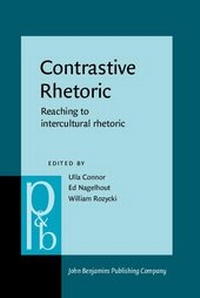
Contrastive Rhetoric
Reaching to intercultural rhetoric
Published on 9. January 2008
Book
Hardback
324 pages
978-90-272-5413-9 (ISBN)
Description
This volume explores contrastive rhetoric for audiences in both ESL contexts and international EFL contexts, exposing the newest developments in theories of culture and discourse and pushing the boundaries beyond any previously staked ground. The book presents a comprehensive set of empirical investigations involving a number of first languages; 13 of the 17 authors are English-as-a-second-language speakers, many working in non-US contexts. This work develops a coherent agenda for contrastive rhetoric researchers, studying genres such as school writing, grant proposals, business letters, newspaper editorials, book reviews, and newspaper commentaries. Four chapters provide ethnographies and observations about contrastive rhetoric and the teaching of EFL and ESL. The book ends with a look to the future, suggesting it is more accurate to use the term 'intercultural rhetoric' to account for the richness of rhetoric variation of written texts and the varying contexts in which they are constructed.
More details
Series
Language
English
Place of publication
Amsterdam
Netherlands
Target group
Adult education
Professional and scholarly
Dimensions
Height: 245 mm
Width: 164 mm
Weight
725 gr
ISBN-13
978-90-272-5413-9 (9789027254139)
Copyright in bibliographic data and cover images is held by Nielsen Book Services Limited or by the publishers or by their respective licensors: all rights reserved.
Schweitzer Classification
Other editions
Additional editions
E-Book
01/2008
1st Edition
John Benjamins Publishing Company
€130.99
Available for download
Persons
Content
1. Introduction (by Connor, Ulla); 2. Section I. Current state of contrastive rhetoric; 3. From contrastive rhetoric to intercultural rhetoric: A search for collective identity (by Li, Xiaoming); 4. The importance of comparable corpora in cross-cultural studies (by Moreno, Ana I.); 5. Section II. Contrastive corpus studies in specific genres; 6. Metadiscourse across three varieties of English: American, British, and advanced learner English (by Adel, Annelie); 7. A genre-based study of research grant proposals in China (by Feng, Haiying); 8. Different cultures - different discourses? Rhetorical patterns of business letters by English and Russian speakers (by Wolfe, Maria Loukianenko); 9. Spanish language newspaper editorials from Mexico, Spain, and the U.S. (by Pak, Chin-Sook); 10. The rhetorical structure of academic book reviews of literature: An English-Spanish cross-linguistic approach (by Suarez, Lorena); 11. Newspaper commentaries on terrorism in China and Australia: A contrastive genre study (by Wang, Wei); 12. Section III. Contrastive rhetoric and the teaching of ESL/EFL writing; 13. "Long sentences and floating commas": Mexican students' rhetorical practices and the sociocultural context (by LoCastro, Virginia); 14. English web page use in an EFL setting: A contrastive rhetoric view of the development of information literacy (by McBride, Kara); 15. From Confucianism to Marxism: A century of theme treatment in Chinese writing instruction (by You, Xiaoye); 16. Plagiarism in an intercultural rhetoric context: What we can learn about one from the other (by Bloch, Joel); 17. Section IV. Future directions; 18. A conversation on contrastive rhetoric: Dwight Atkinson and Paul Kei Matsuda talk about issues, conceptualizations, and the future of contrastive rhetoric (by Matsuda, Paul Kei); 19. Mapping multidimensional aspects of research: Reaching to intercultural rhetoric (by Connor, Ulla); 20. Notes on contributors; 21. Index