

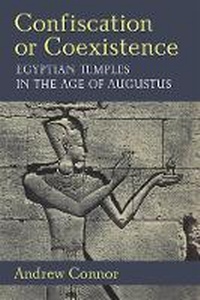
Confiscation or Coexistence
Egyptian Temples in the Age of Augustus
Published on 24. October 2022
Book
Hardback
238 pages
978-0-472-13322-2 (ISBN)
Description
It is generally accepted that Roman administrators, arriving in Egypt in the aftermath of Augustus' annexation of the province, confiscated en masse the land and other property belonging to the temples of Egypt-estimated at as much as one-third of the country. It is further accepted that this confiscation doomed the temples by removing their economic support and making them subservient to the Roman state, and that this in turn led to the collapse of Egyptian religion. In Confiscation or Coexistence: Egyptian Temples in the Age of Augustus, author Andrew Connor takes direct issue with both claims.
The interpretative consensus developed after the publication of a handful of key documents-P.Tebt. 2.302 especially, alongside BGU 4.1198 and 1200, and P.Berl.Leihg. 1.5. Connor offers a fundamentally revised interpretation of these texts, building from a fresh examination of the papyri themselves. The book frames the interpretation in a wider discussion of Roman interactions with Egyptian religion, including material from inside and outside Egypt, and locates the development of an interpretative consensus in early 20th-century scholarship within the wider context of empire and colonization at the time. In doing so, Connor explores these papyri through their historical, intellectual, and linguistic contexts, alongside a number of other important texts bearing on the relationship between the temples and the Roman state.
The interpretative consensus developed after the publication of a handful of key documents-P.Tebt. 2.302 especially, alongside BGU 4.1198 and 1200, and P.Berl.Leihg. 1.5. Connor offers a fundamentally revised interpretation of these texts, building from a fresh examination of the papyri themselves. The book frames the interpretation in a wider discussion of Roman interactions with Egyptian religion, including material from inside and outside Egypt, and locates the development of an interpretative consensus in early 20th-century scholarship within the wider context of empire and colonization at the time. In doing so, Connor explores these papyri through their historical, intellectual, and linguistic contexts, alongside a number of other important texts bearing on the relationship between the temples and the Roman state.
Reviews / Votes
"Andrew Connor is careful, methodical, and thorough as he reexamines the accepted history that temple property in Egypt was widely confiscated throughout Egypt by the Roman imperial powers. ...A superb example of historical research at its best." -- New York Journal of Books "Connor's monograph is, in sum, a masterful work of ancient (revisionary) history that will interest classicists, historians, and scholars of ancient Mediterranean religion(s) at large." -- Religious Studies Review "Connor's carefully researched book provides a fresh understanding of the key document and its property dispute, which does not attest province-wide policy, but a localized quarrel. By explaining in detail why he is refuting the confiscation narrative, he has contributed a vital basis for further interdisciplinary explorations of Roman Egypt." -- Journal of Roman Studies "The logic of these arguments is compelling, and historians of Roman Egypt should certainly discard any illusions of a wholesale confiscation (or reappropriation) of temple land under Augustus." -- The Classical ReviewMore details
Series
Language
English
Place of publication
Ann Arbor
United States
Target group
Professional and scholarly
Illustrations
5 illustrations
Dimensions
Height: 229 mm
Width: 152 mm
ISBN-13
978-0-472-13322-2 (9780472133222)
DOI
https://doi.org/10.3998/mpub.12220891
Copyright in bibliographic data and cover images is held by Nielsen Book Services Limited or by the publishers or by their respective licensors: all rights reserved.
Schweitzer Classification
Person
Content
Table of Contents
Acknowledgments
Chapter 1: Introduction
PART I: CONTEXTS
Chapter 2 Bastards and the Temple: Legitimacy and Rhetoric in Priestly Petitions
Chapter 3 Crocodile Tears: A Rhetoric of Loss and of Chaos
Chapter 4 "No one can claim the priestly land":
Land, disputes, and a new interpretation
PART II: BARKING ANUBIS
Chapter 5 Motivations and Confiscations: Religious control in context
Chapter 6 Unforeseen Consequences: Confiscation in practice
Chapter 7 "Tear the monument of such a monster to pieces":
Creating a modern confiscation
Appendix: P.Tebt. 2.302: Text(s) and Translation
Bibliography
Index of sources
General index
Acknowledgments
Chapter 1: Introduction
PART I: CONTEXTS
Chapter 2 Bastards and the Temple: Legitimacy and Rhetoric in Priestly Petitions
Chapter 3 Crocodile Tears: A Rhetoric of Loss and of Chaos
Chapter 4 "No one can claim the priestly land":
Land, disputes, and a new interpretation
PART II: BARKING ANUBIS
Chapter 5 Motivations and Confiscations: Religious control in context
Chapter 6 Unforeseen Consequences: Confiscation in practice
Chapter 7 "Tear the monument of such a monster to pieces":
Creating a modern confiscation
Appendix: P.Tebt. 2.302: Text(s) and Translation
Bibliography
Index of sources
General index