

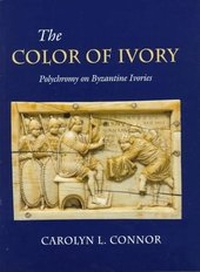
The Color of Ivory
Polychromy on Byzantine Ivories
Published on 22. March 1998
Book
Hardback
164 pages
978-0-691-04818-5 (ISBN)
Description
Carolyn Connor shows here that Byzantine ivory carvings - often assumed to have been monochromatic - were originally brightly colored. Most ivories today show no obvious traces of paint or stain, and many scholars believe that the Byzantines preferred the aesthetic of ivory's natural, creamy color. However, Connor's close examination of one hundred Late Antique and Byzantine ivories reveals that artists frequently colored ivories in bright hues of red, blue, green, and gold. Intrigued by barely visible traces of paint or stain, Connor subjected such ivory objects as boxes, plaques, and book covers to scientific analysis. Under the microscope, she saw that their surfaces were once ablaze with color, while tests identified the actual pigments. Her findings, presented here, demonstrate that the ivories were colored and that the paint or stain - which does not adhere well to the surface of ivory - either wore off or was cleaned away. She draws on the work of archaeologists, classicists, historians, and art historians to show that this color was almost certainly original and not, as many scholars have assumed, a medieval or later addition.
The author also locates Byzantine ivories within a long tradition of colored ivory going back, for example, to a painted chest found in the tomb of the Egyptian boy-king Tutankhamen. Connor's close study and contextualizing of a significant group of ivories will reshape our thinking about color, culture, and art.
The author also locates Byzantine ivories within a long tradition of colored ivory going back, for example, to a painted chest found in the tomb of the Egyptian boy-king Tutankhamen. Connor's close study and contextualizing of a significant group of ivories will reshape our thinking about color, culture, and art.
Reviews / Votes
The debate about whether medieval ivories might originally have been coloured has been a long-running one. Since Winckelmann, the ideal of purity has been intrinsic to the appreciation of much sculpture, above all to the study of ivory, which has a colour of its own and a beauty of material appreciated for its grain and gloss. Carolyn Connor's book, a survey of the results of her Byzantine ivories project, deals with the issue conclusively. She proves finally that late antique and Byzantine ivories were painted and gilded and thus effectively silences this dispute ... Connor's book is significant in answering the polychromy question. It provides the first important step towards a reassessment of the aesthetics of Byzantine colour perception and reveals the need for much more analysis and discussion. Burlington MagazineMore details
Language
English
Place of publication
New Jersey
United States
Target group
Professional and scholarly
College/higher education
Product notice
Trade binding
Illustrations
17 farbige Bildtafeln, 12 Fotos bzw. Rasterbilder, 7 Abbildungen
17 color plates 12 halftones 7 line illus.
Dimensions
Height: 254 mm
Width: 178 mm
Weight
595 gr
ISBN-13
978-0-691-04818-5 (9780691048185)
Copyright in bibliographic data and cover images is held by Nielsen Book Services Limited or by the publishers or by their respective licensors: all rights reserved.
Schweitzer Classification
Person
Carolyn L. Connor is Assistant Professor of Classics at the University of North Carolina at Chapel Hill. She is the author of Art and Miracles in Medieval Byzantium (Princeton).
Content
<TABLE><TR><TD> <TD>List of Illustrations <TR><TD>Ch. 1 <TD>Color on Byzantine Ivories <TR><TD>Ch. 2 <TD>Colors, Pigments, and Pigment Analysis <TR><TD>Ch. 3 <TD>The Ancient Tradition of Polychrome Ivories <TR><TD>Ch. 4 <TD>The Testimony of Ancient and Medieval Texts <TR><TD>Ch. 5 <TD>Color on Ivory and the Byzantine Aesthetic <TR><TD> <TD>Conclusion: Shifting the Paradigm <TR><TD>Appendix A <TD>Ivories Project Database <TR><TD>Appendix B <TD>Diagrams of Joshua Ivories <TR><TD> <TD>Notes <TR><TD> <TD>Bibliography <TR><TD> <TD>Index