

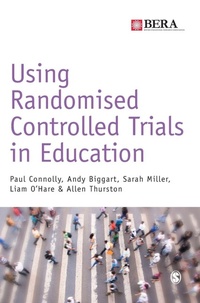
Using Randomised Controlled Trials in Education
1st Edition
Published on 27. July 2017
Book
Hardback
200 pages
978-1-4739-0282-4 (ISBN)
Description
The use of randomised controlled trials (RCTs), most commonly a medical sciences research tool, is a hotly debated topic in Education. This book examines the controversial aspects of RCTs in Education and sets out the potential and pitfalls of the method.
Drawing on their own extensive experience of running RCTs, and their work at the Centre for Evidence and Social Innovation (CESI) at Queen's University, Belfast, the authors provide a thorough practical introduction to the use of randomised controlled trials in education. Using real data sets, chapters equip the reader with all of the key knowledge and skills required to design, run, analyse and report an RCT.
Coverage includes:
? Step-by-step guidance on analysing data
? How to assess the reliability and validity of results
? Advice on balancing the demands of various stakeholders
Essential reading for postgraduate and more experienced researchers, as well as teachers and educationalists seeking to increase their knowledge and understanding of the use of such methods in education.
Drawing on their own extensive experience of running RCTs, and their work at the Centre for Evidence and Social Innovation (CESI) at Queen's University, Belfast, the authors provide a thorough practical introduction to the use of randomised controlled trials in education. Using real data sets, chapters equip the reader with all of the key knowledge and skills required to design, run, analyse and report an RCT.
Coverage includes:
? Step-by-step guidance on analysing data
? How to assess the reliability and validity of results
? Advice on balancing the demands of various stakeholders
Essential reading for postgraduate and more experienced researchers, as well as teachers and educationalists seeking to increase their knowledge and understanding of the use of such methods in education.
Reviews / Votes
This is essential reading for anyone getting to grips with running an RCT in schools. It demystifies the statistical analysis of trials data. Coverage of the historical controversy surrounding the method, in conjunction with guidance on reporting, provides a measured view of the role of experiments in education research. -- Ben StylesMore details
Series
Edition
First Edition
Language
English
Place of publication
London
United Kingdom
Target group
College/higher education
Professional and scholarly
Dimensions
Height: 250 mm
Width: 175 mm
Thickness: 16 mm
Weight
537 gr
ISBN-13
978-1-4739-0282-4 (9781473902824)
Copyright in bibliographic data and cover images is held by Nielsen Book Services Limited or by the publishers or by their respective licensors: all rights reserved.
Schweitzer Classification
Other editions
Additional editions
Paul Connolly | Andy Biggart | Sarah Miller
Using Randomised Controlled Trials in Education
Book
07/2017
1st Edition
SAGE Publications Ltd
€81.50
Shipment within 15-20 days
Paul Connolly | Andy Biggart | Sarah Miller
Using Randomised Controlled Trials in Education
E-Book
07/2017
1st Edition
SAGE Publications Ltd
€73.49
Available for download
Paul Connolly | Andy Biggart | Sarah Miller
Using Randomised Controlled Trials in Education
E-Book
07/2017
1st Edition
SAGE Publications Ltd
€73.49
Available for download
Persons
Paul Connolly is an award-winning journalist and author whose work has appeared in the Monthly, Guardian Australia, the Age, and the Sydney Morning Herald. The author of the weekly flash fiction column 'Kitchen Sink Drama' in Good Weekend magazine, he has written and edited a number of books. These include Kitchen Sink Drama, Father Figures, Sucking the Marrow Out of Life, and The World's Weirdest Sports. He lives in Brunswick, Melbourne, with his partner and their two daughters. He played football throughout his youth and the older he gets, the better he was.
Content
Introduction
1 What RCTs Can and Cannot Tell Us
2 Logic Models and Outcome Measures
3 Research Designs for RCTs
4 The Fundamentals of Analysing RCT Data
5 Dealing with the Analysis of More Complex RCT Designs
6 How to Report RCTs and Synthesise Evidence from Different Trials
1 What RCTs Can and Cannot Tell Us
2 Logic Models and Outcome Measures
3 Research Designs for RCTs
4 The Fundamentals of Analysing RCT Data
5 Dealing with the Analysis of More Complex RCT Designs
6 How to Report RCTs and Synthesise Evidence from Different Trials