

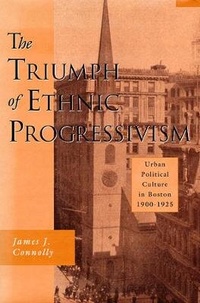
The Triumph of Ethnic Progressivism
Urban Political Culture in Boston, 1900-1925
Published on 15. September 1998
Book
Hardback
272 pages
978-0-674-90950-2 (ISBN)
Description
Progressivism, James Connolly shows us, was a language and style of political action available to a wide range of individuals and groups. A diverse array of political and civic figures used it to present themselves as leaders of a communal response to the growing power of illicit interests and to the problems of urban-industrial life. As structural reforms weakened a ward-based party system that helped mute ethnic conflict, this new formula for political mobilization grew more powerful. Its most effective variation in Boston was an "ethnic progressivism" that depicted the city's public life as a clash between its immigrant majority-"the people"-and a wealthy Brahmin elite-"the interests." As this portrayal took hold, Bostonians came to view their city as a community permanently beset by ethnic strife.
In showing that the several reform visions that arose in Boston included not only the progressivism of the city's business leaders but also a series of ethnic progressivisms, Connolly offers a new approach to urban public life in the early twentieth century. He rejects the assumption that ethnic politics was machine politics and employs both institutional and rhetorical analysis to reconstruct the inner workings of neighborhood public life and the social narratives that bound the city together. The result is a deeply textured picture that differs sharply from the traditional view of machine-reform conflict.
In showing that the several reform visions that arose in Boston included not only the progressivism of the city's business leaders but also a series of ethnic progressivisms, Connolly offers a new approach to urban public life in the early twentieth century. He rejects the assumption that ethnic politics was machine politics and employs both institutional and rhetorical analysis to reconstruct the inner workings of neighborhood public life and the social narratives that bound the city together. The result is a deeply textured picture that differs sharply from the traditional view of machine-reform conflict.
Reviews / Votes
The Triumph of Ethnic Progressivism is absolutely 'must reading' for anyone interested in Progressive Era municipal reform or ethnocultural politics. At the very least, it is the best history to date of that crucial period in Boston's history, as well as an excellent model for similar studies of other major cities during the same era. The sections that focus on what Connolly dubs a 'ground-level analysis' of Boston politics are exceptionally well constructed, exhaustively documented, and cogently presented. Viewed in a wider perspective, the author has succeeded in challenging almost everything we thought we knew about Progressive Era municipal reform and in constructing a provocative new paradigm to encompass the mass of the data informing existing interpretations... It is fair to say that any scholar worth his salt has an intellectual obligation to test his own theories against those proffered by Connolly. -- John D. Buenker * Journal of American History * This provocative reinterpretation of the structures and styles of urban politics advances a number of...counterintuitive arguments and, in the end, largely succeeds. Connolly maps out a new Progressive Boston and defines anew the political struggles and social transformations of the era. -- David Quigley * H-Net Reviews * Historical studies of Progressive Era urban politics depict middle-class reformers pitted against political bosses and machines supported by immigrants. By analyzing Progressive rhetoric, narratives of social identity, grassroots politics, and institutional change, Connolly finds Boston politics more complex... This is a well-written, pathbreaking study; it is highly recommended. -- J. Borchert * Choice * Connolly argues that Progressivism was a style and process rather than a platform or set of programs or beliefs. He contends that 'Progressivism' basically consists of making the claim for speaking on behalf of the people as a whole against selfish particular interests. This book adds an interesting, nuanced dimension to the depiction of shifting electoral politics we have for this era. In its attention to the ways in which the triumph of reformers in the Good Government Association backfired and led to division instead of unity, it provides an important contribution to the fields of political history, history of reform, and social history. -- Sarah Deutsch, Clark University The fullest and most deeply researched account we have of Boston politics at the grassroots in the late nineteenth and early twentieth centuries. Martin Lomasney, Honey Fitz, James Michael Curley, and the rest are all here, but they appear in a fresh light. The interest of the book lies far beyond the reinterpretation of Boston politics that it offers, however; this study is rich with implications for politics and society in other American cities in the era. The author tackles the much-debated and murky problem of what Progressivism at the municipal level was all about. Connolly has demolished every element of the older view, and has advanced a powerful and subtle alternative interpretation of the nature of municipal Progressivism. His case is provocative, penetrating, and thoroughly persuasive. -- Stephan Thernstrom, Harvard UniversityMore details
Language
English
Place of publication
Cambridge, Mass
United States
Target group
College/higher education
Professional and scholarly
Illustrations
1 line illustration, 1 map, 9 tables
Dimensions
Height: 235 mm
Width: 156 mm
Weight
544 gr
ISBN-13
978-0-674-90950-2 (9780674909502)
Copyright in bibliographic data and cover images is held by Nielsen Book Services Limited or by the publishers or by their respective licensors: all rights reserved.
Schweitzer Classification
Other editions
Additional editions
E-Book
07/2009
Harvard University Press
€218.99
Available for download
Person
James J. Connolly is Assistant Professor of History, Ball State University, Muncie, Indiana.
Content
* Introduction * Politics and Society at the End of the Nineteenth Century * The Dimensions of Progressivism * The Politics of Municipal Reform * The New Urban Political Terrain * James Michael Curley and the Politics of Ethnic Progressivism * Ethnic Progressivism Triumphant: Boston Public Life in the 1920s * Epilogue * Statistical Appendix * Selected Primary Sources * Notes * Index