

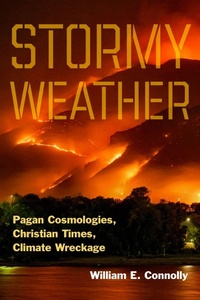
Stormy Weather
Pagan Cosmologies, Christian Times, Climate Wreckage
Published on 3. September 2024
Book
Hardback
272 pages
978-1-5315-0920-0 (ISBN)
Description
Composed as a counter-history of western philosophical and political thought, Stormy Weather explores the role western cosmologies have played in the conquests of paganism in Europe and the Americas, the production of climate wreckage, and the concealment of that wreckage from western humanists and earth scientists until late in the day. A lived cosmology, Connolly says, contains embedded understandings about the beginnings of the earth and the way time unfolds. The text engages the major western cosmologies of Augustine, Descartes, Kant, Tocqueville, together with pagan and minor western orientations that posed challenges to them or could have. Hesiod, Ovid, William Apess, Amazonian and Aztec cosmologies, Catherine Keller's minor Christianity, James Baldwin, and Michel Serres instigate key responses, often challenging binary logics and the subject/object dichotomy with a world of multiple human and nonhuman subjectivities.
Connolly pursues a conception of time as a multiplicity of intersecting temporalities to come to terms with the vicissitudes of climate destruction and the grandeur of an earth neither highly susceptible to mastery nor designed to harmonize smoothly with humans. The book revisits the "improbable necessity" of a politics of swarming to respond to the ongoing wreckage and potential fascist responses to vast infusions of climate refugees from the south into temperate-zone capitalist states.
Stormy Weather draws on the work of earth scientists, indigenous thinkers, naturalists, humanists, and students of nonwestern cosmologies. Ultimately, Connolly contends that critical intellectuals today must not remain enclosed in disciplinary silos, or even in "the humanities" as currently defined, to do justice to our moment of climate wreckage.
Connolly pursues a conception of time as a multiplicity of intersecting temporalities to come to terms with the vicissitudes of climate destruction and the grandeur of an earth neither highly susceptible to mastery nor designed to harmonize smoothly with humans. The book revisits the "improbable necessity" of a politics of swarming to respond to the ongoing wreckage and potential fascist responses to vast infusions of climate refugees from the south into temperate-zone capitalist states.
Stormy Weather draws on the work of earth scientists, indigenous thinkers, naturalists, humanists, and students of nonwestern cosmologies. Ultimately, Connolly contends that critical intellectuals today must not remain enclosed in disciplinary silos, or even in "the humanities" as currently defined, to do justice to our moment of climate wreckage.
More details
Edition
New edition
Language
English
Place of publication
New York
United States
Target group
Professional and scholarly
Edition type
New edition
Product notice
Cloth over boards
Dimensions
Height: 229 mm
Width: 152 mm
Thickness: 19 mm
Weight
535 gr
ISBN-13
978-1-5315-0920-0 (9781531509200)
Copyright in bibliographic data and cover images is held by Nielsen Book Services Limited or by the publishers or by their respective licensors: all rights reserved.
Schweitzer Classification
Other editions
Additional editions
E-Book
09/2024
Fordham University Press
€49.99
Available for download
Person
William E. Connolly is Krieger-Eisenhower Professor emeritus at Johns Hopkins, where he teaches political theory. His books include Resounding Events (Fordham, 2022); Climate Machines, Fascist Drives, and Truth (Duke, 2020); Aspirational Fascism (Minnesota, 2017); Facing the Planetary (Duke, 2017); Capitalism and Christianity, American Style (Duke, 2008); Why I Am Not a Secularist (Minnesota, 1999); The Ethos of Pluralization (Minnesota, 1995); and The Terms of Political Discourse (Princeton, 1983; 3rd ed., 1993). In a poll of American political theorists published in 2010, he was named the fourth most influential political theorist in America over the last twenty years, after Rawls, Habermas, and Foucault.
Content
Introduction: Lived Cosmologies and Climate Wreckage 1
1 Hesiod, Ovid, and a Turbulent Cosmos 18
First Coda: Jocasta, James Baldwin, and Tragic Possibility 45
2 Augustine and the First Conquest of Pagans 58
Second Coda: Catherine Keller and Diverse Christianities 89
3 Todorov, the Second Conquest, and Aztec Cosmology 99
Third Coda: Tocqueville and White Settler Society 124
4 Descartes, Kant, and Amazonian Perspectivism 135
Fourth Coda: Nietzsche and the History of an Error 165
5 Amitav Ghosh, Michel Serres, and the Time of Climate Wreckage 178
Acknowledgments 211
Notes 215
Bibliography 241
Index 251
1 Hesiod, Ovid, and a Turbulent Cosmos 18
First Coda: Jocasta, James Baldwin, and Tragic Possibility 45
2 Augustine and the First Conquest of Pagans 58
Second Coda: Catherine Keller and Diverse Christianities 89
3 Todorov, the Second Conquest, and Aztec Cosmology 99
Third Coda: Tocqueville and White Settler Society 124
4 Descartes, Kant, and Amazonian Perspectivism 135
Fourth Coda: Nietzsche and the History of an Error 165
5 Amitav Ghosh, Michel Serres, and the Time of Climate Wreckage 178
Acknowledgments 211
Notes 215
Bibliography 241
Index 251