

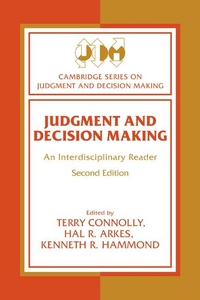
Judgment and Decision Making
An Interdisciplinary Reader
2nd Edition
Published on 28. December 1999
Book
Paperback/Softback
808 pages
978-0-521-62602-6 (ISBN)
Description
Researchers in a growing number of fields - public policy, law, business, medicine, psychology, engineering, and others - are working to understand and improve human judgment and decision making. This book, which presupposes no formal training, brings together a selection of key articles in the area, with careful organization, introduction and commentaries. Issues involving medical diagnosis, weather forecasting, labor negotiations, risk, public policy, business strategy, eyewitnesses, jury decisions issues, and more are treated in this largely expanded volume, indicating the variety of problems - and scope in judgment and decision making. This is a revision of Arkes and Hammond's 1986 collection of papers on judgment and decision making. Updated and extended, the focus of this volume is interdisciplinary and applied. The papers selected are scientific in nature, but chosen specifically to appeal to the scholar, student and layperson alike.
Reviews / Votes
"The three papers in this section are excellent...In this highly readable paper, Dawes draws on examples from a number of disparate fields to discuss the well known, though surprising, finding that simple weighted means of predictor variables produce more accurate forecasts than experts who are basing their judgment on the same variables." Internationsl Journal of ForcastingMore details
Series
Edition
2nd Revised edition
Language
English
Place of publication
Cambridge
United Kingdom
Target group
Professional and scholarly
Edition type
Revised edition
Product notice
Paperback (trade)
Illustrations
45 Tables, unspecified; 1 Halftones, unspecified; 73 Line drawings, unspecified
Dimensions
Height: 234 mm
Width: 156 mm
Thickness: 43 mm
Weight
1203 gr
ISBN-13
978-0-521-62602-6 (9780521626026)
Copyright in bibliographic data and cover images is held by Nielsen Book Services Limited or by the publishers or by their respective licensors: all rights reserved.
Schweitzer Classification
Other editions
Previous edition
Book
10/1986
Cambridge University Press
€30.89
Article exhausted; check for reprint
Persons
Content
Series preface; Contributors; Editors' preface to the second edition; Part I. Introduction and Overview: 1. Multiattribute evaluation; 2. Judgment under uncertainty: heuristics and biases; 3. Coherence and correspondence theories in judgment and decision making; 4. Enhancing diagnostic decisions; Part II. Applications in Public Policy: 5. Illusions and mirages in public policy; 6. The psychology of sunk cost; 7. Value-focused thinking about strategic decisions at BC Hydro; 8. Making better use of scientific knowledge: separating truth from justice; Part III. Applications in Economics: 9. Choices, values and frames; 10. Who uses the cost-benefit rules of choice? Implications for the normative status of microeconomic theory; 11. Does studying economics inhibit cooperation?; Part IV. Legal Applications: 12. Leading questions and the eyewitness report; 13. Explanation-based decision making; 14. Decision theory, reasonable doubt and the utility of erroneous acquittals; Part V. Medical Applications: 15. Capturing policy in hearing-aid decisions by audiologists; 16. Physicians' use of probabilistic information in a real clinical setting; 17. On the elicitation of preferences for alternative therapies; 18. Enhanced interpretation of diagnostic images; Part VI. Experts: 19. Reducing the influence of irrelevant information on experienced decision makers; 20. Expert judgment: some necessary conditions and an example; 21. The expert witness in psychology and psychiatry; Part VII. Forecasting and Prediction: 22. What forecast (seems to) mean; 23. Proper and improper linear models; 24. Seven components of judgmental forecasting skill: implications for research and the improvement of forecasts; Part VIII. Bargaining and negotiation: 25. The judgment policies of negotiators and the structure of negotiation problems; 26. The effect of agents and mediators on negotiation outcomes; Part IX. Risk: 27. Risk within reason; 28. Risk perception and communication; 29. Perceived risk, trust and democracy; Part X. Research Methods: 30. Value elicitation: is there anything in there?; 31. The overconfidence phenomenon as a consequence of informal experimenter-guided selection of almanac items; 32. The a priori case against graphology: methodological and conceptual issues; Part XI. Critiques and New Directions I: 33. The two camps on rationality Helmut Jungermann; 34. On cognitive illusions and their implications; 35. Reasoning the fast and frugal way: models of bounded rationality; 36. Judgment and decision making in social context: discourse processes and rational inference; Part XII. Critiques and New Directions II: 37. Why we still use our heads instead of formulas: toward an integrative approach; 38. Nonconsequentialist decisions; 39. Algebra and process in the modeling of risky choice; 40. The theory of image theory: an examination of the central conceptual structure; Author index; Subject index.