

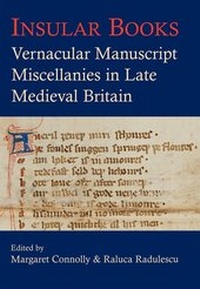
Insular Books
Vernacular manuscript miscellanies in late medieval Britain
Published on 11. June 2015
Book
Hardback
330 pages
978-0-19-726583-3 (ISBN)
Description
Medieval miscellanies are multi-text manuscripts, made up of varied contents, often in a mixture of languages. They might be the work of one compiler or several, and might have been put together over a short period of time or over many years (even over several generations). Such mixed manuscripts are much more common that we might imagine and indeed are a typical environment for the survival of medieval texts.
Two novel and ambitious avenues for investigation form the core of the present volume. First, how can we define the miscellany and best engage with and exploit the complex questions that it raises? Second - though of no lesser importance - is the cultural significance of this type of manuscript: how may the miscellany reveal processes and interactions that are otherwise obscured in modern editions or critical studies of individual texts?
The essays in this volume discuss a great number of manuscript miscellanies produced in Britain in the 14th, 15th, and 16th centuries. Some of the essays offer new insights into very well-known miscellanies, whilst others draw attention to little-known volumes. Whilst previous studies of the miscellany have restricted themselves to disciplinary or linguistic boundaries, this collection uniquely draws on the expertise of specialists in the rich range of vernacular languages used in Britain in the later Middle Ages (Anglo-French, Middle English, Older Scots, Middle Welsh). As a result it has been possible to draw illuminating comparisons between miscellany manuscripts that were the products of different geographical areas and cultures. Collectively the essays in Insular Books explore the wide range of heterogeneous manuscripts that may be defined as miscellanies, and model approaches to their study that will permit a deeper and more nuanced understanding of the production of these assemblages, as well as their circulation and reception in their own age and beyond
Two novel and ambitious avenues for investigation form the core of the present volume. First, how can we define the miscellany and best engage with and exploit the complex questions that it raises? Second - though of no lesser importance - is the cultural significance of this type of manuscript: how may the miscellany reveal processes and interactions that are otherwise obscured in modern editions or critical studies of individual texts?
The essays in this volume discuss a great number of manuscript miscellanies produced in Britain in the 14th, 15th, and 16th centuries. Some of the essays offer new insights into very well-known miscellanies, whilst others draw attention to little-known volumes. Whilst previous studies of the miscellany have restricted themselves to disciplinary or linguistic boundaries, this collection uniquely draws on the expertise of specialists in the rich range of vernacular languages used in Britain in the later Middle Ages (Anglo-French, Middle English, Older Scots, Middle Welsh). As a result it has been possible to draw illuminating comparisons between miscellany manuscripts that were the products of different geographical areas and cultures. Collectively the essays in Insular Books explore the wide range of heterogeneous manuscripts that may be defined as miscellanies, and model approaches to their study that will permit a deeper and more nuanced understanding of the production of these assemblages, as well as their circulation and reception in their own age and beyond
More details
Series
Language
English
Place of publication
Oxford
United Kingdom
Target group
College/higher education
Professional and scholarly
Illustrations
black and white illustrations
Dimensions
Height: 241 mm
Width: 162 mm
Thickness: 25 mm
Weight
780 gr
ISBN-13
978-0-19-726583-3 (9780197265833)
Copyright in bibliographic data and cover images is held by Nielsen Book Services Limited or by the publishers or by their respective licensors: all rights reserved.
Schweitzer Classification
Persons
Editor
Honorary Research FellowHonorary Research Fellow, School of English, University of St Andrews
Reader in Medieval Literature Co-Director of the Institute for Medieval and Early Modern StudiesReader in Medieval Literature Co-Director of the Institute for Medieval and Early Modern Studies, Bangor University
Content
1: Margaret Connolly and Raluca Radulescu: Introduction
2: Marianne Ailes and Phillipa Hardman: Texts in Conversation: Charlemagne Epics and Romances in Insular Plural-Text Codices
3: Keith Busby: Multilingualism, the Harley Scribe, and Johannes Jacobi
4: Susanna Fein: Literary Scribes: The Harley Scribe and Robert Thornton as Case Studies
5: Ad Putter: The Organisation of Multilingual Miscellanies: the Contrasting Fortunes of Middle English Lyrics and Romances
6: Wendy Scase: John Northwood's Miscellany Revisited
7: Raluca Radulescu: Vying for Attention: the Contents of Trinity College Dublin MS 432
8: Andrew Taylor: The Chivalric Miscellany: Classifying John Paston's 'Grete Boke'
9: Carol Meale: Amateur Book Production and the Miscellany in Late-Medieval East Anglia: Tanner 407 and Beinecke 365
10: Ceridwen Lloyd-Morgan: Writing Without Borders: Multilingual Content in Welsh Miscellanies from Wales, the Marches and Beyond
11: Dafydd Johnston: Welsh Bardic Miscellanies
12: Emily Wingfield: Lancelot of the Laik and the Literary Manuscript Miscellany in Fifteenth- and Sixteenth-Century Scotland
13: Deborah Youngs: Entertainment Networks, Reading Communities, and the Early Tudor Anthology: Bodliean Library, MS Rawlinson C. 813
14: William Marx: Aberystwyth, National Library of Wales, MS Peniarth 12: The Development of a Bilingual Miscellany - Welsh and English
15: Julia Boffey and A. S. G. Edwards: Towards a Taxonomy of Middle English Manuscript Assemblages
16: Margaret Connolly: The Whole Book and the Whole Picture: Editions and Facsimiles of Medieval Miscellanies and their Influence
17: Ardis Butterfield: Afterword
2: Marianne Ailes and Phillipa Hardman: Texts in Conversation: Charlemagne Epics and Romances in Insular Plural-Text Codices
3: Keith Busby: Multilingualism, the Harley Scribe, and Johannes Jacobi
4: Susanna Fein: Literary Scribes: The Harley Scribe and Robert Thornton as Case Studies
5: Ad Putter: The Organisation of Multilingual Miscellanies: the Contrasting Fortunes of Middle English Lyrics and Romances
6: Wendy Scase: John Northwood's Miscellany Revisited
7: Raluca Radulescu: Vying for Attention: the Contents of Trinity College Dublin MS 432
8: Andrew Taylor: The Chivalric Miscellany: Classifying John Paston's 'Grete Boke'
9: Carol Meale: Amateur Book Production and the Miscellany in Late-Medieval East Anglia: Tanner 407 and Beinecke 365
10: Ceridwen Lloyd-Morgan: Writing Without Borders: Multilingual Content in Welsh Miscellanies from Wales, the Marches and Beyond
11: Dafydd Johnston: Welsh Bardic Miscellanies
12: Emily Wingfield: Lancelot of the Laik and the Literary Manuscript Miscellany in Fifteenth- and Sixteenth-Century Scotland
13: Deborah Youngs: Entertainment Networks, Reading Communities, and the Early Tudor Anthology: Bodliean Library, MS Rawlinson C. 813
14: William Marx: Aberystwyth, National Library of Wales, MS Peniarth 12: The Development of a Bilingual Miscellany - Welsh and English
15: Julia Boffey and A. S. G. Edwards: Towards a Taxonomy of Middle English Manuscript Assemblages
16: Margaret Connolly: The Whole Book and the Whole Picture: Editions and Facsimiles of Medieval Miscellanies and their Influence
17: Ardis Butterfield: Afterword