

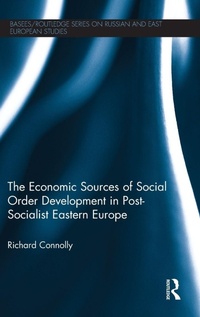
The Economic Sources of Social Order Development in Post-Socialist Eastern Europe
1st Edition
Published on 8. November 2012
Book
Hardback
288 pages
978-0-415-67242-9 (ISBN)
Description
Nearly twenty years after the collapse of socialism, the countries of post-socialist Eastern Europe have experienced divergent trajectories of political development. This book looks at why this is the case, based on the assumption that societies, or social orders, can be distinguished by the extent to which competitive tendencies contained within them - economic, political, social and cultural - are resolved according to open, rule-based processes.
The book explores which economic conditions allow for increased levels of political competition, and it tests the hypothesis that the nature of a country's ties with the international economy, and the level of competition within a country's economic system, will shape the trajectory of political competition within that society. The book goes on to argue that after several decades of relative 'bloc autarky' during the socialist period, the ongoing process of reintegration with the international economy across the post-socialist region has resulted in distinct patterns of structural economic development, and that that these patterns are of crucial importance in explaining the variation in social order type across the post-socialist region. By offering a more precise analysis of the causal mechanisms that link economic and political competition, the book makes a useful contribution to research on the different patterns of political behaviour that have been observed across the post-socialist region since the collapse of the socialist regimes.
The book explores which economic conditions allow for increased levels of political competition, and it tests the hypothesis that the nature of a country's ties with the international economy, and the level of competition within a country's economic system, will shape the trajectory of political competition within that society. The book goes on to argue that after several decades of relative 'bloc autarky' during the socialist period, the ongoing process of reintegration with the international economy across the post-socialist region has resulted in distinct patterns of structural economic development, and that that these patterns are of crucial importance in explaining the variation in social order type across the post-socialist region. By offering a more precise analysis of the causal mechanisms that link economic and political competition, the book makes a useful contribution to research on the different patterns of political behaviour that have been observed across the post-socialist region since the collapse of the socialist regimes.
More details
Series
Language
English
Place of publication
London
United Kingdom
Publishing group
Taylor & Francis Ltd
Target group
College/higher education
Illustrations
31 s/w Abbildungen, 31 s/w Zeichnungen, 30 s/w Tabellen
30 Tables, black and white; 31 Line drawings, black and white; 31 Illustrations, black and white
Dimensions
Height: 240 mm
Width: 161 mm
Thickness: 20 mm
Weight
599 gr
ISBN-13
978-0-415-67242-9 (9780415672429)
Copyright in bibliographic data and cover images is held by Nielsen Book Services Limited or by the publishers or by their respective licensors: all rights reserved.
Schweitzer Classification
Other editions
Additional editions
Book
07/2014
1st Edition
Routledge
€79.20
Shipment within 10-20 days
E-Book
11/2012
Routledge
€72.49
Available for download
E-Book
11/2012
1st Edition
Routledge
€72.49
Available for download
Person
Richard Connolly is a Lecturer in Political Economy at the Centre for Russian and East European Studies, University of Birmingham, UK.
Content
1. Introduction 2. Economic Structure, the International Economy, and Social-order Development 3. Data Description, Measurement and Case Selection 4. The International Economy and Political Economy in the Post-socialist Region: An Historical Overview 5. Economic Structure, the International Economy and the Collapse of the Soviet Union 6. Russia: Natural Resource Sectors and Limited-access Social Order Development 7. Belarus and Romania: Contrasting Cases in Structural Transformation and Social Order Development 8. Estonia: Economic Diversification and Open-access Social Order Development 9. Conclusion