

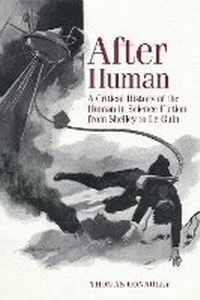
After Human
A Critical History of the Human in Science Fiction from Shelley to Le Guin
Published on 1. April 2021
Book
Hardback
240 pages
978-1-80034-816-5 (ISBN)
Description
Shortlisted for the British Fantasy Awards (Non-Fiction) 2022
Shortlisted for the Locus Science Fiction Foundation Non-Fiction Award 2022
SF has
long been understood as a literature of radical potential, capable of imagining
entirely new worlds and ways of being. Yet SF has been slow to embrace
posthumanist ideas about the human subject. The human of the SF tradition is
instead a liminal being, caught somewhere between the transcendent 'Man' of
classical humanism and the subversive 'cyborg' of posthumanist thought.
This
study offers a critical history of the 'human' in SF. By examining a range
of SF works from 1818 to the 1970s, it seeks to answer some key questions: What
role does technology play in defining what it means to be-or not to be-human?
How do these writers understand the relationship between humanity and the rest
of nature? And how can we use SF to re-examine our ethical position towards the
non-human world and move to more egalitarian understandings of the human
subject?
Shortlisted for the Locus Science Fiction Foundation Non-Fiction Award 2022
SF has
long been understood as a literature of radical potential, capable of imagining
entirely new worlds and ways of being. Yet SF has been slow to embrace
posthumanist ideas about the human subject. The human of the SF tradition is
instead a liminal being, caught somewhere between the transcendent 'Man' of
classical humanism and the subversive 'cyborg' of posthumanist thought.
This
study offers a critical history of the 'human' in SF. By examining a range
of SF works from 1818 to the 1970s, it seeks to answer some key questions: What
role does technology play in defining what it means to be-or not to be-human?
How do these writers understand the relationship between humanity and the rest
of nature? And how can we use SF to re-examine our ethical position towards the
non-human world and move to more egalitarian understandings of the human
subject?
Reviews / Votes
'This wide-ranging and original study convincingly shows how science fiction has (almost) always been posthuman. Thomas Connolly's critical and cultural history of "the human" in Anglo-American sf ranges from the nineteenth century through the 1970s, constructing an expansive pre-history of the posthuman before the cyberpunk explosion of the 1980s. This is an exciting new story about the history of science fiction.'Veronica Hollinger, co-editor of Science Fiction Studies "This monograph gives a valuable starting point for considering the developments of human figures in science fiction before posthumanism had been articulated and it contributes productively to current conversations about reading such texts retroactively as engagements with the posthuman and posthumanism."
Anna McFarlane, Science Fiction Studies 'For those scholars interested to treat posthumanism not as a given of the 21st century, but as a development of the humanism and anti-humanism that came before, Connolly's book is a valuable resource explaining the lines of thought in sf that have led up to, for example, the cyberpunk multiplication of posthumanism. After Human will help ground current work in contemporary posthumanist criticism by providing a historical perspective.' Lars Schmeink, SFRA Review
More details
Series
Language
English
Place of publication
Liverpool
United Kingdom
Target group
College/higher education
Professional and scholarly
Dimensions
Height: 239 mm
Width: 163 mm
ISBN-13
978-1-80034-816-5 (9781800348165)
Copyright in bibliographic data and cover images is held by Nielsen Book Services Limited or by the publishers or by their respective licensors: all rights reserved.
Schweitzer Classification
Person
Thomas Connolly is an independent researcher based in Dublin. His research interests include science fiction, posthumanism, disability in literature, and popular culture.
Content
Introduction: 'Beyond the common range of men': H.G. Wells, the OncoMouse, and the Human in Anglo-American SF
1. Worlds Lost and Gained: Evolution, Primitivism, and the Pre-Human in Arthur Conan Doyle's The Lost World and Jack London's The Iron Heel
2. Soma and Skylarks: Technocracy, Agency and the Trans-Human in Aldous Huxley's Brave New World and E.E. 'Doc' Smith's Skylark Series
3. Homo Gestalt: Atomics, Empire, and the Supra-Human in Isaac Asimov's Foundation and Arthur C. Clarke's The City and the Stars
4. Disaster and Redemption: Utopia, Nature, and the Post-Human in J.G. Ballard's The Crystal World and Ursula K. Le Guin's The Dispossessed
Conclusion: Bio/Techno/Homo: The Future of the Human in SF
1. Worlds Lost and Gained: Evolution, Primitivism, and the Pre-Human in Arthur Conan Doyle's The Lost World and Jack London's The Iron Heel
2. Soma and Skylarks: Technocracy, Agency and the Trans-Human in Aldous Huxley's Brave New World and E.E. 'Doc' Smith's Skylark Series
3. Homo Gestalt: Atomics, Empire, and the Supra-Human in Isaac Asimov's Foundation and Arthur C. Clarke's The City and the Stars
4. Disaster and Redemption: Utopia, Nature, and the Post-Human in J.G. Ballard's The Crystal World and Ursula K. Le Guin's The Dispossessed
Conclusion: Bio/Techno/Homo: The Future of the Human in SF