

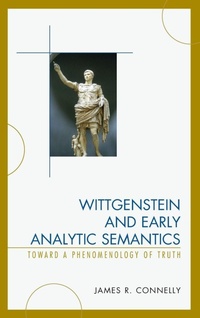
Wittgenstein and Early Analytic Semantics
Toward a Phenomenology of Truth
Published on 16. December 2015
Book
Hardback
282 pages
978-0-7391-9954-1 (ISBN)
Description
This book assesses the respective prospects of two competing methodological approaches to the study of meaning and communication, as well truth and inference, each figuring prominently within the analytic tradition of philosophy of language.
The first, 'logistical' approach is characterized by the employment of de-compositional logical analysis designed to resolve various theoretically problematic semantic and logical puzzles.The representative proponents of this approach are the three great early analytic philosophers (Frege, Russell, and the early Wittgenstein).
The second, 'phenomenological' approach, by contrast, instead advocates careful inspection and detailed description of our actual linguistic practices, along with general features of the ordinary circumstances, and lived experiences, in which they are situated. The aim of such description is then to dissolve the aforementioned puzzles by showing them to derive from key misunderstandings of these practices and circumstances. The principle proponent here is the later Wittgenstein.
Expanding upon the work of the later Wittgenstein, this book argues that considerations regarding the nature of following a rule, and deriving from the impossibility of private languages, decisively recommend the phenomenological over the logistical methodology, in particular because these considerations demand that we identify linguistic meanings with the disciplined uses of words within public, and proto-typically social, linguistic practices.
The first, 'logistical' approach is characterized by the employment of de-compositional logical analysis designed to resolve various theoretically problematic semantic and logical puzzles.The representative proponents of this approach are the three great early analytic philosophers (Frege, Russell, and the early Wittgenstein).
The second, 'phenomenological' approach, by contrast, instead advocates careful inspection and detailed description of our actual linguistic practices, along with general features of the ordinary circumstances, and lived experiences, in which they are situated. The aim of such description is then to dissolve the aforementioned puzzles by showing them to derive from key misunderstandings of these practices and circumstances. The principle proponent here is the later Wittgenstein.
Expanding upon the work of the later Wittgenstein, this book argues that considerations regarding the nature of following a rule, and deriving from the impossibility of private languages, decisively recommend the phenomenological over the logistical methodology, in particular because these considerations demand that we identify linguistic meanings with the disciplined uses of words within public, and proto-typically social, linguistic practices.
More details
Language
English
Place of publication
United States
Publishing group
Bloomsbury Publishing Plc
Target group
Professional and scholarly
Illustrations
2 BW Illustrations
Dimensions
Height: 235 mm
Width: 157 mm
Thickness: 21 mm
Weight
612 gr
ISBN-13
978-0-7391-9954-1 (9780739199541)
Copyright in bibliographic data and cover images is held by Nielsen Book Services Limited or by the publishers or by their respective licensors: all rights reserved.
Schweitzer Classification
Other editions
Additional editions
E-Book
12/2015
1st Edition
Lexington Books
€107.99
Available for download
E-Book
12/2015
1st Edition
Lexington Books
€107.99
Available for download
Person
James Connelly is assistant professor at Trent University.
Content
Part one: The Semantic Problematic of Early Analytic Philosophy
Chapter 1: Frege: Logicism and the Laws of Truth
Chapter 2: Russell: From the Principles of Mathematics to the Theory of Knowledge
Chapter 3: Normativity and Method in Wittgenstein's Tractatus
Part two: Normativity and Method in Wittgenstein's Philosophical Investigations
Chapter 4: Wittgenstein's Critique of Early Analytic Semantics
Chapter 5: Wittgenstein on Private Language and Following a Rule
Chapter 6: Subjectivity and the Living Human Body
Chapter 1: Frege: Logicism and the Laws of Truth
Chapter 2: Russell: From the Principles of Mathematics to the Theory of Knowledge
Chapter 3: Normativity and Method in Wittgenstein's Tractatus
Part two: Normativity and Method in Wittgenstein's Philosophical Investigations
Chapter 4: Wittgenstein's Critique of Early Analytic Semantics
Chapter 5: Wittgenstein on Private Language and Following a Rule
Chapter 6: Subjectivity and the Living Human Body