

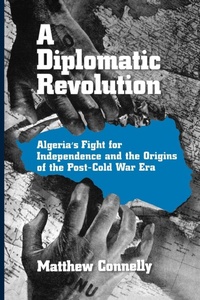
A Diplomatic Revolution
Algeria's Fight for Independence and the Origins of the Post-Cold War Era
Published on 20. November 2003
Book
Paperback/Softback
424 pages
978-0-19-517095-5 (ISBN)
Description
Algeria sits at the crossroads of the Atlantic, European, Arab, and African worlds. Yet, unlike the wars in Korea and Vietnam, Algeria's fight for independence has rarely been viewed as an international conflict. Even forty years later, it is remembered as the scene of a national drama that culminated with Charles de Gaulle's decision to "grant" Algerians their independence despite assassination attempts, mutinies, and settler insurrection.
Yet, as Matthew Connelly demonstrates, the war the Algerians fought occupied a world stage, one in which the U.S. and the USSR, Israel and Egypt, Great Britain, Germany, and China all played key roles. Recognizing the futility of confronting France in a purely military struggle, the Front de Liberation Nationale instead sought to exploit the Cold War competition and regional rivalries, the spread of mass communications and emigrant communities, and the proliferation of international and non-governmental organizations. By harnessing the forces of nascent globalization they divided France internally and isolated it from the world community. And, by winning rights and recognition as Algeria's legitimate rulers without actually liberating the national territory, they rewrote the rules of international relations.
Based on research spanning three continents and including, for the first time, the rebels' own archives, this study offers a landmark reevaluation of one of the great anti-colonial struggles as well as a model of the new international history. It will appeal to historians of post-colonial studies, twentieth-century diplomacy, Europe, Africa, and the Middle East.
Yet, as Matthew Connelly demonstrates, the war the Algerians fought occupied a world stage, one in which the U.S. and the USSR, Israel and Egypt, Great Britain, Germany, and China all played key roles. Recognizing the futility of confronting France in a purely military struggle, the Front de Liberation Nationale instead sought to exploit the Cold War competition and regional rivalries, the spread of mass communications and emigrant communities, and the proliferation of international and non-governmental organizations. By harnessing the forces of nascent globalization they divided France internally and isolated it from the world community. And, by winning rights and recognition as Algeria's legitimate rulers without actually liberating the national territory, they rewrote the rules of international relations.
Based on research spanning three continents and including, for the first time, the rebels' own archives, this study offers a landmark reevaluation of one of the great anti-colonial struggles as well as a model of the new international history. It will appeal to historians of post-colonial studies, twentieth-century diplomacy, Europe, Africa, and the Middle East.
Reviews / Votes
"In concentrating on the international dimension, Connelly weaves into his story the changing roles of the United States, Gamal Abdel Nasser's Egypt, Morocco, and Tunisia; the ebb and flow of FLN relations with the soviet bloc; and much more." --Foreign Affairs "This extensively researched study will provide extremely valuable information to scholars of decolonization, and represents a major contribution to the history of what one of the belligerent parties, France, only officially recognized as a war in October 1999."--Journal of Military History 'a fine new volume by Matthew Connelly...Matthew Connelly's main offering is important and new: the international dimensions of the insurgency were not tertiary or secondary, as often depicted but primary... with almost 300 pages of text and then extensive supportive notes and bibliography, this substantial book offers much to ponder...The many pleasures of this book include pen portraits of the various cities in which Bourqueney served; the descriptions of the splendour and squalor of Contstantinople and Vienna are particularly striking...It is written with zest and pace,and is packed full of insights about diplomacy across the continent as the European 'concert', and Bourqueney's career, developed and ultimately failed. * Geoffrey Hicks, University of East Anglia, Norwich,Diplomacy and Statecraft *More details
Language
English
Place of publication
New York
United States
Target group
College/higher education
Illustrations
8 pp halftones, 1 map
Dimensions
Height: 229 mm
Width: 152 mm
Thickness: 25 mm
Weight
691 gr
ISBN-13
978-0-19-517095-5 (9780195170955)
Copyright in bibliographic data and cover images is held by Nielsen Book Services Limited or by the publishers or by their respective licensors: all rights reserved.
Schweitzer Classification
Other editions
Additional editions
Matthew Connelly
A Diplomatic Revolution
Algeria's Fight for Independence and the Origins of the Post-Cold War Era
Book
05/2002
Oxford University Press Inc
€231.80
Shipment within 15-20 days
Matthew Connelly
A Diplomatic Revolution
Algeria's Fight for Independence and the Origins of the Post-Cold War Era
E-Book
04/2002
1st Edition
OUP eBook
€45.99
Available for download
Matthew Connelly
A Diplomatic Revolution
Algeria's Fight for Independence and the Origins of the Post-Cold War Era
E-Book
04/2002
1st Edition
OUP eBook
€45.99
Available for download
Person
Matthew Connelly is an Associate Professor of History at Columbia University.
Content
PART THREE: WAGING THE ALGERIAN WAR AS A WORLD WAR, 1956-1958; PART FOUR: WAGING THE ALGERIAN WAR AS A WORLD WAR, 1958-1960; PART FIVE: THE DOMESTICATION OF THE ALGERIAN QUESTION, 1960-1962; CONCLUSION: THE SENSE OF HISTORY