

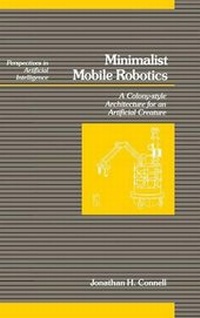
Minimalist Mobile Robotics
Published on 6. September 1990
Book
Hardback
192 pages
978-0-12-185230-6 (ISBN)
Description
Rather than using traditional artificial intelligence techniques, which are ineffective when applied to the complexities of real-world robot navigaiton, Connell describes a methodology of reconstructing intelligent robots with distributed, multiagent control systems. After presenting this methodology, hte author describes a complex, robust, and successful application-a mobile robot "can collection machine" which operates in an unmodified offifce environment occupied by moving people.
More details
Language
English
Place of publication
San Francisco
United States
Publishing group
Elsevier Science & Technology
Target group
Professional and scholarly
Weight
500 gr
ISBN-13
978-0-12-185230-6 (9780121852306)
Copyright in bibliographic data and cover images is held by Nielsen Book Services Limited or by the publishers or by their respective licensors: all rights reserved.
Schweitzer Classification
Other editions
Additional editions
Jonathan H. Connell
Minimalist Mobile Robotics
E-Book
07/1990
Morgan Kaufmann
€54.95
Available for download
Person
By Jonathan H. Connell
Content
Foreword
Preface
1. Introduction
1.1 The Task
1.2 Animal Stories
1.3 Design Principles
1.4 Contributions
1.5 Roadmap
2. Architecture
2.1 What we Use
2.2 The Subsumption Architecture
2.3 The Multiprocessor Implementation
2.4 Related Architectures
3. Manipulation
3.1 Hardware
3.2 Sensors
3.3 Controlling the Hand
3.4 Controlling the Arm Locally
3.5 Controlling the Arm Globally
3.6 Controlling the Base
3.7 Experiments
4. Vision
4.1 Hardware
4.2 Image Processing
4.3 Visual Guidance
4.4 Experiments
5. Navigation
5.1 Sensors
5.2 Tactical Navigation
5.3 Strategic Navigation
5.4 Experiments
6. Discussion
6.1 Spatial Representation
6.2 Distributed Systems
6.3 Limitations
6.4 Extending Arbitration
6.5 Learning
6.6 Conclusion
Bibliography
Index
Preface
1. Introduction
1.1 The Task
1.2 Animal Stories
1.3 Design Principles
1.4 Contributions
1.5 Roadmap
2. Architecture
2.1 What we Use
2.2 The Subsumption Architecture
2.3 The Multiprocessor Implementation
2.4 Related Architectures
3. Manipulation
3.1 Hardware
3.2 Sensors
3.3 Controlling the Hand
3.4 Controlling the Arm Locally
3.5 Controlling the Arm Globally
3.6 Controlling the Base
3.7 Experiments
4. Vision
4.1 Hardware
4.2 Image Processing
4.3 Visual Guidance
4.4 Experiments
5. Navigation
5.1 Sensors
5.2 Tactical Navigation
5.3 Strategic Navigation
5.4 Experiments
6. Discussion
6.1 Spatial Representation
6.2 Distributed Systems
6.3 Limitations
6.4 Extending Arbitration
6.5 Learning
6.6 Conclusion
Bibliography
Index