

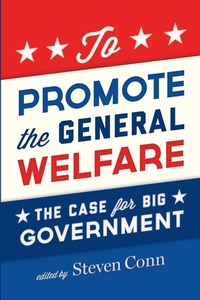
To Promote the General Welfare
The Case for Big Government
1st Edition
Published on 23. August 2012
Book
Paperback/Softback
256 pages
978-0-19-985855-2 (ISBN)
Description
Americans love to hate their government, and a long tradition of anti-government suspicion reaches back to debates among the founders of the nation. But the election of Barack Obama has created a backlash rivaled only by the anti-government hysteria that preceded the Civil War.
Lost in all the Tea Party rage and rhetoric is this simple fact: the federal government plays a central role in making our society function, and it always has. Edited by Steven Conn and written by some of America's leading scholars, the essays in To Promote the General Welfare explore the many ways government programs have improved the quality of life in America. The essays cover everything from education, communication, and transportation to arts and culture, housing, finance, and public health. They explore how and why government programs originated, how they have worked and changed--and been challenged--since their inception, and why many of them are important to preserve.
The book shows how the WPA provided vital, in some cases career-saving, assistance to artists and writers like Jackson Pollock, Dorothea Lange, Richard Wright, John Cheever, and scores of others; how millions of students from diverse backgrounds have benefited and continue to benefit from the G.I. Bill, Fulbright scholarships, and federally insured student loans; and how the federal government created an Interstate highway system unparalleled in the world, linking the entire nation. These are just a few examples of highly successful programs the book celebrates--and that anti-government critics typically ignore.
For anyone wishing to explore the flip side of today's vehement attacks on American government, To Promote the General Welfare is the best place to start.
Lost in all the Tea Party rage and rhetoric is this simple fact: the federal government plays a central role in making our society function, and it always has. Edited by Steven Conn and written by some of America's leading scholars, the essays in To Promote the General Welfare explore the many ways government programs have improved the quality of life in America. The essays cover everything from education, communication, and transportation to arts and culture, housing, finance, and public health. They explore how and why government programs originated, how they have worked and changed--and been challenged--since their inception, and why many of them are important to preserve.
The book shows how the WPA provided vital, in some cases career-saving, assistance to artists and writers like Jackson Pollock, Dorothea Lange, Richard Wright, John Cheever, and scores of others; how millions of students from diverse backgrounds have benefited and continue to benefit from the G.I. Bill, Fulbright scholarships, and federally insured student loans; and how the federal government created an Interstate highway system unparalleled in the world, linking the entire nation. These are just a few examples of highly successful programs the book celebrates--and that anti-government critics typically ignore.
For anyone wishing to explore the flip side of today's vehement attacks on American government, To Promote the General Welfare is the best place to start.
Reviews / Votes
An impressive collection. * The Historian * So effectively do these essays make 'the case for big government' that one is left wondering why the animus against government should be so strong in the United States today, if it has been so beneficial a force, and so generally respectful of popular antistatism... Conn and his colleagues reveal that contemporary advocates of smaller government are far less in tune with the reality of American political development than they imagine. * Journal of American History * One of the greatest secrets of American history is that Americans have from the very beginning relied on government to improve their nation, help it grow, and make it more just. An energetic government is not simply consistent with keeping our country free, but actually essential to expanding our liberties and our personal possibilities. The authors make their arguments so clearly and so well that Tea Party members willing to grapple with To Promote the General Welfare might find themselves changing their minds. This is an excellent book that is also perfectly matched with our political moment. * E.J. Dionne, author of Our Divided Political Heart: The Battle for the American Idea in an Age of Discontent * To Promote the General Welfare injects a welcome note of realism into our hyperbolic public discourse. Because government in the United States has usually functioned out of sight, Americans have constructed a mythology of private enterprise and individualism and forgotten that the free market depends on the rule of law, state-funded infrastructure, and state-sponsored support of citizens' initiatives. From the earliest provision of security and infrastructure through social security and the GI Bill to medicare and middle-class housing, health, and education subsidies, these first-rate historians demonstrate that public-private partnerships have always been the American Way. * James Kloppenberg, Charles Warren Professor of American History, Harvard University * The scholars brought together by Ohio State historian Conn persuasively demonstrate how the growth of 'big government' throughout the 20th century has benefited ordinary Americans so comprehensively and unobtrusively that they have often taken it for granted. * Publishers Weekly *More details
Language
English
Place of publication
New York
United States
Target group
College/higher education
Professional and scholarly
Trade readers with an interest in American political and social history, especially liberals looking for reading material in the 2012 election season; America history survey courses; courses on American politics, government, and policy; AP Government; AP American History
Dimensions
Height: 210 mm
Width: 140 mm
Thickness: 15 mm
Weight
353 gr
ISBN-13
978-0-19-985855-2 (9780199858552)
Copyright in bibliographic data and cover images is held by Nielsen Book Services Limited or by the publishers or by their respective licensors: all rights reserved.
Schweitzer Classification
Other editions
Additional editions
Book
08/2012
1st Edition
Oxford University Press Inc
€75.20
Shipment within 15-20 days
E-Book
08/2012
1st Edition
OUP eBook
€13.49
Available for download
E-Book
07/2012
1st Edition
OUP eBook
€11.99
Available for download
Person
Steven Conn is Professor and Director of Public History at Ohio State University. His books include Do Museums Still Need Objects?, Metropolitan Philadelphia: Living with the Presence of the Past, and History's Shadow: Native Americans and Historical Consciousness in the Nineteenth Century. He is the founding editor of the online magazine Origins: Current Events in Historical Perspective.
Content
Chapter 1: Looking for Government in All the Wrong Places ; Brian Balogh ; Chapter 2: From Franklin to Facebook: The Civic Mandate for American Communications ; Richard R. John ; Chapter 3: "Roads Will Everywhere Be Shortened": Transportation and the Uniting of the Nation ; Zachary M. Schrag ; Chapter 4: Banking on Government: The Federal Role in Credit, Finance and Banking ; Michael S. Barr ; Chapter 5: One Third of a Nation: Big Government and the Search for Security ; Kevin Boyle ; Chapter 6: How the Federal Government Built the American Dream ; Thomas J. Sugrue ; Chapter 7: From Hook Worm to HIV: Solving the Nation's Number One Health Problem(s) ; Karen Kruse Thomas ; Chapter 8: Uncle Sam at the Blackboard: The Federal Government and American Education ; Jon Zimmerman ; Chapter 9: Art and Culture in the Public Interest ; Steven Conn ; Chapter 10: Government's Greatest Hits in Peril ; Paul C. Light