

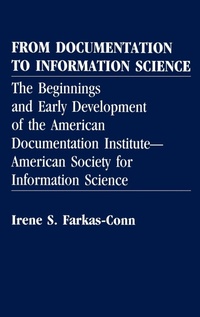
From Documentation to Information Science
The Beginnings and Early Development of the American Documentation Institute--American Society for Information Science
Published on 30. December 1990
Book
Hardback
248 pages
978-0-313-25505-2 (ISBN)
Description
As fast-paced technical changes are transforming the field of information science, this book explores in depth the early stages of the field through the history of the American Society for Information Science (ASIS), which began in 1937 as the American Documentation Institute (ADI). ADIs early years coincided with the period when the organization, communication, and retrieval of information began to undergo critical changes. At this time, its appointed members represented the scientific and scholarly elite of the country. ADI offered innovative services that allowed research workers to obtain published information from remote sources and initiated a new channel for distribution of unpublished data. Only in the early 1950s did ADI become a membership organization. Examining this period, Irene Farkas-Conn raises important questions: How did the ADI come about? Did its founding signal the beginning of a new profession? Was it then, or still now, a technology-driven organization? Bringing together her knowledge of organizations, insights gained from interviews with key actors, and analysis of archival collections and private papers, she reconstitutes the emergence of the field as the history of ASIS is covered.
Beginning with a detailed survey of the post-World War I period that preceded the creation of ADI covering topics such as the impact of national science, the introduction of microfilm for dissemination of scientific and scholarly information, copywright and documentation in the mid-1930s, she leads up to a discussion of the establishment and early years of the institute. The next sections covering World War II and the post-war period bring out the tie between the organization of wartime research and development and scientific communication, which contributed to the winning of the war. The concept of a Scientific Information Institute that would embrace bibliography, announcement, and distribution of scientific work, which Watson Davis developed in the 30s, was being realized in the postwar period when the cumulated results of wartime research had to be made avaliable to the public under presidential order. The remaining chapters chart international interests, restructuring of the institute, and the role of government and the profession in a changed society. The book includes a selected bibliography embodied in the endnotes and an index.
Beginning with a detailed survey of the post-World War I period that preceded the creation of ADI covering topics such as the impact of national science, the introduction of microfilm for dissemination of scientific and scholarly information, copywright and documentation in the mid-1930s, she leads up to a discussion of the establishment and early years of the institute. The next sections covering World War II and the post-war period bring out the tie between the organization of wartime research and development and scientific communication, which contributed to the winning of the war. The concept of a Scientific Information Institute that would embrace bibliography, announcement, and distribution of scientific work, which Watson Davis developed in the 30s, was being realized in the postwar period when the cumulated results of wartime research had to be made avaliable to the public under presidential order. The remaining chapters chart international interests, restructuring of the institute, and the role of government and the profession in a changed society. The book includes a selected bibliography embodied in the endnotes and an index.
More details
Series
Language
English
Place of publication
United States
Publishing group
Bloomsbury Publishing Plc
Target group
College/higher education
Professional and scholarly
Interest Age: From 7 to 17 years
Dimensions
Height: 240 mm
Width: 161 mm
Thickness: 18 mm
Weight
540 gr
ISBN-13
978-0-313-25505-2 (9780313255052)
Copyright in bibliographic data and cover images is held by Nielsen Book Services Limited or by the publishers or by their respective licensors: all rights reserved.
Schweitzer Classification
Person
IRENE S. FARKAS-CONN is a consultant, an internationally known expert on information management, and an advocate of new computing, telecommunication, and optical disc technologies to make most effective use of information. A frequent lecturer in the United States and abroad, her experience has led her to examine not only how people use information and how it is transferred, but how organizations can be made to function more effectively. She served on the board of the American Society for Information Science, the Information for Industry Committee of the International Federation for Information and Documentation (FID/II), and on a working committee of the U.S. Department of State. Dr. Farkas-Conn has also received the Watson Davis award of ASIS.
Content
Prologue
The Incubation Period
Visions and Realities: Documentation in the 1930s
First Steps Toward Realization
Organizing the American Documentation Institute
Early Years, Early Projects
The War Years, then Information Turmoil
New Winds Blowing
International Interests and Steps Toward Revival
A Threat, a Shift, and a New ADI
A New Profession, a Changed Society
Appendix
Index
The Incubation Period
Visions and Realities: Documentation in the 1930s
First Steps Toward Realization
Organizing the American Documentation Institute
Early Years, Early Projects
The War Years, then Information Turmoil
New Winds Blowing
International Interests and Steps Toward Revival
A Threat, a Shift, and a New ADI
A New Profession, a Changed Society
Appendix
Index