

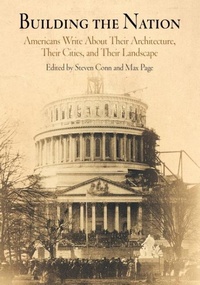
Building the Nation
Americans Write About Their Architecture, Their Cities, and Their Landscape
Published on 23. June 2003
Book
Paperback/Softback
424 pages
978-0-8122-1852-7 (ISBN)
Description
Moving away from the standard survey that takes readers from architect to architect and style to style, Building the Nation: Americans Write About Their Architecture, Their Cities, and Their Landscape suggests a wholly new way of thinking about the history of America's built environment and how Americans have related to it.
Through an enormous range of American voices, some famous and some obscure, and across more than two centuries of history, this anthology shows that the struggle to imagine what kinds of buildings and land use would best suit the nation pervaded all classes of Americans and was not the purview only of architects and designers. Some of the nation's finest writers, including Mark Twain, W. E. B. Du Bois, Henry James, Edith Wharton, Lewis Mumford, E. B. White, and John McPhee, are here, contemplating the American way of building. Equally important are those eloquent but little-known voices found in American newspapers and magazines which insistently wondered what American architecture and environmental planning should look like.
Building the Nation also insists that American architecture can be understood only as both a result of and a force in shaping American social, cultural, and political developments. In so doing, this anthology demonstrates how central the built environment has been to our definition of what it is to be American and reveals seven central themes that have repeatedly animated American writers over the course of the past two centuries: the relationship of American architecture to European architecture, the nation's diverse regions, the place and shape of nature in American life, the design of cities, the explosion of the suburbs, the power of architecture to reform individuals, and the role of tradition in a nation dedicated to being perennially young.
Through an enormous range of American voices, some famous and some obscure, and across more than two centuries of history, this anthology shows that the struggle to imagine what kinds of buildings and land use would best suit the nation pervaded all classes of Americans and was not the purview only of architects and designers. Some of the nation's finest writers, including Mark Twain, W. E. B. Du Bois, Henry James, Edith Wharton, Lewis Mumford, E. B. White, and John McPhee, are here, contemplating the American way of building. Equally important are those eloquent but little-known voices found in American newspapers and magazines which insistently wondered what American architecture and environmental planning should look like.
Building the Nation also insists that American architecture can be understood only as both a result of and a force in shaping American social, cultural, and political developments. In so doing, this anthology demonstrates how central the built environment has been to our definition of what it is to be American and reveals seven central themes that have repeatedly animated American writers over the course of the past two centuries: the relationship of American architecture to European architecture, the nation's diverse regions, the place and shape of nature in American life, the design of cities, the explosion of the suburbs, the power of architecture to reform individuals, and the role of tradition in a nation dedicated to being perennially young.
Reviews / Votes
"This anthology will undoubtedly open new paths of inquiry into the making, shaping, preservation, and use of the American landscape."-Daniel Bluestone, University of Virginia"Some anthologies seem slapdash or opportunistic; others are labors of love, informed by a mastery of a particular field and a passion for sharing the heterogeneous richness of their documents. Building the Nation is happily one of the latter. . . . Vastly useful."-Preservation
More details
Language
English
Place of publication
Pennsylvania
United States
Target group
College/higher education
Product notice
Paperback (trade)
Illustrations
47 illus.
Dimensions
Height: 253 mm
Width: 180 mm
Thickness: 28 mm
Weight
871 gr
ISBN-13
978-0-8122-1852-7 (9780812218527)
Copyright in bibliographic data and cover images is held by Nielsen Book Services Limited or by the publishers or by their respective licensors: all rights reserved.
Schweitzer Classification
Other editions
Additional editions
Steven Conn | Max Page
Building the Nation
Americans Write About Their Architecture, Their Cities, and Their Landscape
E-Book
01/2016
1st Edition
University of Pennsylvania Press
€38.99
Available for download
Persons
Steven Conn is Associate Professor of History at The Ohio State University. He is the author of Museums and American Intellectual Life, 1876-1926 and Metropolitan Philadelphia: Living with the Presence of the Past, the latter also available from the University of Pennsylvania Press. Max Page is Associate Professor of Architecture and History at the University of Massachusetts, Amherst, and the author of The Creative Destruction of Manhattan, 1900-1940.
Content
Chapter 1. Introduction
Chapter 2. "They Do Things Better in Europe": Americans View the World
Chapter 3. So Glorious a Landscape: Shaping Nature the American Way
Chapter 4. One Nation, of Many Parts: Regionalism and the Built Environment
Chapter 5. Urbanism, Real and Imagined
Chapter 6. Taming the Crabgrass Frontier: The Triumph of the Suburbs
Chapter 7. Better Buildings, Better People: American Architecture and Social Reform
Chapter 8. Monuments and Memory: Building and Protecting the American Past
Index
Acknowledgments
Chapter 2. "They Do Things Better in Europe": Americans View the World
Chapter 3. So Glorious a Landscape: Shaping Nature the American Way
Chapter 4. One Nation, of Many Parts: Regionalism and the Built Environment
Chapter 5. Urbanism, Real and Imagined
Chapter 6. Taming the Crabgrass Frontier: The Triumph of the Suburbs
Chapter 7. Better Buildings, Better People: American Architecture and Social Reform
Chapter 8. Monuments and Memory: Building and Protecting the American Past
Index
Acknowledgments