

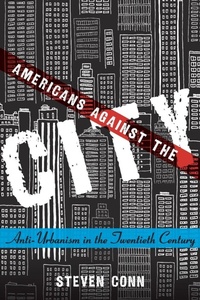
Americans Against the City
Anti-Urbanism in the Twentieth Century
Published on 8. December 2016
Book
Paperback/Softback
394 pages
978-0-19-063634-0 (ISBN)
Description
It is a paradox of American life that we are a highly urbanized nation filled with people deeply ambivalent about urban life. An aversion to urban density and all that it contributes to urban life, and a perception that the city was the place where "big government" first took root in America fostered what historian Steven Conn terms the "anti-urban impulse." In response, anti-urbanists called for the decentralization of the city, and rejected the role of government in American life in favor of a return to the pioneer virtues of independence and self-sufficiency.
In this provocative and sweeping book, Conn explores the anti-urban impulse across the 20th century, examining how the ideas born of it have shaped both the places in which Americans live and work, and the anti-government politics so strong today. Beginning in the booming industrial cities of the Progressive era at the turn of the 20th century, where debate surrounding these questions first arose, Conn examines the progression of anti-urban movements. : He describes the decentralist movement of the 1930s, the attempt to revive the American small town in the mid-century, the anti-urban basis of urban renewal in the 1950s and '60s, and the Nixon administration's program of building new towns as a response to the urban crisis, illustrating how, by the middle of the 20th century, anti-urbanism was at the center of the politics of the New Right. Concluding with an exploration of the New Urbanist experiments at the turn of the 21st century, Conn demonstrates the full breadth of the anti-urban impulse, from its inception to the present day. Engagingly written, thoroughly researched, and forcefully argued, Americans Against the City is important reading for anyone who cares not just about the history of our cities, but about their future as well.
In this provocative and sweeping book, Conn explores the anti-urban impulse across the 20th century, examining how the ideas born of it have shaped both the places in which Americans live and work, and the anti-government politics so strong today. Beginning in the booming industrial cities of the Progressive era at the turn of the 20th century, where debate surrounding these questions first arose, Conn examines the progression of anti-urban movements. : He describes the decentralist movement of the 1930s, the attempt to revive the American small town in the mid-century, the anti-urban basis of urban renewal in the 1950s and '60s, and the Nixon administration's program of building new towns as a response to the urban crisis, illustrating how, by the middle of the 20th century, anti-urbanism was at the center of the politics of the New Right. Concluding with an exploration of the New Urbanist experiments at the turn of the 21st century, Conn demonstrates the full breadth of the anti-urban impulse, from its inception to the present day. Engagingly written, thoroughly researched, and forcefully argued, Americans Against the City is important reading for anyone who cares not just about the history of our cities, but about their future as well.
Reviews / Votes
Although the literature on America's attitudes toward its cities is large, Steven Conn's new book, Americans against the City, sheds new light on the topic and demonstrates that ideas can have a powerful effect on landscape and politics.... Conn connects intellectual history to the history of politics and the physical environment to show how concerns about urban density and public life have permeated not only American thought but also all aspects of American life. By pursuing his theme into the twenty-first century, he also demonstrates its persistence and continued importance. * Journal of American History * This clearly written, analytically perceptive work introduces us to the people and the politics that represented the decentralizing, anti-urban spirit of the last century. * Journal of Appalachian Studies * Americans Against the City is about the past, but brings into relief the surprising character of the present. * LA Review of Books *More details
Language
English
Place of publication
New York
United States
Target group
College/higher education
Professional and scholarly
Illustrations
34 illus.
Dimensions
Height: 234 mm
Width: 156 mm
Thickness: 21 mm
Weight
594 gr
ISBN-13
978-0-19-063634-0 (9780190636340)
Copyright in bibliographic data and cover images is held by Nielsen Book Services Limited or by the publishers or by their respective licensors: all rights reserved.
Schweitzer Classification
Other editions
Additional editions

Book
10/2014
Oxford University Press Inc
€34.65
Article exhausted; check different version
Person
Steven Conn is Professor and Director, Public History, Ohio State University. He is the author of, To Promote the General Welfare: The Case for Big Government; Metropolitan Philadelphia: Living in the Presence of the Past, among others; he is the co-editor of Building the Nation: Americans Write about Their Architecture, Their Cities, and Their Landscape.
Content
Acknowledgments
Introduction: The American Urban Paradox
1. Anti-Urbanism: An American Tradition
2. America's Urban Moment Arrives
3. The Center Should Not Hold: Decentralizing the City in the 1920s and '30s
4. New Deal, New Towns: The Anti-Urban New Deal
5. Looking for Alternatives to the City: The Past and the Folk
6. The Center Did Not Hold: The City in the Age of Urban Renewal
7. The Triumph of the Decentralized City
8. Small Town, New Town, Commune
9. New Communities, New Urbanisms
Afterword: Urbanism as a Way of Life
Notes
Bibliography
Introduction: The American Urban Paradox
1. Anti-Urbanism: An American Tradition
2. America's Urban Moment Arrives
3. The Center Should Not Hold: Decentralizing the City in the 1920s and '30s
4. New Deal, New Towns: The Anti-Urban New Deal
5. Looking for Alternatives to the City: The Past and the Folk
6. The Center Did Not Hold: The City in the Age of Urban Renewal
7. The Triumph of the Decentralized City
8. Small Town, New Town, Commune
9. New Communities, New Urbanisms
Afterword: Urbanism as a Way of Life
Notes
Bibliography