

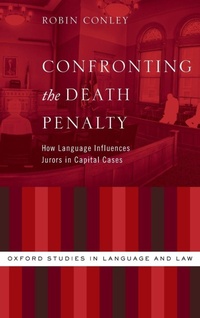
Confronting the Death Penalty
How Language Influences Jurors in Capital Cases
Published on 10. December 2015
Book
Hardback
256 pages
978-0-19-933416-2 (ISBN)
Description
Confronting the Death Penalty: How Language Influences Jurors in Capital Cases probes how jurors make the ultimate decision about whether another human being should live or die. Drawing on ethnographic and qualitative linguistic methods, this book explores the means through which language helps to make death penalty decisions possible - how specific linguistic choices mediate and restrict jurors', attorneys', and judges' actions and experiences while serving and reflecting on capital trials.
The analysis draws on fifteen months of ethnographic fieldwork in diverse counties across Texas, including participant observation in four capital trials and post-verdict interviews with the jurors who decided those cases. Given the impossibility of access to actual capital jury deliberations, this integration of methods aims to provide the clearest possible window into jurors' decision-making. Using methods from linguistic anthropology, conversation analysis, and multi-modal discourse analysis, Conley analyzes interviews, trial talk, and written legal language to reveal a variety of communicative practices through which jurors dehumanize defendants and thus judge them to be deserving of death.
By focusing on how language can both facilitate and stymie empathic encounters, the book addresses a conflict inherent to death penalty trials: jurors literally face defendants during trial and then must distort, diminish, or negate these face-to-face interactions in order to sentence those same defendants to death. The book reveals that jurors cite legal ideologies of rational, dispassionate decision-making - conveyed in the form of authoritative legal language - when negotiating these moral conflicts. By investigating the interface between experiential and linguistic aspects of legal decision-making, the book breaks new ground in studies of law and language, language and psychology, and the death penalty.
The analysis draws on fifteen months of ethnographic fieldwork in diverse counties across Texas, including participant observation in four capital trials and post-verdict interviews with the jurors who decided those cases. Given the impossibility of access to actual capital jury deliberations, this integration of methods aims to provide the clearest possible window into jurors' decision-making. Using methods from linguistic anthropology, conversation analysis, and multi-modal discourse analysis, Conley analyzes interviews, trial talk, and written legal language to reveal a variety of communicative practices through which jurors dehumanize defendants and thus judge them to be deserving of death.
By focusing on how language can both facilitate and stymie empathic encounters, the book addresses a conflict inherent to death penalty trials: jurors literally face defendants during trial and then must distort, diminish, or negate these face-to-face interactions in order to sentence those same defendants to death. The book reveals that jurors cite legal ideologies of rational, dispassionate decision-making - conveyed in the form of authoritative legal language - when negotiating these moral conflicts. By investigating the interface between experiential and linguistic aspects of legal decision-making, the book breaks new ground in studies of law and language, language and psychology, and the death penalty.
Reviews / Votes
Dr Riner's approach is a unique one that makes for a compelling read ... a lucid exposition of the contradictions and fallacies that capital jurors must wrestle with in their role within the American criminal justice system ... Confronting the Death Penalty: How Language Influences Jurors in Capital Cases would be an asset to the collection of any academic law library, as well as to legal practitioners searching for a deeper understanding of the link between language and the legal practice. * Erica Friesen, Canadian Law Library Review * There is no doubt that profound lessons from this book can shed new light on the implementation and management of capital pubishment in America. * Zhonghua Wu, Journal of Language and Politics *More details
Series
Language
English
Place of publication
New York
United States
Target group
Professional and scholarly
Dimensions
Height: 235 mm
Width: 157 mm
Thickness: 18 mm
Weight
521 gr
ISBN-13
978-0-19-933416-2 (9780199334162)
Copyright in bibliographic data and cover images is held by Nielsen Book Services Limited or by the publishers or by their respective licensors: all rights reserved.
Schweitzer Classification
Other editions
Additional editions
Book
12/2020
Oxford University Press Inc
€33.30
Shipment within 15-20 days
E-Book
11/2015
1st Edition
OUP eBook
€12.49
Available for download
E-Book
11/2015
1st Edition
OUP eBook
€11.99
Available for download
Person
Robin Conley is Assistant Professor of Anthropology at Marshall University.
Content
Table of Contents ; 1 Introduction: "That's the hardest thing I've ever had to do" ; 2 Doing Death in Texas: Studying jurors in "the death penalty state" ; 3 "I hope I'm strong enough to follow the law": Emotion and objectivity in capital jurors law. ; 4 Facing death: Empathy, emotion and embodied actions in jurors'decisions ; 5 Linguistic distance and the dehumanization of capital defendants ; 6 Agents of the state: Capital jurors' accountability for their sentencing decisions ; 7 Conclusions: Linguistic dehumanization and democracy