

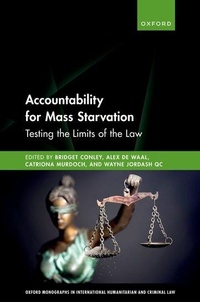
Accountability for Mass Starvation
Testing the Limits of the Law
Published on 25. August 2022
Book
Hardback
496 pages
978-0-19-286473-4 (ISBN)
Description
Famine is an age-old scourge that almost disappeared in our lifetime. Between 2000 and 2011 there were no famines and deaths in humanitarian emergencies were much reduced. The humanitarian agenda was ascendant. Then, in 2017, the United Nations identified four situations that threatened famine or breached that threshold in north-eastern Nigeria, Somalia, South Sudan, and Yemen. Today, this list is longer. Each of these famines is the result of military actions and exclusionary, authoritarian politics conducted without regard to the wellbeing or even the survival of people.
Violations of international law including blockading ports, attacks on health facilities, violence against humanitarian workers, and obstruction of relief aid are carried out with renewed impunity. Yet there is an array of legal offenses, ranging from war crimes and crimes against humanity to genocide, available to a prosecutor to hold individuals to account for the deliberate starvation of civilians. However, there has been a dearth of investigations and accountability for those violating international law.
The reasons for this neglect and the gaps between the black-letter law and practice are explored in this timely volume. It provides a comprehensive overview of the key themes and cases required to catalyze a new approach to understanding the law as it relates to starvation. It also illustrates the complications of historical and ongoing situations where starvation is used as a weapon of war, and provides expert analysis on defining starvation, early warning systems, gender and mass starvation, the use of sanctions, journalistic reporting, and memorialization of famine.
Violations of international law including blockading ports, attacks on health facilities, violence against humanitarian workers, and obstruction of relief aid are carried out with renewed impunity. Yet there is an array of legal offenses, ranging from war crimes and crimes against humanity to genocide, available to a prosecutor to hold individuals to account for the deliberate starvation of civilians. However, there has been a dearth of investigations and accountability for those violating international law.
The reasons for this neglect and the gaps between the black-letter law and practice are explored in this timely volume. It provides a comprehensive overview of the key themes and cases required to catalyze a new approach to understanding the law as it relates to starvation. It also illustrates the complications of historical and ongoing situations where starvation is used as a weapon of war, and provides expert analysis on defining starvation, early warning systems, gender and mass starvation, the use of sanctions, journalistic reporting, and memorialization of famine.
More details
Series
Language
English
Place of publication
Oxford
United Kingdom
Product notice
sewn/stitched
Cloth over boards
Dimensions
Height: 224 mm
Width: 163 mm
Thickness: 51 mm
Weight
907 gr
ISBN-13
978-0-19-286473-4 (9780192864734)
Copyright in bibliographic data and cover images is held by Nielsen Book Services Limited or by the publishers or by their respective licensors: all rights reserved.
Schweitzer Classification
Other editions
Additional editions
Bridget Conley | Alex de Waal | Catriona Murdoch
Accountability for Mass Starvation
Testing the Limits of the Law
E-Book
09/2022
1st Edition
OUP eBook
€67.49
Available for download
Bridget Conley | Alex de Waal | Catriona Murdoch
Accountability for Mass Starvation
Testing the Limits of the Law
E-Book
09/2022
1st Edition
OUP eBook
€67.49
Available for download
Persons
Bridget Conley is Research Director of the World Peace Foundation (WPF) and Associate Research Professor at The Fletcher School, Tufts University. Her work focuses on mass atrocities and genocide, memory and violence, and how museums can engage on human rights issues. She previously worked at the U.S. Holocaust Memorial Museum, leading the Museum's research and projects on contemporary threats of genocide.
Alex de Waal is Executive Director of the World Peace Foundation, and Research Professor at the Fletcher School, Tufts University. He has worked on the Horn of Africa and humanitarian issues since the 1980s as a researcher and practitioner, focusing on famine and humanitarian crises, including the African Union High-Level Panel on Sudan and South Sudan.
Catriona Murdoch is a Partner at Global Rights Compliance (GRC) with expertise on the crime of starvation and accountability for atrocity crimes. At GRC, she manages the strategy to advance accountability for the crime of starvation. In this role, she leads large grant programmes in support of the agenda and provides legal advice to States, UN bodies, and CSOs to assess the legality and accountability prospects of conflict-induced hunger. Separately, in support of GRC's broader conflict work, Catriona provides advice on accountability strategies and works with CSOs to investigate and prosecute international crimes.
Wayne Jordash QC is Managing Partner of Global Rights Compliance, where he advises states and corporations regarding their responsibilities to protect civilians and international law in conflict-affected and high-risk areas. He has worked in all the international courts over the last two decades, representing governments, military and political leaders, and victims. He has represented the Serbia Government at the International Court of Justice, the (post revolution) Libyan Government, the Ukrainian Government, Rohingya, and Sri Lankan Tamils at the International Criminal Court, and the ex-head of the State Security of Serbia at the International Criminal Tribunal for the former Yugoslavia.
Alex de Waal is Executive Director of the World Peace Foundation, and Research Professor at the Fletcher School, Tufts University. He has worked on the Horn of Africa and humanitarian issues since the 1980s as a researcher and practitioner, focusing on famine and humanitarian crises, including the African Union High-Level Panel on Sudan and South Sudan.
Catriona Murdoch is a Partner at Global Rights Compliance (GRC) with expertise on the crime of starvation and accountability for atrocity crimes. At GRC, she manages the strategy to advance accountability for the crime of starvation. In this role, she leads large grant programmes in support of the agenda and provides legal advice to States, UN bodies, and CSOs to assess the legality and accountability prospects of conflict-induced hunger. Separately, in support of GRC's broader conflict work, Catriona provides advice on accountability strategies and works with CSOs to investigate and prosecute international crimes.
Wayne Jordash QC is Managing Partner of Global Rights Compliance, where he advises states and corporations regarding their responsibilities to protect civilians and international law in conflict-affected and high-risk areas. He has worked in all the international courts over the last two decades, representing governments, military and political leaders, and victims. He has represented the Serbia Government at the International Court of Justice, the (post revolution) Libyan Government, the Ukrainian Government, Rohingya, and Sri Lankan Tamils at the International Criminal Court, and the ex-head of the State Security of Serbia at the International Criminal Tribunal for the former Yugoslavia.
Content
- 1: Bridget Conley, Alex de Waal, Catriona Murdoch, and Wayne Jordash: Introduction
- Part I: The Historical and Conceptual Context
- 2: Bridget Conley and Alex de Waal: What is Starvation?
- 3: Susanne Jaspars: Social Nutrition and Accountability for Mass Starvation
- 4: Bridget Conley, Randle Defalco, Senai Abraha, and Alex de Waal: 'An Unprosecuted Crime'
- Part II: The Law
- 5: Wayne Jordash, Catriona Murdoch, and Joe Holmes: A Comprehensive Review of Existing IHL and ICL As It Relates to Starvation
- 6: Simone Hutter: The Right to Food in Armed Conflict
- Part III: The Case for Prosecutions Today
- 7: Chris Newton: 'Not Never Again, but Next Time': Armed Conflict and Mass Starvation in South Sudan 2013-2019
- 8: Mohammad Kanfash and Ali Aljasem: Starvation as Strategy in the Syrian Armed Conflict: Siege, Deprivation, and Detention
- 9: Aditya Sarkar: 'Once We Control Them, We Will Feed Them': Mass Starvation in Yemen
- 10: Wayne Jordash and Uzay Yasar Aysev: Prosecution of Starvation in South Sudan
- Part IV: Broader Perspectives
- 11: Dan Maxwell: Humanitarian Challenges and Implications for Famine Early Warning Systems
- 12: Ben Spatz, Catriona Murdoch, and Olivier Windridge: Sanctions as a Mechanism for Accountability for Starvation Crimes
- 13: Dyan Mazurana, Bridget Conley, and Kinsey Spears: Sex, Gender, Age, and Mass Starvation
- 14: Jane Ferguson: Reporting Famine
- 15: Alex de Waal: Truth, Memory, and Victims