

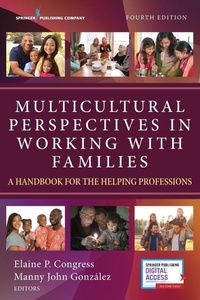
Multicultural Perspectives in Working with Families
A Handbook for the Helping Professions
4th Edition
Published on 20. May 2020
Book
Paperback/Softback
470 pages
978-0-8261-5414-9 (ISBN)
Description
Note to Readers: Publisher does not guarantee quality or access to any included digital components if book is purchased through a third-party seller.
Features a new intersectional approach to assessment and treatment and interweaves the perspectives of psychologists
Focusing on critical emerging issues in regard to multicultural families, the fourth edition of this popular book reflects fundamental issues surrounding assessment and treatment of families from diverse cultural backgrounds. The most effective treatment methods for working with culturally diverse families across the life cycle are covered in detail. Individual chapters focus on a variety of distinct ethnic groups including African American, Hispanic, Asian American, Native American, and Arab American, as well as the needs of LGBTQ multicultural families and the role of spirituality.
The text underlines the importance of an intersectional approach to working with families that, in addition to culture and ethnicity, also considers socioeconomic class, gender, age, religion, immigration status, and sexual orientation as important factors. Additionally, the text expands its direct-practice view with the addition of four new chapters written by psychologists, plus a new chapter on health issues in multicultural families and access to health services. The text is updated with the latest knowledge and research, along with new and revised case vignettes demonstrating culturally competent practice.
NEW TO THE FOURTH EDITION:Provides a new intersectional approach to assessment and treatment
Adds the perspectives of psychologists in four completely new chapters
Includes a new chapter on DSM-5 from a multicultural perspective, plus new chapters on health and access to health services
Offers the most up-to-date knowledge and research
Provides new and updated case vignettes
Reflects changes in the family unit over the last quarter century and how they impact treatment
Addresses distinct sociopolitical issues affecting immigrants and undocumented families
KEY FEATURES:Focuses on the most important emerging issues of multicultural families
Covers multicultural mental health across the life span
Encompasses the distinct perspectives of different ethnic and racial groups and those of LGBTQ families
Discusses domestic violence and substance abuse in regard to multicultural families
Delineates the most effective treatment methods
Examines the culturagram as a useful assessment and treatment planning modality
Addresses ethical issues including the NASW code of ethics
Features a new intersectional approach to assessment and treatment and interweaves the perspectives of psychologists
Focusing on critical emerging issues in regard to multicultural families, the fourth edition of this popular book reflects fundamental issues surrounding assessment and treatment of families from diverse cultural backgrounds. The most effective treatment methods for working with culturally diverse families across the life cycle are covered in detail. Individual chapters focus on a variety of distinct ethnic groups including African American, Hispanic, Asian American, Native American, and Arab American, as well as the needs of LGBTQ multicultural families and the role of spirituality.
The text underlines the importance of an intersectional approach to working with families that, in addition to culture and ethnicity, also considers socioeconomic class, gender, age, religion, immigration status, and sexual orientation as important factors. Additionally, the text expands its direct-practice view with the addition of four new chapters written by psychologists, plus a new chapter on health issues in multicultural families and access to health services. The text is updated with the latest knowledge and research, along with new and revised case vignettes demonstrating culturally competent practice.
NEW TO THE FOURTH EDITION:Provides a new intersectional approach to assessment and treatment
Adds the perspectives of psychologists in four completely new chapters
Includes a new chapter on DSM-5 from a multicultural perspective, plus new chapters on health and access to health services
Offers the most up-to-date knowledge and research
Provides new and updated case vignettes
Reflects changes in the family unit over the last quarter century and how they impact treatment
Addresses distinct sociopolitical issues affecting immigrants and undocumented families
KEY FEATURES:Focuses on the most important emerging issues of multicultural families
Covers multicultural mental health across the life span
Encompasses the distinct perspectives of different ethnic and racial groups and those of LGBTQ families
Discusses domestic violence and substance abuse in regard to multicultural families
Delineates the most effective treatment methods
Examines the culturagram as a useful assessment and treatment planning modality
Addresses ethical issues including the NASW code of ethics
More details
Edition
4th New edition
Language
English
Place of publication
New York
United States
Target group
Professional and scholarly
Edition type
New edition
Illustrations
10 Illustrations
Dimensions
Height: 229 mm
Width: 152 mm
Thickness: 25 mm
Weight
678 gr
ISBN-13
978-0-8261-5414-9 (9780826154149)
Copyright in bibliographic data and cover images is held by Nielsen Book Services Limited or by the publishers or by their respective licensors: all rights reserved.
Schweitzer Classification
Other editions
New editions

Multicultural Perspectives in Working with Individuals and Families
A Practical Approach
Book
approx. 10/2026
Springer Publishing Company
€88.03
Not yet published
Previous edition
Elaine Congress | Manny Gonzalez
Multicultural Perspectives In Social Work Practice with Families, 3rd Edition
Book
10/2012
Springer Publishing Company
€106.03
Article exhausted; check for reprint
Persons
Elaine Congress, DSW, MSW, is Professor and Associate Dean at the Fordham University Graduate School of Social Service. At the United Nations she represents three NGOs (Non-government Organizations), the International Federation of Social Workers (IFSW), the Institute of Multicultural Counseling and Education Services (IMCES), and Fordham University. Each year she oversees a group of Fordham graduate students at the United Nations. Dr. Congress is also a member of the executive committee of the NGO Committee on the Rights of Indigenous Peoples, is Vice-chair of the NGO Committee on Mental Health and is active on the NGO Committee on Migration and the Committee on the Status of Women. She has served as the North American representative on the IFSW's Permanent Committee on Ethical Issues.
Manny John Gonzalez, PhD, is an associate professor and program coordinator of the doctoral program at the Phyllis and Harvey Sandler School of Social Work at Florida Atlantic University in Boca Raton, Florida.
Manny John Gonzalez, PhD, is an associate professor and program coordinator of the doctoral program at the Phyllis and Harvey Sandler School of Social Work at Florida Atlantic University in Boca Raton, Florida.
Content
Contributors
Foreword
Preface
Acknowledgments
PART I: OVERVIEW
1. Using the Culturagram and an Intersectional Approach in Practice With Culturally Diverse Families
2. Practice With Multiracial Individuals and Families
3. Transracial Adoption and Transracial Socialization: Clinical Implications and Recommendations
4. The DSM-5 From a Multicultural Perspective
5. Evidence-Based Practice With Ethnically Diverse Clients
PART II: ADMINISTRATIVE AND LEGAL PERSPECTIVES
6. Managing Agencies for Multicultural Services
7. Legal Issues in Practice With Immigrants and Refugees
PART III: LIFE CYCLE PERSPECTIVES
8. The Multicultural Triangle of the Child, the Family, and the School: Culturally Competent Approaches
9. Cross-Cultural Perspectives on Working With Adolescents
10. Working With Culturally Diverse Older Adults
PART IV: PRACTICE WITH INDIVIDUALS AND FAMILIES FROM DIFFERENT RACIAL/ETHNIC BACKGROUNDS AND GENDER ORIENTATION
11. Practice With African American Families
12. Practice With Hispanic Individuals and Families
13. Practice With Asian Immigrant Families and Intergenerational Issues
14. Practice With Native American Families
15. Practice With Arab American Families
16. Practice With Lesbian, Gay, Bisexual, and Transgender People and Their Families
PART V: PHYSICAL AND MENTAL HEALTH ISSUES WITH MULTICULTURAL FAMILIES
17. Health Beliefs, Care, and Access of Individuals and Families From Diverse Backgrounds
18. Spirituality and Culturally Diverse Families: The Intersection of Culture, Religion, and Spirituality
19. HIV/AIDS and Latinx Families: Practice Considerations
20. Substance Abuse
21. Practice With Immigrant Victims of Domestic Violence
22. Culture, Intersectionality, and Suicide
PART VI ETHICAL ISSUES AND FUTURE DIRECTIONS
23. Ethical Issues and Future Directions
Index
Foreword
Preface
Acknowledgments
PART I: OVERVIEW
1. Using the Culturagram and an Intersectional Approach in Practice With Culturally Diverse Families
2. Practice With Multiracial Individuals and Families
3. Transracial Adoption and Transracial Socialization: Clinical Implications and Recommendations
4. The DSM-5 From a Multicultural Perspective
5. Evidence-Based Practice With Ethnically Diverse Clients
PART II: ADMINISTRATIVE AND LEGAL PERSPECTIVES
6. Managing Agencies for Multicultural Services
7. Legal Issues in Practice With Immigrants and Refugees
PART III: LIFE CYCLE PERSPECTIVES
8. The Multicultural Triangle of the Child, the Family, and the School: Culturally Competent Approaches
9. Cross-Cultural Perspectives on Working With Adolescents
10. Working With Culturally Diverse Older Adults
PART IV: PRACTICE WITH INDIVIDUALS AND FAMILIES FROM DIFFERENT RACIAL/ETHNIC BACKGROUNDS AND GENDER ORIENTATION
11. Practice With African American Families
12. Practice With Hispanic Individuals and Families
13. Practice With Asian Immigrant Families and Intergenerational Issues
14. Practice With Native American Families
15. Practice With Arab American Families
16. Practice With Lesbian, Gay, Bisexual, and Transgender People and Their Families
PART V: PHYSICAL AND MENTAL HEALTH ISSUES WITH MULTICULTURAL FAMILIES
17. Health Beliefs, Care, and Access of Individuals and Families From Diverse Backgrounds
18. Spirituality and Culturally Diverse Families: The Intersection of Culture, Religion, and Spirituality
19. HIV/AIDS and Latinx Families: Practice Considerations
20. Substance Abuse
21. Practice With Immigrant Victims of Domestic Violence
22. Culture, Intersectionality, and Suicide
PART VI ETHICAL ISSUES AND FUTURE DIRECTIONS
23. Ethical Issues and Future Directions
Index