

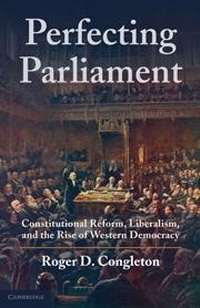
Perfecting Parliament
Constitutional Reform, Liberalism, and the Rise of Western Democracy
Published on 1. November 2010
Book
Paperback/Softback
668 pages
978-0-521-15169-6 (ISBN)
Description
This book explains why contemporary liberal democracies are based on historical templates rather than revolutionary reforms; why the transition in Europe occurred during a relatively short period in the nineteenth century; why politically and economically powerful men and women voluntarily supported such reforms; how interests, ideas, and pre-existing institutions affected the reforms adopted; and why the countries that liberalized their political systems also produced the Industrial Revolution. The analysis is organized in three parts. The first part develops new rational choice models of (1) governance, (2) the balance of authority between parliaments and kings, (3) constitutional exchange, and (4) suffrage reform. The second part provides historical overviews and detailed constitutional histories of six important countries. The third part provides additional evidence in support of the theory, summarizes the results, contrasts the approach taken in this book with that of other scholars, and discusses methodological issues.
Reviews / Votes
'If we know how we got here, we know more about how to proceed. This book is a comprehensive effort to help us understand the evolution of the political institutions of Western democracies. The analysis is generalized across several countries with separate but comparable histories. Emphasis is on peaceful processes of institutional development as opposed to romanticized revolutionary change. An exemplary exercise in explanatory social science.' James M. Buchanan, Nobel Laureate in Economics, 1986, George Mason University 'It is rare to find an economist who is a serious student of political history. Roger Congleton's new book is a powerful contribution to historical institutionalism.' Iain McLean, FBA, Oxford University 'Roger Congleton has written a masterful account of the evolution of parliamentary democracy in the West. The book is filled with insightful discussions of the transition to democracy in different countries. It should be of interest for all students of democracy.' Dennis C. Mueller, University of Vienna, Austria 'Roger Congleton has spent years perfecting his knowledge of democratic governance - an extraordinary effort of great value for scholars, students, politicians, and citizens.' Elinor Ostrom, Nobel Laureate in Economics, 2009, Indiana UniversityMore details
Language
English
Place of publication
Cambridge
United Kingdom
Target group
Professional and scholarly
Product notice
Paperback (trade)
Illustrations
14 Tables, unspecified; 16 Line drawings, unspecified
Dimensions
Height: 229 mm
Width: 154 mm
Thickness: 37 mm
Weight
901 gr
ISBN-13
978-0-521-15169-6 (9780521151696)
Copyright in bibliographic data and cover images is held by Nielsen Book Services Limited or by the publishers or by their respective licensors: all rights reserved.
Schweitzer Classification
Other editions
Additional editions
Roger D. Congleton
Perfecting Parliament
Constitutional Reform, Liberalism, and the Rise of Western Democracy
E-Book
11/2010
1st Edition
Cambridge University Press
€44.49
Available for download

Roger D. Congleton
Perfecting Parliament
Constitutional Reform, Liberalism, and the Rise of Western Democracy
Book
11/2010
Cambridge University Press
€117.60
Shipment within 15-20 days
Person
Roger D. Congleton is Professor of Economics and Senior Research Associate, Center for Study of Public Choice, at George Mason University, Fairfax, Virginia, where he has taught since 1988. His research focuses on the political economy of constitutions and public policy. Professor Congleton's most recent books include 40 Years of Research on Rent Seeking (two edited volumes, 2008), which surveys the theoretical and applied literatures on rent seeking; Democratic Constitutional Design and Public Policy (2006), which surveys the empirical literature on the effects of democratic constitutional design on public policies and economic growth; Improving Democracy through Constitutional Reform (2003), which analyzes the effects of constitutional reform on policies and economic developments within Sweden during the past two centuries; and Politics by Principle Not Interest (Cambridge University Press, 1998, written with Nobel prize winner James Buchanan), which analyzes how a generality rule can improve the performance of democratic governments. In addition to his books, Professor Congleton has published more than 100 papers in academic journals and edited volumes on such topics as the politics of constitutional reform, the importance of information in democratic decision making, the emergence and significance of norms, and analyzed policy-making within national governments and international organizations.
Content
1. On the origins of Western democracy; 2. Team production, organization, and governance; 3. Organizational governance in the long run; 4. The origins of territorial governance; 5. Constitutional exchange and divided governance; 6. The power of the purse and constitutional reform; 7. Suffrage without democracy; 8. Ideology, interest groups, and adult suffrage; 9. Setting the stage: philosophical, economic and political developments prior to the nineteenth century; 10. Liberalism and reform in the transformative century; 11. Fine-grained constitutional bargaining; 12. An overview of British constitutional history: the English king and the medieval parliament; 13. Constitutional exchange in England: from the Glorious Revolution to universal suffrage; 14. The Swedish transition to democracy; 15. Constitutional reform in the Netherlands: from republic to kingdom, to parliamentary democracy; 16. Germany: constitutional exchange in an emerging state during the nineteenth century; 17. The Japanese transition to democracy and back; 18. The United States, an exception or further illustration?; 19. Quantitative evidence of gradual reform; 20. Ideas, interests, and constitutional reform; Appendix: methodological approach, limits, and extensions.