

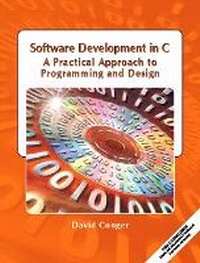
Software Development in C
A Practical Approach to Programming and Design
Published on 5. September 2002
Book
Paperback/Softback
516 pages
978-0-13-370172-2 (ISBN)
Description
For C/C++ Programming courses.
This comprehensive yet readable text teaches students C language skills and how to build complete working programs (entire software systems) in C. By the end of the book, students will have written a working text editor, will have learned program design skills, and will have been introduced to software testing and debugging.
This comprehensive yet readable text teaches students C language skills and how to build complete working programs (entire software systems) in C. By the end of the book, students will have written a working text editor, will have learned program design skills, and will have been introduced to software testing and debugging.
More details
Language
English
Place of publication
United States
Publishing group
Pearson Education (US)
Target group
Professional and scholarly
Dimensions
Height: 275 mm
Width: 210 mm
Thickness: 20 mm
Weight
1084 gr
ISBN-13
978-0-13-370172-2 (9780133701722)
Copyright in bibliographic data and cover images is held by Nielsen Book Services Limited or by the publishers or by their respective licensors: all rights reserved.
Schweitzer Classification
Person
David Conger, formerly a Professor of Computer Science and Business Computer Programming at the Albuquerque Technical-Vocational Institute, has developed software for a wide range of applications. These applications include military aircraft, games, a variety of specialized business applications, and programs for interactive TV. He currently produces custom software and technical documentation. His clients include Microsoft Corporation, for whom he has written developer documentation for the Windows Platform Software Development Kit (PSDK). The Windows subsystems he documented, in whole or in part, include DirectX, OpenGL, Extensible Scene Graph (XSG), Image Color Management (ICM), Still Image (STI), Windows Image Acquisition (WIA), Remote Procedure Calls (RPC), the Microsoft Interface Definition Language (MIDL) compiler, and the Mobile Internet Toolkit (MIT).
Content
Introduction.
1. A Brief History of C.
2. A First Look at C Programming.
3. Atomic Data Types: Integer and Floating Point Variables.
4. Atomic Data Types in C: Characters.
5. Introduction to C Operators.
6. Other Numeric Operators.
7. Logical Operators.
8. Flow Control: Branching.
9. Flow Control: Looping.
10. Single Dimensional Arrays.
11. Multidimensional Arrays.
12. User I/O, Strings, and String Functions.
13. Structured Design with Functions.
14. Programmer-Defined Data Types.
15. Designing Data Types.
16. Preprocessor Directives.
17. Organizing Programs.
18. Pointers.
19. Dynamic Memory Allocation.
20. Encapsulating Data.
21. File Input and Output.
22. Fiddling with Bits.
23. Designing the Text Editor.
24. Developing the Text Editor: TEdit.c.
25. Developing the Text Editor: TBuffer.h, TBuffer.c, TString.h, and TString.c.
26. Developing the Text Editor: InstList.h, InstList.c, MiscType.h, and Platform.h.
27. Moving to C++, C#, and Java.
Appendix A: Installing and Using Visual C++.
Appendix B: The ASCII Character Set.
Appendix C: Operator Precedence in C.
Appendix D: Binary, Decimal, and Hexadecimal Numbers.
Index.
1. A Brief History of C.
2. A First Look at C Programming.
3. Atomic Data Types: Integer and Floating Point Variables.
4. Atomic Data Types in C: Characters.
5. Introduction to C Operators.
6. Other Numeric Operators.
7. Logical Operators.
8. Flow Control: Branching.
9. Flow Control: Looping.
10. Single Dimensional Arrays.
11. Multidimensional Arrays.
12. User I/O, Strings, and String Functions.
13. Structured Design with Functions.
14. Programmer-Defined Data Types.
15. Designing Data Types.
16. Preprocessor Directives.
17. Organizing Programs.
18. Pointers.
19. Dynamic Memory Allocation.
20. Encapsulating Data.
21. File Input and Output.
22. Fiddling with Bits.
23. Designing the Text Editor.
24. Developing the Text Editor: TEdit.c.
25. Developing the Text Editor: TBuffer.h, TBuffer.c, TString.h, and TString.c.
26. Developing the Text Editor: InstList.h, InstList.c, MiscType.h, and Platform.h.
27. Moving to C++, C#, and Java.
Appendix A: Installing and Using Visual C++.
Appendix B: The ASCII Character Set.
Appendix C: Operator Precedence in C.
Appendix D: Binary, Decimal, and Hexadecimal Numbers.
Index.