

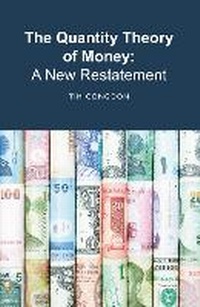
The Quantity Theory of Money
A New Restatement
Published on 13. June 2024
Book
Paperback/Softback
182 pages
978-0-255-36842-1 (ISBN)
Description
As Covid-19 hit the world's leading economies, most economists - in central banks and elsewhere - expected years of disinflation or even falling prices. To counter the supposed risks, policy-makers embarked on expansionary measures which caused money growth to reach remarkably high rates in spring and summer of 2020. In the event inflation soared in the next few quarters. In 2022 it reached the highest levels for 40 years in the USA, Europe, the UK and elsewhere. In this bold new book Congdon laments the widespread forecasting failure. From the very start - in late March 2020 - he warned both that rapid money growth was to be expected and that it would lead to a serious inflation flare-up. In rigorous but accessible language, Congdon explains the continuing analytical power of the quantity theory of money. As with other inflation episodes in the past, the inflation of the early 2020s demonstrated the force of Milton Friedman's dictum that 'inflation is always and everywhere a monetary phenomenon'.
More details
Language
English
Place of publication
London
United Kingdom
Dimensions
Height: 198 mm
Width: 129 mm
ISBN-13
978-0-255-36842-1 (9780255368421)
Copyright in bibliographic data and cover images is held by Nielsen Book Services Limited or by the publishers or by their respective licensors: all rights reserved.
Schweitzer Classification
Other editions
Additional editions
Tim Congdon
The Quantity Theory of Money: A New Restatement
E-Book
06/2024
1st Edition
London Publishing Partnership
€14.49
Available for download
Person
Tim Congdon is an economist and businessman. For almost 50 years, he has been a consistent advocate of free markets and sound money in the UK policy debate. One of his themes is that banking and money growth have powerful influences on macroeconomic outcomes. He is currently chair of the Institute of International Monetary Research, which he founded in 2014. The Institute is based at the University of Buckingham, where he is a professor of economics. He was a member of the Treasury Panel of Independent Forecasters (the so-called 'wise persons') between 1992 and 1997, which advised the Chancellor of the Exchequer in a successful period for UK economic policy. He has been an advocate of money targeting to control inflation (and deflation) since his first job as an economic journalist on The Times between 1973 and 1976. He worked in the City of London from 1976 to 2005, where he explained the implications of macroeconomic trends for securities prices and asset allocation. He set up the influential consultancy, Lombard Street Research (now TS Lombard), in 1989.