

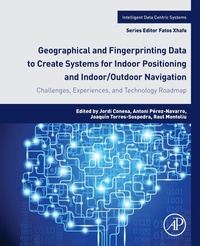
Geographical and Fingerprinting Data for Positioning and Navigation Systems
Challenges, Experiences and Technology Roadmap
Published on 14. September 2018
Book
Paperback/Softback
403 pages
978-0-12-813189-3 (ISBN)
Description
Geographical and Fingerprinting Data for Positioning and Navigation Systems: Challenges, Experiences and Technology Roadmap explores the state-of-the -art software tools and innovative strategies to provide better understanding of positioning and navigation in indoor environments using fingerprinting techniques. The book provides the different problems and challenges of indoor positioning and navigation services and shows how fingerprinting can be used to address such necessities. This advanced publication provides the useful references educational institutions, industry, academic researchers, professionals, developers and practitioners need to apply, evaluate and reproduce this book's contributions.
The readers will learn how to apply the necessary infrastructure to provide fingerprinting services and scalable environments to deal with fingerprint data.
The readers will learn how to apply the necessary infrastructure to provide fingerprinting services and scalable environments to deal with fingerprint data.
More details
Series
Language
English
Place of publication
San Diego
United States
Publishing group
Elsevier Science Publishing Co Inc
Target group
Professional and scholarly
Researchers and PhD students in the geographical information systems, geography and machine learning domain
Product notice
Paperback (trade)
Dimensions
Height: 235 mm
Width: 191 mm
Thickness: 21 mm
Weight
696 gr
ISBN-13
978-0-12-813189-3 (9780128131893)
Copyright in bibliographic data and cover images is held by Nielsen Book Services Limited or by the publishers or by their respective licensors: all rights reserved.
Schweitzer Classification
Other editions
Additional editions
Jordi Conesa | Antoni Pérez-Navarro | Joaquin Torres-Sospedra
Geographical and Fingerprinting Data for Positioning and Navigation Systems
Challenges, Experiences and Technology Roadmap
E-Book
10/2018
Academic Press
€131.00
Available for download
Persons
Jordi Conesa is an associate professor of computer science at the Universitat Oberta de Catalunya. He received his PhD in software engineering from the Technical University of Catalonia, after a research stay in Georgia State University of Atlanta (US). His research interest concerns the areas of conceptual modelling, ontologies, semantic web, knowledge-based systems, and e-learning. His long-term goal is to develop methodologies and tools to use ontologies effectively in several application domains, such as conceptual modelling, software engineering, and e-learning. He has authored more than 60 research papers, has participated in several research projects, including EU-FP7, CICYT and AVANZA funded projects, and has contributed in the organization of international conferences and has been program chair and program committee member of several international conferences. Finally, he also serves as external reviewer for many conferences and journals. Dr. Antoni Perez-Navarro has a PhD in Physics from the Universitat Autonoma de Barcelona and Is graduated in Physics from the same university. His research domain is mainly focused in location bases systems (LBS) and context aware recommendation systems, outdoors as well as indoors, and its applications mainly to health and tourism. He has worked as physics and geographic information systems lecturer at several institutions: Universitat Oberta de Catalunya UOC, Universitat Autonoma de Barcelona, Escola Universitaria Salesiana de Sarria and Institut Cartografic de Catalunya. He has also 5 years of experience as project manager in a GIS company, Aurensis, S.L. His main research interests are indoor positioning and prevention of deseases via smartphones. He has lead the project Itiner@ where a Context Aware Recommender System was created. Regarding education, his main contributions are mathematical notation in physics and mathematics in online environments; and the introduction of video as a learning tool in the virtual classroom, which received the Best Innovation Project Award at UOC in 2010 with the project Present@. He has published over 12 articles in journals indexed in ISI-JCR and has supervided over 14 MSc theses already completed. Nowadays he is supervising three PhD Thesis He holds a Bachelor's Degree in Computer Science (2003) and a PhD with distinction (2011), both from Universitat Jaume I. His main research interests are in the areas of Indoor Positioning and Navigation, Wi-Fi fingerprinting, Machine Learning, Pattern Recognition, Multiple Classifier Systems, Sensor Fusion, Knowledge-based Systems and Interoperability. As a result of his work, during the last years, he published over 70 research contributions as books, book chapters, international journals and conference papers, he served as a reviewer in different international journals and conferences, has participated in 10 different research projects, and advised 1 Phd student. He holds a Bachelor's Degree in Computer Science (1998) and a PhD with distinction (2008), both from Universitat Jaume I. His current research interests include indoor localization and navigation, human and social behavior from sensor data, sport video analysis and surveillance applications. As a result of his work, during the last years, he published over 45 research contributions as books, book chapters, international journals and conference papers, he served as a reviewer in different international journals and conferences, has participated in 10 different research projects, and advised 2 Phd student.
Editor
Faculty of Computer Sciences,Multimedia and Telecommunication, eHealth
Center at Universitat Oberta de Catalunya (UOC), Barcelona, Spain
Center at Universitat Oberta de Catalunya (UOC), Barcelona, Spain
Faculty of Computer Sciences,Multimedia and Telecommunication at
Universitat Oberta de Catalunya (UOC), Barcelona;
Internet Interdisciplinary Institute (IN3), Castelldefels, Spain
Universitat Oberta de Catalunya (UOC), Barcelona;
Internet Interdisciplinary Institute (IN3), Castelldefels, Spain
Institute of New Imaging Technologies, Jaume I University, Castellon, Spain
Institute of New Imaging Technologies, Jaume I University, Castellon, Spain
Content
1. Challenges of Fingerprinting in Indoor Positioning and Navigation
2. Wi-Fi Tracking Threatens Users' Privacy in Fingerprinting Techniques
3. Lessons Learned in Generating Ground Truth for Indoor Positioning Systems Based on Wi-Fi Fingerprinting
4. Radio Maps for Fingerprinting in Indoor Positioning
5. Crowdsourced Indoor Mapping
6. Study and Evaluation of Selected RSSI-Based Positioning Algorithms
7. Low-Complexity Offline and Online Strategies for Wi-Fi Fingerprinting Indoor Positioning Systems
8. Radio Fingerprinting-Based Indoor Localization: Overcoming Practical Challenges
9. Mapping Indoor Environments: Challenges Related to the Cartographic Representation and Routes
10. OGC IndoorGML: A Standard Approach for Indoor Maps
11. The EvAAL Evaluation Framework and the IPIN Competitions
12. IndoorLoc Platform: A Web Tool to Support the Comparison of Indoor Positioning Systems
13. Challenges and Solutions in Received Signal Strength-Based Seamless Positioning
14. Deployment of a Passive Localization System for Occupancy Services in a Lecture Building
15. Remote Monitoring for Safety of Workers in Industrial Plants: Learned Lessons Beyond Technical Issues
16. A Review of Indoor Localization Methods Based on Inertial Sensors
17. Fundamentals of Airborne Acoustic Positioning Systems
18. Indoor Positioning System Based on PSD Sensor
2. Wi-Fi Tracking Threatens Users' Privacy in Fingerprinting Techniques
3. Lessons Learned in Generating Ground Truth for Indoor Positioning Systems Based on Wi-Fi Fingerprinting
4. Radio Maps for Fingerprinting in Indoor Positioning
5. Crowdsourced Indoor Mapping
6. Study and Evaluation of Selected RSSI-Based Positioning Algorithms
7. Low-Complexity Offline and Online Strategies for Wi-Fi Fingerprinting Indoor Positioning Systems
8. Radio Fingerprinting-Based Indoor Localization: Overcoming Practical Challenges
9. Mapping Indoor Environments: Challenges Related to the Cartographic Representation and Routes
10. OGC IndoorGML: A Standard Approach for Indoor Maps
11. The EvAAL Evaluation Framework and the IPIN Competitions
12. IndoorLoc Platform: A Web Tool to Support the Comparison of Indoor Positioning Systems
13. Challenges and Solutions in Received Signal Strength-Based Seamless Positioning
14. Deployment of a Passive Localization System for Occupancy Services in a Lecture Building
15. Remote Monitoring for Safety of Workers in Industrial Plants: Learned Lessons Beyond Technical Issues
16. A Review of Indoor Localization Methods Based on Inertial Sensors
17. Fundamentals of Airborne Acoustic Positioning Systems
18. Indoor Positioning System Based on PSD Sensor