

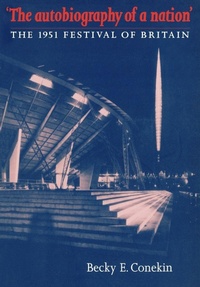
The Autobiography of a Nation
The 1951 Festival of Britain
Published on 27. March 2003
Book
Paperback/Softback
272 pages
978-0-7190-6060-1 (ISBN)
Description
The first full-length study on the 1951 Festival of Britain. An examination of how Britain and Britishness were portrayed in the 1951's Festival's exhibitions and events. Covers the Festival's history and historiography, its purpose, its representations of the future and the past, the role of London and the 'local', the British Empire and finally its legacy. -- .
More details
Series
Language
English
Place of publication
Manchester
United Kingdom
Target group
College/higher education
Professional and scholarly
Illustrations
Illustrations, black & white
Dimensions
Height: 244 mm
Width: 170 mm
Thickness: 15 mm
Weight
482 gr
ISBN-13
978-0-7190-6060-1 (9780719060601)
Copyright in bibliographic data and cover images is held by Nielsen Book Services Limited or by the publishers or by their respective licensors: all rights reserved.
Schweitzer Classification
Person
Becky E. Conekin is a Research Fellow and Lecturer at the London College of Fashion, The London Institute -- .
Content
List of Illustrations
Acknowledgements
Section 1: Introducing the Festival
1. The Background: history and historiography
2. The Festival's People and Purposes
Section 2: Time
3. The Festival's representations of the future
4. The Festival's representations of the past
Section 3: Place
5. London-based representations of the metropole and the 'regions'
6. The role of 'the local' in the Festival
7. The place that was almost absent: the British Empire
8. The place of escape and edification: the Battersea Pleasure Gardens
Section 4: Conclusion
9. Conclusion: The Festival and its legacy
Select Bibliography
Appendices
Index -- .
Acknowledgements
Section 1: Introducing the Festival
1. The Background: history and historiography
2. The Festival's People and Purposes
Section 2: Time
3. The Festival's representations of the future
4. The Festival's representations of the past
Section 3: Place
5. London-based representations of the metropole and the 'regions'
6. The role of 'the local' in the Festival
7. The place that was almost absent: the British Empire
8. The place of escape and edification: the Battersea Pleasure Gardens
Section 4: Conclusion
9. Conclusion: The Festival and its legacy
Select Bibliography
Appendices
Index -- .