

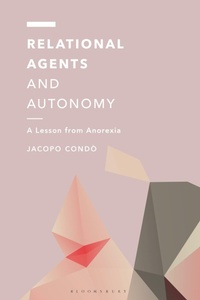
Relational Agents and Autonomy
A Lesson from Anorexia
Published on 14. May 2026
Book
Hardback
216 pages
978-1-350-61166-5 (ISBN)
Description
A critical examination of how value-neutral policy fails patients with anorexia nervosa, and what anorexia can teach us about liberal autonomy.
Reconsidering and reframing autonomy through the lived experiences of individuals with anorexia nervosa, Relational Agents and Autonomy challenges our current perspectives on personal agency, especially in medical settings. The central question this book poses revolves around the widely accepted but inadequately examined "value-neutral" conception of autonomy. Value-neutral perspectives claim to have an objective view of individual decisions by considering them as purely private and isolated matters, without recognizing the broader frameworks - moral, social, historical, and cultural - encompassing the decision-maker.
The heart of this book lies in the powerful narratives of individuals grappling with anorexia that invite readers to reconsider their deeply held understandings of personal autonomy. It offers a detailed exploration of self-respect, self-worth, self-trust, relational responsibility, and dialogical accountability as these intersect with the autonomy of individuals in a healthcare setting. Bringing together clinical data, philosophical theory and legal doctrine, and probing current ethical and legal assumptions, it shines a light on the conceptual and practical challenges associated with understanding and treating this complex disorder.
Challenging the traditionally accepted view of the human agent as an independent, private entity, this book contends that autonomy is not a mere characteristic of an isolated individual, but is dynamically shaped and constituted by a broad range of factors, from interpersonal relationships, societal norms, and dialogical capacities, to cultural contexts, personal histories and wider narratives.
Reconsidering and reframing autonomy through the lived experiences of individuals with anorexia nervosa, Relational Agents and Autonomy challenges our current perspectives on personal agency, especially in medical settings. The central question this book poses revolves around the widely accepted but inadequately examined "value-neutral" conception of autonomy. Value-neutral perspectives claim to have an objective view of individual decisions by considering them as purely private and isolated matters, without recognizing the broader frameworks - moral, social, historical, and cultural - encompassing the decision-maker.
The heart of this book lies in the powerful narratives of individuals grappling with anorexia that invite readers to reconsider their deeply held understandings of personal autonomy. It offers a detailed exploration of self-respect, self-worth, self-trust, relational responsibility, and dialogical accountability as these intersect with the autonomy of individuals in a healthcare setting. Bringing together clinical data, philosophical theory and legal doctrine, and probing current ethical and legal assumptions, it shines a light on the conceptual and practical challenges associated with understanding and treating this complex disorder.
Challenging the traditionally accepted view of the human agent as an independent, private entity, this book contends that autonomy is not a mere characteristic of an isolated individual, but is dynamically shaped and constituted by a broad range of factors, from interpersonal relationships, societal norms, and dialogical capacities, to cultural contexts, personal histories and wider narratives.
Reviews / Votes
What can we learn about autonomy by thinking about the challenges of severe eating disorders? And what can we learn about eating disorders by thinking through the lens of autonomy? These are the questions that Jacopo Condo takes up in this penetrating book. Condo draws on a broad array of research materials ranging from biomedical research to case law to feminism and disability studies, with a particular focus on relational and dialogical approaches to autonomy. His book manages to be at once philosophically sophisticated and highly relevant to the practice of those professionals who struggle with the sometimes excruciating clinical, ethical, legal dilemmas that arise in attempts to support this challenging and vulnerable patient group. * Wayne Martin, University of Essex, UK * This nuanced and provocative book tackles the clinically, legally, and philosophically vexed issues surrounding refusal of treatment by individuals who are intentionally starving themselves. Cordo's contextually grounded and theoretically sophisticated challenge to dominant value-neutral conceptions of autonomy yields new practical insights and contributes significantly to relational approaches to autonomy. * Joel Anderson, Utrecht University, the Netherlands *More details
Series
Language
English
Place of publication
London
United Kingdom
Publishing group
Bloomsbury Publishing PLC
Target group
Professional and scholarly
Illustrations
10 bw illus
Dimensions
Height: 240 mm
Width: 161 mm
Thickness: 16 mm
Weight
487 gr
ISBN-13
978-1-350-61166-5 (9781350611665)
Copyright in bibliographic data and cover images is held by Nielsen Book Services Limited or by the publishers or by their respective licensors: all rights reserved.
Schweitzer Classification
Other editions
Additional editions
E-Book
04/2026
1st Edition
Bloomsbury Academic
€94.49
Available for download
E-Book
04/2026
1st Edition
Bloomsbury Academic
€94.49
Available for download
Person
Jacopo Condo is postdoctoral researcher at INDIRE (Istituto Nazionale di Documentazione, Innovazione e Ricerca Educativa), Italy. His research intersects various domains including moral and political philosophy, epistemology, and psychiatric disorders. He received his Ph.D. in Philosophy (Applied Ethics) from the University of Brighton and Sussex Medical School in 2022. Dr. Condo's professional journey is marked by diverse roles - from an educator imparting knowledge of Philosophy and History in Italian high schools to a tutor at the University of Brighton, and from a private tutor fostering individual academic growth to a representative for the international association "Diculther" for the "European Cultural Project" under the Erasmus+ Programme. Dr. Condo also makes contributions to academic discourse. He serves as a reviewer for academic journals (Umanistica Digitale, Culture Digitali) and acts as a committee member for cultural organizations (Diculther, ISRF).
Content
Introduction
1. Ethereal Anorexia
2. Anorexic Patients and Normative Gaps
3. Bridging the Divide Between Autonomy, Reasons, and Values
4. Overcoming the Monological Framework: Relationality and Conditions of Exercise of Autonomy
5. Anorexic Patients and Relational Conditions: Practices of Dialogical Responsibility
Conclusion: Radical Commitments: A Responsive Take on Autonomy, Vulnerability, and Independence
1. Ethereal Anorexia
2. Anorexic Patients and Normative Gaps
3. Bridging the Divide Between Autonomy, Reasons, and Values
4. Overcoming the Monological Framework: Relationality and Conditions of Exercise of Autonomy
5. Anorexic Patients and Relational Conditions: Practices of Dialogical Responsibility
Conclusion: Radical Commitments: A Responsive Take on Autonomy, Vulnerability, and Independence