

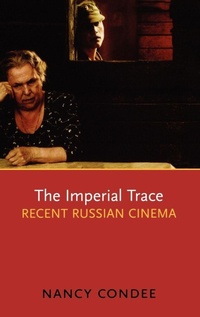
The Imperial Trace
Recent Russian Cinema
Published on 8. October 2009
Book
Hardback
360 pages
978-0-19-536676-1 (ISBN)
Description
The collapse of the USSR seemed to spell the end of the empire, yet it by no means marked the end of Russia's enduring imperial preoccupations, extending over four and a half centuries since the reign of Ivan IV. Is there such a thing as an imperial trace in Russia's contemporary culture? Condee argues that we cannot make sense of contemporary Russian culture without accounting for its imperial legacy and mapping out the terms of such an analysis. She turns to the instance of contemporary cinema to focus this line of inquiry. Within film (and implicitly other cultural fields as well) do we limit our accounting to narrative evidence-Chechen wars at the periphery, historical costume dramas of court life-or could an imperial trace be sought in other, more embedded ways, in the manner and structure or representation, the conditions of productions, the recurrent preoccupations of its leading filmmakers, the ways in which collective belonging is figured or disfigured? This book organizes these questions around the work of Russia's internationally ranked auteurs of the late Soviet and post-Soviet period: Kira Muratova, Vadim Abdrashitov, Nikita Mikhalkov, Aleksei German, and Aleksandr Sokurov.
Reviews / Votes
The Imperial Trace is hands down the most thought-provoking book that I have read in quite some time. It is as well (and wittily) written as it is thoroughly researched and skillfully argued, no mean feat given the complexity of the ideas therein. This superb book is essential reading for anyone interested in nations and empire and their cultural manifestations, in Russian cultural politics, and in late Soviet and contemporary Russian film. * Slavic Review * Offers some compelling interpretations for six of Russia's contemporary directors. This is greatly appreciated and provides a starting point for other such scholarly discussions...Condee provides much insight into late- and post-Soviet cinema, which will be a relevant source for future scholarship. * Slavic and East European Journal * Imperial Trace provides insightful, always absorbing, sometimes provocative readings of the dialogue with the imperial legacy in the work of the six most significant film directors working in contemporary Russia. * Julian Graffy, University College London * This is a book full of surprises; rather than settling issues, it breaks open the discussion. * Ronald Grigor Suny, University of Michigan * This study represents not only a superb overview and nuanced reading of works by major Russian filmmakers bridging the late Soviet and post-Soviet period, but also a groundbreaking study of the intersection between constructions of empire, cultural institutions, and cinematic texts. * Catharine Nepomnyashchy, Columbia University *More details
Language
English
Place of publication
New York
United States
Target group
College/higher education
Professional and scholarly
Illustrations
20 halftones
Dimensions
Height: 240 mm
Width: 161 mm
Thickness: 24 mm
Weight
708 gr
ISBN-13
978-0-19-536676-1 (9780195366761)
Copyright in bibliographic data and cover images is held by Nielsen Book Services Limited or by the publishers or by their respective licensors: all rights reserved.
Schweitzer Classification
Other editions
Additional editions
E-Book
04/2009
1st Edition
OUP eBook
€27.49
Available for download
E-Book
04/2009
1st Edition
OUP eBook
€20.99
Available for download
Person
Nancy Condee is on the Slavic and Film Studies faculty at the University of Pittsburgh. She has been Director of the Graduate Program for Cultural Studies for over a decade (1995-2006) and is a Senior Associate Member of St. Antony's College (Oxford University). She is co-founder and co-editor of the journal Studies in Russian and Soviet Cinema, and serves on a number of editorial and advisory boards, including Kinokultura, Critical Quarterly, and Russian Studies in Literature. She is a member of the Russian Guild of Cinema Scholars and Critics (Union of Cinematographers of the Russian Federation) and is one of two US scholars annually for over a decade invited to and supported by the Kinotavr Film Festival (Sochi), Russia's leading post-socialist film festival. She has served for six years as Chair of the Board of Directors of the National Council for Eurasian and East European Research, the largest US grant agency for social-science research in the former socialist bloc.
Content
List of Illustrations ; Acknowledgements ; 1. Introduction: Custodian of the Empire ; 2. Cine-Amnesia: How Russia Forgot to Go to the Movies ; 3. Mikhalkov: European but Not Western ; 4. Muratova: The Zoological Imperium ; 5. Abdrashitov-Mindadze: A Comuunity of Somnambulants ; 6. Sokurov: Shuffling Off the Imperial Coil ; 7. German: Forensics in the Dynastic Capital ; 8. Balabanov: The Metropole's Death Drive ; 9. Postscript ; References ; Index