

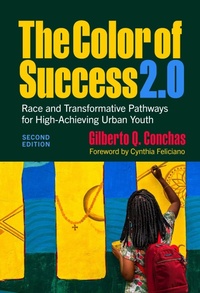
The Color of Success 2.0
Race and Transformative Pathways for High-Achieving Urban Youth
2nd Edition
Published on 26. July 2024
Book
Paperback/Softback
240 pages
978-0-8077-6990-4 (ISBN)
Description
The first edition of The Color of Success was a groundbreaking, asset-based exploration of the educational trajectories of high-achieving, low-income students within urban schools. The author brings his now seminal book up to date with insights based on existing and new research, current policies, and innovative pedagogical approaches. Conchas utilizes a critical lens to examine the intersectional identities of racially minoritized students, the role of existing power hierarchies within schools, and offers specific structural approaches that create educational opportunity. The Color of Success 2.0 amplifies student voice; explores school, family, and community partnerships; promotes culturally relevant pedagogy and teacher preparation; includes a new chapter on Black male optimism after the historic election of President Barack Obama; and offers a thought-provoking additional chapter on the role of educational leaders in promoting successful school pathways; plus, a thoroughly revised quantitative chapter on social capital. With a sense of urgency, readers will gain vital insights for understanding what is needed to create, promote, and expand equitable school environments and transformative pathways for racially minoritized urban youth.
Book Features:
Takes a rare look at Black, Latinx, and Vietnamese urban school success stories, instead of those depicting failure.
Includes narratives and perspectives of students' daily struggles, affirmations, and successes in their quest to navigate school and beyond.
Uses mixed-methods research to respond to the challenges of a new post-pandemic political reality of racial unrest and an unequal social landscape.
Examines the role of educational leaders' responsibility as change agents to provide equitable and dynamic pathways for success.
Book Features:
Takes a rare look at Black, Latinx, and Vietnamese urban school success stories, instead of those depicting failure.
Includes narratives and perspectives of students' daily struggles, affirmations, and successes in their quest to navigate school and beyond.
Uses mixed-methods research to respond to the challenges of a new post-pandemic political reality of racial unrest and an unequal social landscape.
Examines the role of educational leaders' responsibility as change agents to provide equitable and dynamic pathways for success.
More details
Edition
Second Edition
Language
English
Place of publication
New York
United States
Target group
Professional and scholarly
Edition type
New edition
Product notice
Paperback (trade)
Unsewn / adhesive bound
Dimensions
Height: 228 mm
Width: 157 mm
Thickness: 12 mm
Weight
354 gr
ISBN-13
978-0-8077-6990-4 (9780807769904)
Copyright in bibliographic data and cover images is held by Nielsen Book Services Limited or by the publishers or by their respective licensors: all rights reserved.
Schweitzer Classification
Persons
Gilberto Q. Conchas is the Wayne K. and Anita Woolfolk Hoy Endowed Chair of Education at The Pennsylvania State University. His books include Race Frames in Education: Structuring Inequality and Opportunity in a Changing Society coedited with Sophia Rodriguez.
Content
Contents
Foreword to the 1st Edition ?vii
Foreword to the 2nd Edition ?xi
Preface ?xv
Acknowledgments ?xix
Introduction: Race and Transformative Pathways to High-Achieving Urban Youth ?1
The OG: The Color of Success ?2
The Color of Success 2.0: New Research, Emerging Research, and Praxis ?3
Minimizing Inequity and Promoting Opportunity ?5
Semantic Conventions ?6
Case Study Research Approach and Design ?7
On My Subjectivity as a Chicana/o/x Researcher ?11
Organization of this Book ?14
1. ?A Critical Perspective of the Challenges Confronting Students of Color: Toward a Conceptual Framework of Transformative Urban School Pathways ?18
Issues Associated With Educational Inequity ?19
Cultural-Ecological Explanations of Low Academic Performance Among Racially Minoritized Students ?21
Complicating the Cultural Ecological Framework ?24
School Processes and Engagement Among Students of Color ?25
The Student Voice of High-Achieving Minoritized Youth ?27
Confronting Segregation and Stereotypes ?28
Valuing Minoritized Students' Experiences to Promote Urban School Success ?30
Conclusion ?30
2. ?Balkanization in Urban School Spaces: Integrated and Segregated Organizational Cultures and Structures Side-by-Side ?32
Racial Segregation, Engagement, and Performance ?33
Baldwin High School as the Case Study Setting ?33
Why a California High School? ?35
The General School Climate as Perceived by Teachers and Students ?36
Non-Belonging Student Perceptions of the General School Pathway ?38
The College and Career Academies ?41
Mediating Distinct Peer Relations ?50
Conclusion ?51
3. ?"We Just Make the Best of What We Have": Immigrant and U.S-Born Vietnamese American Youth Surfing the "Model Minority" Wave of Success ?52
Background on Asian American Student Achievement ?53
Vietnamese Origin Students at Baldwin High School ?56
Gender and the Construction of Student Ability ?58
Academic Identity Groups among High-Achieving Vietnamese Students ?59
Understanding the "Model Minority" Stereotype ?59
Structuring Competition Versus Collaborative Learning ?61
Benefiting from the "Model Minority" Typology ?62
Conclusion ?64
4. ?"I Want to Make a Difference": Understanding Immigrant and U.S.- Born Latina/o/x Students' Variability in Academic Aspirations, School Engagement, and Optimism ?66
Background on Latina/o/x School Achievement ?67
School Opportunity Structure and Racial Perceptions ?68
Identity Formation Among Latina/o/x Students ?70
Responses of High-Achieving Latina/o/x Students ?71
Creating Optimism Despite Inequity Among Medical Academy Latina/o/xs ?77
Conclusion ?79
5. ?"Nothing Can Stop Me Now": Constructing Black Student Aspirations, Expectations, and School Success ?81
Background on Black Student Achievement ?81
The Situation at Baldwin High School ?84
The Academy Experience at Baldwin High School ?88
A Closer Look at Black Males, Aspirations, and Expectations ?93
A Closer Look at Black Females, Aspirations, and Expectations ?96
Conclusion ?98
6. ?"(Obama) Becomin' President Kinda Raise the Bar on What You're Doin' ": Perceptions of Opportunity and Constraining Aspirations Among Black Male Youth During a Time of Historic Change ?101
Oppositional Culture as Institutional Phenomenon ?103
Historical Significance of the Election of Barack Obama ?104
Promoting Academic Achievement for Students of Color ?105
The Palmview Male Cooperative ?107
PMC Students on Social Mobility, Racial Inequality, and Marginalization ?109
The PMC as a Source of Social Capital, Cultural Capital, and Brotherhood ?114
The PMC and Academic Achievement ?122
Conflicting and Constraining Student Perspectives on Aspirations ?123
How Can We Explain This Perplexing Phenomenon? ?126
Conclusion ?129
7. ?Institutional Change Agents: Student-Centered Approaches, Culture Shifts, and the Construction of Pathways for Urban School Success ?131
College and Career Academies as Small Learning Communities ?134
Unraveling School Success's Approach to Providing TA ?136
Overview of School Success ?137
School Success and Technical Assistance ?137
Why and How School Success Promotes the Four Pillars of Linked Learning ?141
Discussion of School Success's Current State and Future in the School Change Landscape ?149
Conclusion ?153
8. ?"We Are Like a Family . . . We Know Each Other Well and Get Along": Teacher and Peer Relationships as (Pre)conditions for the Potential Realization of Social Capital ?155
Preconditions for the Realization of Social Capital ?157
Time Students Spend on Homework Outside of School ?160
A Novel Approach for Examining Familial and School Preconditions for Social Capital ?160
Findings From the Data in Five Steps ?166
Conclusion ?177
9. ?Racial Inequity and Transformative Educational Pathways Informing Policy and Praxis: Wrapping It all Up ?180
Institutional Processes, Social Support Systems, and School Success ?181
Student Ideology, Institutional Mechanisms, and Social Support Systems ?182
Summary of the Key Findings and Policy Recommendations ?186
Implications for Further Research ?190
Policy and Praxis Limitations ?191
Conclusion ?193
References ?195
Index ?213
About the Author ?220
Foreword to the 1st Edition ?vii
Foreword to the 2nd Edition ?xi
Preface ?xv
Acknowledgments ?xix
Introduction: Race and Transformative Pathways to High-Achieving Urban Youth ?1
The OG: The Color of Success ?2
The Color of Success 2.0: New Research, Emerging Research, and Praxis ?3
Minimizing Inequity and Promoting Opportunity ?5
Semantic Conventions ?6
Case Study Research Approach and Design ?7
On My Subjectivity as a Chicana/o/x Researcher ?11
Organization of this Book ?14
1. ?A Critical Perspective of the Challenges Confronting Students of Color: Toward a Conceptual Framework of Transformative Urban School Pathways ?18
Issues Associated With Educational Inequity ?19
Cultural-Ecological Explanations of Low Academic Performance Among Racially Minoritized Students ?21
Complicating the Cultural Ecological Framework ?24
School Processes and Engagement Among Students of Color ?25
The Student Voice of High-Achieving Minoritized Youth ?27
Confronting Segregation and Stereotypes ?28
Valuing Minoritized Students' Experiences to Promote Urban School Success ?30
Conclusion ?30
2. ?Balkanization in Urban School Spaces: Integrated and Segregated Organizational Cultures and Structures Side-by-Side ?32
Racial Segregation, Engagement, and Performance ?33
Baldwin High School as the Case Study Setting ?33
Why a California High School? ?35
The General School Climate as Perceived by Teachers and Students ?36
Non-Belonging Student Perceptions of the General School Pathway ?38
The College and Career Academies ?41
Mediating Distinct Peer Relations ?50
Conclusion ?51
3. ?"We Just Make the Best of What We Have": Immigrant and U.S-Born Vietnamese American Youth Surfing the "Model Minority" Wave of Success ?52
Background on Asian American Student Achievement ?53
Vietnamese Origin Students at Baldwin High School ?56
Gender and the Construction of Student Ability ?58
Academic Identity Groups among High-Achieving Vietnamese Students ?59
Understanding the "Model Minority" Stereotype ?59
Structuring Competition Versus Collaborative Learning ?61
Benefiting from the "Model Minority" Typology ?62
Conclusion ?64
4. ?"I Want to Make a Difference": Understanding Immigrant and U.S.- Born Latina/o/x Students' Variability in Academic Aspirations, School Engagement, and Optimism ?66
Background on Latina/o/x School Achievement ?67
School Opportunity Structure and Racial Perceptions ?68
Identity Formation Among Latina/o/x Students ?70
Responses of High-Achieving Latina/o/x Students ?71
Creating Optimism Despite Inequity Among Medical Academy Latina/o/xs ?77
Conclusion ?79
5. ?"Nothing Can Stop Me Now": Constructing Black Student Aspirations, Expectations, and School Success ?81
Background on Black Student Achievement ?81
The Situation at Baldwin High School ?84
The Academy Experience at Baldwin High School ?88
A Closer Look at Black Males, Aspirations, and Expectations ?93
A Closer Look at Black Females, Aspirations, and Expectations ?96
Conclusion ?98
6. ?"(Obama) Becomin' President Kinda Raise the Bar on What You're Doin' ": Perceptions of Opportunity and Constraining Aspirations Among Black Male Youth During a Time of Historic Change ?101
Oppositional Culture as Institutional Phenomenon ?103
Historical Significance of the Election of Barack Obama ?104
Promoting Academic Achievement for Students of Color ?105
The Palmview Male Cooperative ?107
PMC Students on Social Mobility, Racial Inequality, and Marginalization ?109
The PMC as a Source of Social Capital, Cultural Capital, and Brotherhood ?114
The PMC and Academic Achievement ?122
Conflicting and Constraining Student Perspectives on Aspirations ?123
How Can We Explain This Perplexing Phenomenon? ?126
Conclusion ?129
7. ?Institutional Change Agents: Student-Centered Approaches, Culture Shifts, and the Construction of Pathways for Urban School Success ?131
College and Career Academies as Small Learning Communities ?134
Unraveling School Success's Approach to Providing TA ?136
Overview of School Success ?137
School Success and Technical Assistance ?137
Why and How School Success Promotes the Four Pillars of Linked Learning ?141
Discussion of School Success's Current State and Future in the School Change Landscape ?149
Conclusion ?153
8. ?"We Are Like a Family . . . We Know Each Other Well and Get Along": Teacher and Peer Relationships as (Pre)conditions for the Potential Realization of Social Capital ?155
Preconditions for the Realization of Social Capital ?157
Time Students Spend on Homework Outside of School ?160
A Novel Approach for Examining Familial and School Preconditions for Social Capital ?160
Findings From the Data in Five Steps ?166
Conclusion ?177
9. ?Racial Inequity and Transformative Educational Pathways Informing Policy and Praxis: Wrapping It all Up ?180
Institutional Processes, Social Support Systems, and School Success ?181
Student Ideology, Institutional Mechanisms, and Social Support Systems ?182
Summary of the Key Findings and Policy Recommendations ?186
Implications for Further Research ?190
Policy and Praxis Limitations ?191
Conclusion ?193
References ?195
Index ?213
About the Author ?220