

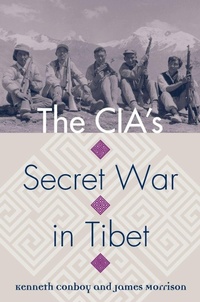
The CIA's Secret War in Tibet
Published on 30. April 2002
Book
Paperback/Softback
302 pages
978-0-7006-1788-3 (ISBN)
Description
Defiance against Chinese oppression has been a defining characteristic of Tibetan life for more than four decades, symbolized most visibly by the much revered Dalai Lama. But the story of Tibetan resistance weaves a far richer tapestry than anyone might have imagined. Kenneth Conboy and James Morrison reveal how America's Central Intelligence Agency encouraged Tibet's revolt against China-and eventually came to control its fledgling resistance movement. While the CIA's presence in Tibet has been alluded to in other works, the authors provide the first comprehensive, as well as most compelling account of this little known agency enterprise.
The CIA's Secret War in Tibet takes readers from training camps in the Colorado Rockies to the scene of clandestine operations in the Himalayas, chronicling the agency's help in securing the Dalai Lama's safe passage to India and subsequent initiation of one of the most remote covert campaigns of the Cold War. Establishing a rebel army in the northern Nepali kingdom of Mustang and a para-commando force in India designed to operate behind Chinese lines, Conboy and Morrison provide previously unreported details about secret missions undertaken in extraordinarily harsh conditions. Their book greatly expands on previous memoirs by CIA officials by putting virtually every major agency participant on record with details of clandestine operations. It also calls as witnesses the people who managed and fought in the program-including Tibetan and Nepalese agents, Indian intelligence officers, and even mission aircrews.
Conboy and Morrison take pains to tell the story from all perspectives, particularly that of the former Tibetan guerrillas, many of whom have gone on record here for the first time. The authors also tell how Tibet led America and India to become secret partners over the course of several presidential administrations and cite dozens of Indian and Tibetan intelligence documents directly related to these covert operations. Ultimately, they are persuasive that the Himalayan operations were far more successful as a proving ground for CIA agents who were later reassigned to southeast Asia than as a staging ground for armed rebellion.
As the movement for Tibetan liberation continues to attract international support, Tibet's status remains a contentious issue in both Washington and Beijing. This book takes readers inside a covert war fought with Tibetan blood and U. S. sponsorship and allows us to better understand the true nature of that controversy.
The CIA's Secret War in Tibet takes readers from training camps in the Colorado Rockies to the scene of clandestine operations in the Himalayas, chronicling the agency's help in securing the Dalai Lama's safe passage to India and subsequent initiation of one of the most remote covert campaigns of the Cold War. Establishing a rebel army in the northern Nepali kingdom of Mustang and a para-commando force in India designed to operate behind Chinese lines, Conboy and Morrison provide previously unreported details about secret missions undertaken in extraordinarily harsh conditions. Their book greatly expands on previous memoirs by CIA officials by putting virtually every major agency participant on record with details of clandestine operations. It also calls as witnesses the people who managed and fought in the program-including Tibetan and Nepalese agents, Indian intelligence officers, and even mission aircrews.
Conboy and Morrison take pains to tell the story from all perspectives, particularly that of the former Tibetan guerrillas, many of whom have gone on record here for the first time. The authors also tell how Tibet led America and India to become secret partners over the course of several presidential administrations and cite dozens of Indian and Tibetan intelligence documents directly related to these covert operations. Ultimately, they are persuasive that the Himalayan operations were far more successful as a proving ground for CIA agents who were later reassigned to southeast Asia than as a staging ground for armed rebellion.
As the movement for Tibetan liberation continues to attract international support, Tibet's status remains a contentious issue in both Washington and Beijing. This book takes readers inside a covert war fought with Tibetan blood and U. S. sponsorship and allows us to better understand the true nature of that controversy.
Reviews / Votes
Conboy and Morrison do a wonderful job of weaving an intricate maze of details within the wider perspective of CIA's operations in China, Indonesia, Vietnam, and Laos, in retelling a story very few know about."-The Tibet Journal"This is a work that makes the reader sit up and take notice. In the hands of Conboy and Morrison, the broader story of the U.S.-backed operation that lasted into the 1970s is engaging as well as important. The tale of Tibet still stands as a salutary warning of the dilemmas of secret and not-so-secret wars."-International History Review
"A superb case study on intelligence that will stand the test of time."-Journal of Military History
"An important story and one that is well told."-Journal of Asian Studies
"The inside story of one of the CIA's most tragic covert operations. Agency officers in the Wild East; nationalist, religious, and ethnic conflict-this is the stuff of a great yarn, which the authors tell in engaging detail."-John Prados, author of Presidents' Secret Wars: CIA and Pentagon Covert Operations from World War II Through the Persian Gulf
"A masterful account of how the CIA sought to play the 'new great game' on the roof of the world."-David F. Rudgers, author of Creating the Secret State: Origins of the Central Intelligence Agency, 1943-1947
"An excellent and impressive study of a major CIA covert operation during the Cold War."-William M. Leary, author of Perilous Missions: Civil Air Transport and CIA Covert Operations in Asia
More details
Series
Language
English
Place of publication
Kansas
United States
Target group
Professional and scholarly
Illustrations
24 photographs, 9 maps
Dimensions
Height: 235 mm
Width: 156 mm
Thickness: 17 mm
Weight
479 gr
ISBN-13
978-0-7006-1788-3 (9780700617883)
Copyright in bibliographic data and cover images is held by Nielsen Book Services Limited or by the publishers or by their respective licensors: all rights reserved.
Schweitzer Classification
Other editions
Additional editions
Kenneth Conboy | James Morrison
The CIA's Secret War in Tibet
E-Book
04/2019
1st Edition
University Press of Kansas
from
€56.99
Available for download
Persons
Kenneth Conboy is a former policy analyst and deputy director at the Asian Studies Center in Washington, D.C., whose other books include Spies and Commandos and Feet to the Fire: CIA Covert Operations in Indonesia, 1957-1958.