

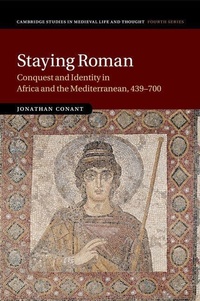
Staying Roman
Conquest and Identity in Africa and the Mediterranean, 439-700
Published on 1. October 2015
Book
Paperback/Softback
458 pages
978-1-107-53072-0 (ISBN)
Description
What did it mean to be Roman once the Roman Empire had collapsed in the West? Staying Roman examines Roman identities in the region of modern Tunisia and Algeria between the fifth-century Vandal conquest and the seventh-century Islamic invasions. Using historical, archaeological and epigraphic evidence, this study argues that the fracturing of the empire's political unity also led to a fracturing of Roman identity along political, cultural and religious lines, as individuals who continued to feel 'Roman' but who were no longer living under imperial rule sought to redefine what it was that connected them to their fellow Romans elsewhere. The resulting definitions of Romanness could overlap, but were not always mutually reinforcing. Significantly, in late antiquity Romanness had a practical value, and could be used in remarkably flexible ways to foster a sense of similarity or difference over space, time and ethnicity, in a wide variety of circumstances.
Reviews / Votes
'Staying Roman is not only intellectually stimulating and an important contribution to the field of study of late antique North Africa, it is noticeably well founded and at the same time a pleasure to read.' Ralf Bockmann, The Medieval Review 'This is a sophisticated volume ... excellent and subtle ...' Guy Halsall, Early Medieval Europe 'As a starting point for Vandal and Moorish history in this period - still better as a thorough overview of the status quaestionis on the murky world of Byzantine Africa - Conant's book is to be warmly recommended.' A. H. Merrills, The Journal of Roman Studies 'It is impossible to do justice to this finely argued and richly evidenced book in ... a short review. Although the book's specific arguments will no doubt provoke continued debate and further research, its overall thesis that Roman cultural identity was paradigmatic throughout the period is highly convincing and will hopefully inform studies of 'long' late antiquity elsewhere in the post-Roman West.' Jamie Wood, Al-Masaq: Journal of the Medieval MediterraneanMore details
Series
Language
English
Place of publication
Cambridge
United Kingdom
Target group
Professional and scholarly
Product notice
Paperback (trade)
Illustrations
29 Tables, black and white; 5 Maps; 5 Line drawings, unspecified
Dimensions
Height: 229 mm
Width: 152 mm
Thickness: 25 mm
Weight
658 gr
ISBN-13
978-1-107-53072-0 (9781107530720)
Copyright in bibliographic data and cover images is held by Nielsen Book Services Limited or by the publishers or by their respective licensors: all rights reserved.
Schweitzer Classification
Other editions
Additional editions
Book
04/2012
Cambridge University Press
€126.90
Shipment within 15-20 days
Person
Jonathan Conant is Assistant Professor of History at the University of San Diego, where his teaching and research focus is on the ancient and medieval Mediterranean.
Content
Introduction; 1. The legitimation of Vandal power; 2. Flight and communications; 3. The old ruling class under the Vandals; 4. New Rome, new Romans; 5. The Moorish alternative; 6. The dilemma of dissent; Aftermath; Conclusions.